

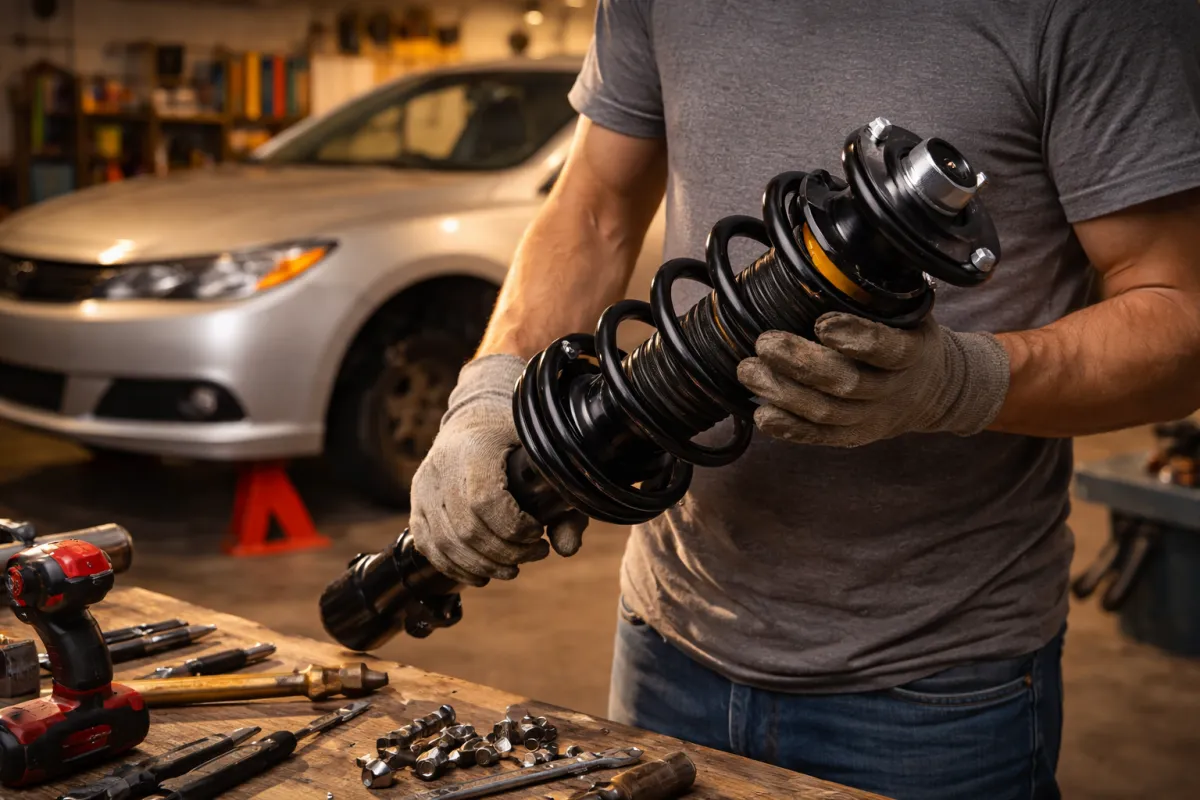
How to Replace Front Struts: Complete 2026 DIY Guide
Save $400+ in labor by replacing struts yourself. Step-by-step instructions, required tools, torque specs, and critical safety tips.
How to Replace Front Struts: The Complete Guide
Front struts are one of the best jobs to cut your teeth on. Pay a shop and you're looking at $400-800 in labor alone. Do it in your own driveway with the right tools and this guide, and figure 2-3 hours per side your first time. It gets faster.
Here's the whole job: when to replace, the tools, the steps in order, and the safety stuff you can't skip.
When Do Struts Need Replacing?
Most struts go 50,000-100,000 miles before they're cooked, though potholes and rough roads pull that number down. Signs yours are done:
Clear Signs You Need New Struts:
- Bouncy or "floaty" ride over bumps
- Excessive nose-dive when braking
- Vehicle leans or sways in corners
- Uneven tire wear (cupping pattern)
- Clunking noise over bumps
- Visible oil leak on strut body
Quick Test: Push down hard on each corner of the car and let go. A good strut lets it bounce once and settle. If it keeps bobbing two or three times, that strut's worn out.
Shop Strut Assemblies at AutoBuffy
Complete Struts vs. Bare Struts: What's the Difference?
Before you buy anything, pick your lane. You're choosing between complete strut assemblies and bare struts.
Complete Strut Assembly (Quick-Strut)
Includes the strut, spring, strut mount, and bearing, all pre-assembled and ready to install. This is what we recommend for DIYers.
Advantages:
- No dangerous spring compressor needed
- Faster installation (30-45 min per side vs. 60-90 min)
- New springs and mounts included (often worn too)
- Less chance of installation error
Disadvantages:
- Higher upfront cost ($150-400 per side)
- Heavier to handle
Shop Complete Strut Assemblies
Bare Struts (Strut Cartridge Only)
Just the strut. You reuse your existing spring, mount, and hardware. Only recommended if you have professional spring compressor experience.
Advantages:
- Lower cost ($80-200 per side)
- Lighter to handle
Disadvantages:
- REQUIRES SPRING COMPRESSOR (dangerous if misused)
- Existing spring/mount may be worn
- Much longer installation time
- Higher risk of injury or error
Our recommendation: Unless you're an experienced mechanic with proper spring compressors, spend the extra money on complete assemblies. A coil spring that slips out of a compressor can land you in the ER. The convenience buys you safety, and that's cheap at this price.
Tools Required
Essential Tools
- Floor jack - 3-ton minimum for safety margin
- Jack stands (2) - Never work under a car on just a jack
- Socket set - Both metric and SAE, 1/2" and 3/8" drive
- Combination wrenches - To hold bolts while turning nuts
- Torque wrench - Critical for proper tightening
- Breaker bar - For stubborn bolts
- Penetrating oil (PB Blaster) - Start soaking bolts day before
- Wire brush - Clean threads before reassembly
- Safety glasses - Absolutely required
Helpful But Optional
- Impact wrench (saves significant time)
- Strut spreader tool (makes knuckle removal easier)
- Pry bar
- Dead blow hammer
- Anti-seize compound
- Blue threadlocker
If Using Bare Struts (NOT Recommended for DIY)
- Professional spring compressor set
- Spring compressor safety cage
- Experience using spring compressors safely
Step-by-Step Instructions
Before You Start
- Apply penetrating oil to all strut bolts 24 hours in advance
- Order struts in pairs - always replace both fronts together
- Have torque specs ready - look up your specific vehicle
- Clear a flat workspace - avoid inclines
Shop Your Strut Assembly By Vehicle
Step 1: Prepare the Vehicle (15 minutes)
- Park on flat, level ground
- Engage parking brake
- Place wheel chocks behind rear tires
- While on the ground, loosen front lug nuts 1/2 turn (don't remove)
- Locate and loosen upper strut mount bolts in engine bay (don't remove yet)
Why loosen while on ground? The car's weight pins everything in place. Try to crack those lug nuts loose once the wheel's spinning in the air and you'll just fight yourself, or worse, wrench something you didn't mean to.
Step 2: Jack Up and Secure Vehicle (10 minutes)
- Position floor jack under approved lift point
- Lift front of vehicle
- Place jack stands under frame rails or subframe
- Lower car onto jack stands
- Shake the car to confirm it's stable
- Remove front wheels
SAFETY WARNING: Never work under a vehicle supported only by a jack. Jack stands are required. People have died from cars falling off jacks.
Step 3: Remove the Old Strut (30-45 minutes per side)
The exact procedure varies by vehicle, but the general process is:
Step 3a: Disconnect Components from Strut
- Disconnect ABS sensor wire (if attached to strut)
- Remove brake line bracket from strut
- Remove sway bar end link if connected to strut
- Remove any other brackets or wiring attached
Step 3b: Support the Knuckle
- Place a jack under the lower control arm
- Slightly compress the suspension to take pressure off bolts
- This prevents the knuckle from dropping when disconnected
Step 3c: Remove Strut-to-Knuckle Bolts
- Remove the lower strut-to-knuckle bolts (usually 2-3 large bolts)
- Use breaker bar if needed - these are torqued tight
- You may need to spread the knuckle slightly with a pry bar
- Lower the knuckle carefully as strut releases
Step 3d: Remove Upper Strut Mount Bolts
- Go to engine bay
- Remove the 2-3 nuts holding strut mount to body
- Support strut from below as you remove final nut
- Lower strut out through wheel well
Note: A complete assembly is heavy, 20-40 lbs depending on the car. Get a helper or be ready to catch the weight yourself as that last nut comes off.
Step 4: Install New Strut Assembly (30-45 minutes per side)
- Compare old and new struts - confirm length and mounting points match
- Position new strut assembly in wheel well
- Guide upper mount studs through holes in strut tower
- Hand-thread upper mount nuts (don't tighten yet)
- Raise knuckle with jack to meet strut
- Align and install strut-to-knuckle bolts
- Hand-thread all fasteners before tightening any
Step 5: Torque to Specification
Don't skip this. Under-torqued bolts back out on you. Over-torqued ones strip or snap. Both ruin your day.
Common Torque Values (VERIFY FOR YOUR VEHICLE):
- Upper strut mount nuts: 25-35 ft-lbs
- Strut-to-knuckle bolts: 75-100 ft-lbs
- Lug nuts: 80-100 ft-lbs
Always look up exact specs for your vehicle. These values are general guidelines only.
- Torque upper mount nuts first
- Torque strut-to-knuckle bolts
- Reconnect all disconnected components (ABS, brake line, sway bar)
- Install wheel and hand-tighten lug nuts
- Lower vehicle to ground
- Torque lug nuts in star pattern
Step 6: Final Steps
- Bounce each corner of car to settle suspension
- Check that nothing is binding or rubbing
- Test drive slowly in parking lot first
- Listen for any clunks or abnormal sounds
- Get an alignment within 1 week - this is critical
Critical Safety Warnings
Spring Compressor Danger
If you're running bare struts and have to move the spring over:
SPRING COMPRESSORS CAN KILL YOU. A coil spring holds a frightening amount of stored energy. Let one slip while it's compressed and it'll fire metal parts across the garage hard enough to kill.
Safety requirements:
- Use professional-grade compressors only (not the cheap wall-mount type)
- Compress spring in a safety cage when possible
- Wear full face shield, not just safety glasses
- Never put your face over a compressed spring
- Have someone nearby in case of emergency
Our strong recommendation: Spend the extra $100-200 on complete strut assemblies. No home job is worth an eye or worse.
Jack Safety
- Never work under a vehicle supported only by a jack
- Use quality jack stands rated for your vehicle's weight
- Place stands on solid frame points, not sheet metal
- Always test stability before going under vehicle
Do I Need an Alignment?
Yes. Always. Pulling the struts moves your suspension geometry around. Skip the alignment and here's what you're buying:
- Tires will wear unevenly
- Car may pull to one side
- Handling will be unpredictable
Budget $80-120 for a four-wheel alignment. Some tire shops throw one in free when you buy tires, so it's worth asking.
Recommended Strut Brands
We stock several good strut brands. What we'd point you toward:
For Comfort:
Monroe Quick-Struts - American brand known for smooth, comfortable ride quality. Great for daily drivers.
For Handling:
KYB Strut-Plus - Japanese brand with firmer valving for better body control. Great for spirited drivers.
For Trucks/SUVs:
FCS Strut Assemblies - Heavy-duty options for trucks and SUVs that carry loads.
Frequently Asked Questions
How long does strut replacement take?
2-3 hours per side for DIY. Professional shops do it in 1-1.5 hours per side.
Can I replace just one strut?
No. Always replace in pairs (both fronts or both rears). Mismatched struts cause handling problems.
Do struts affect alignment?
Yes. Always get an alignment after strut replacement.
How do I know if my springs are bad too?
Measure ride height (ground to fender). Compare left vs right and to factory specs. If sagging or uneven, springs are worn.
Should I replace struts and shocks together?
If both are worn, yes. But they wear independently, so replace what actually needs it.
Shop Struts at AutoBuffy
Ready to replace your worn struts? AutoBuffy carries complete strut assemblies from all major brands with guaranteed fitment for your vehicle.
Every part comes with our fitment guarantee. If it doesn't fit your vehicle, we make it right.
Keep Reading

Silverado / Sierra 2500HD (2001-2010) Front-End Rebuild: The Parts List a Shop Actually Needs
7
GM 1500 Lower Ball Joint (2007-2014 Silverado, Sierra, Tahoe, Suburban): Press-In or Whole Arm?
7
Comments
Loading comments...
Comments are moderated by the AutoBuffy team.