P0420 Code: Meaning, Causes, and Real Repair Costs
P0420 means your catalytic converter is underperforming — but it's not always the cat. The 8 real causes ranked by likelihood, how to diagnose it yourself in an afternoon, and honest repair costs by cause.
P0420 in Plain English: Your Catalytic Converter Isn't Doing Its Job
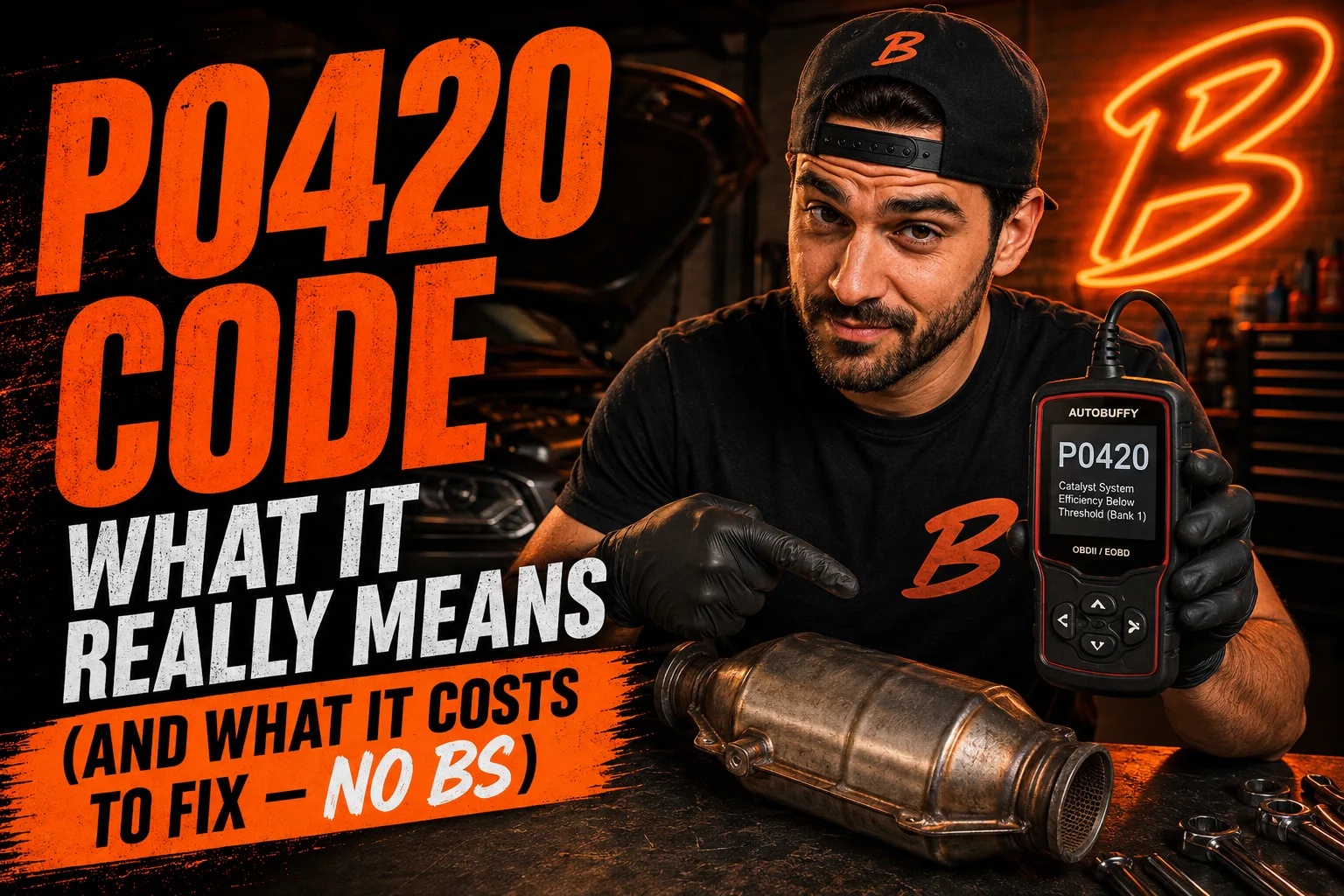
P0420 — "Catalyst System Efficiency Below Threshold (Bank 1)" — means your car's computer has decided the catalytic converter is no longer cleaning exhaust the way it should. It is not an emergency, your engine is not about to fail, and — this is the part most people get wrong — it does not automatically mean you need a new catalytic converter.
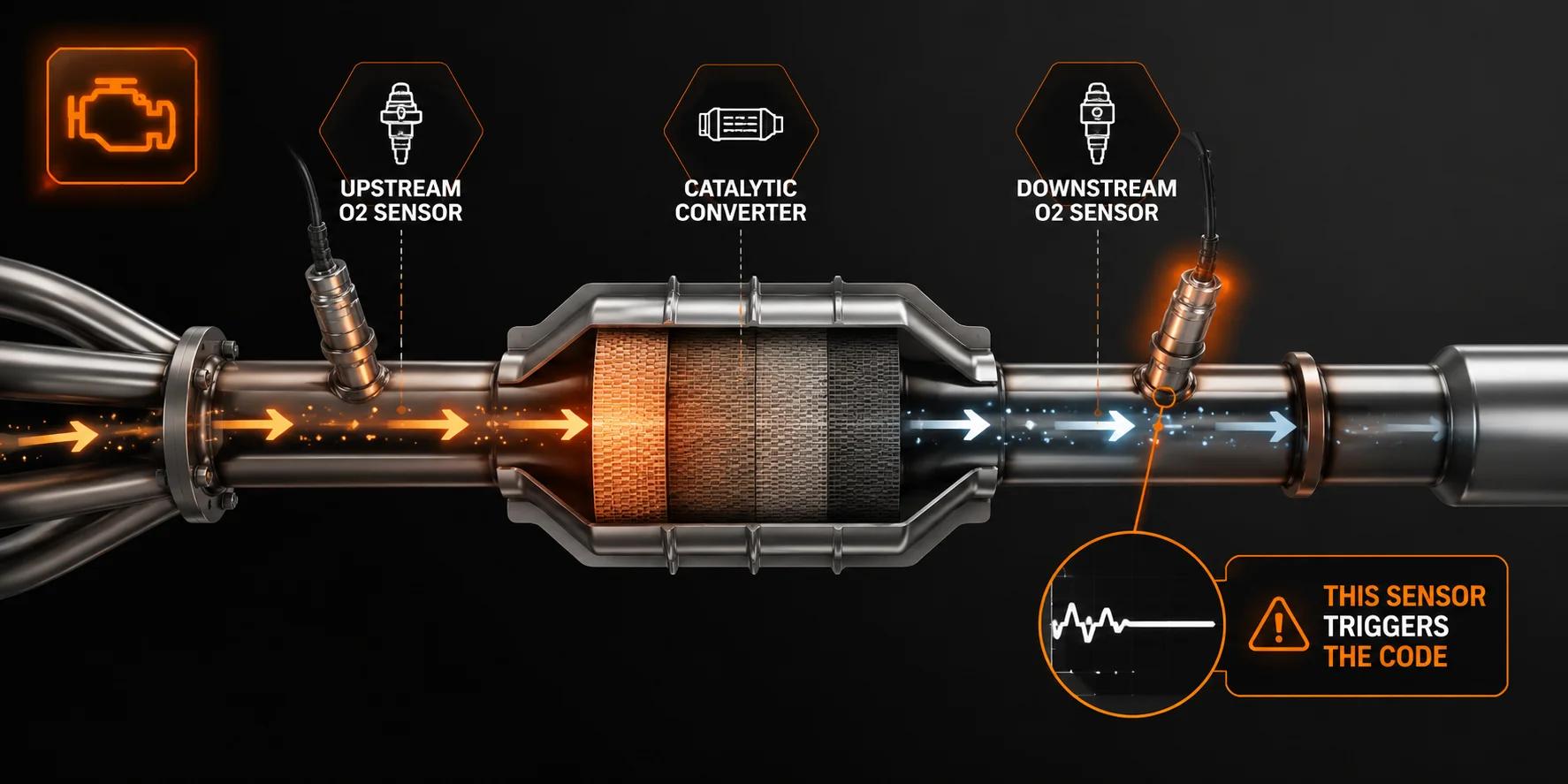
Here's what's actually happening. Your exhaust has two oxygen sensors: one before the catalytic converter (upstream) and one after it (downstream). The upstream sensor watches raw exhaust, so its signal swings constantly as the computer adjusts the fuel mixture. If the converter is working — storing and releasing oxygen as it burns off pollutants — the downstream signal comes out smooth and steady.
When the computer sees the downstream sensor swinging almost as much as the upstream one, it concludes the converter isn't storing oxygen anymore. That's the "efficiency below threshold" trigger — P0420 is really a comparison test between two sensors, not a direct measurement of the converter itself.
That distinction matters, because anything that fools the comparison — a lazy sensor, an air leak, a mixture problem — can throw P0420 with a perfectly good converter still bolted under the car. (On V6/V8 engines, the same code for the other cylinder bank is P0430.)
Is P0420 Serious? Can You Keep Driving?
Short-term: yes, you can drive. P0420 doesn't put the engine at risk by itself — many people drive with this code for months without noticing a difference. If the check engine light is solid (not flashing) and the car isn't misfiring, you don't need a tow truck.
But there are three real consequences of ignoring it:
- You will fail emissions testing. An active P0420 is an automatic fail anywhere with inspections — and clearing the code right before the test doesn't work, because the reset readiness monitors give it away.
- If a failing cat is the cause, it can get worse. A converter breaking apart internally can eventually clog, costing you power and fuel economy — and loose ceramic substrate can restrict flow enough to make the car feel like it's dragging an anchor.
- The light masks new problems. With the check engine light already on, you won't notice when a second, more urgent code appears.
One hard exception: if the check engine light is flashing, stop driving. A flashing light means active misfires dumping raw fuel into a hot cat, which can melt the substrate in minutes — turning a possible $150 fix into a definite $1,500 one.
The 8 Causes of P0420, Ranked by Likelihood
P0420 has a reputation as a "cat code," and the converter is indeed the most common single cause — but it's nowhere near the only one. Here's the honest ranking.
1. A Genuinely Worn-Out Catalytic Converter
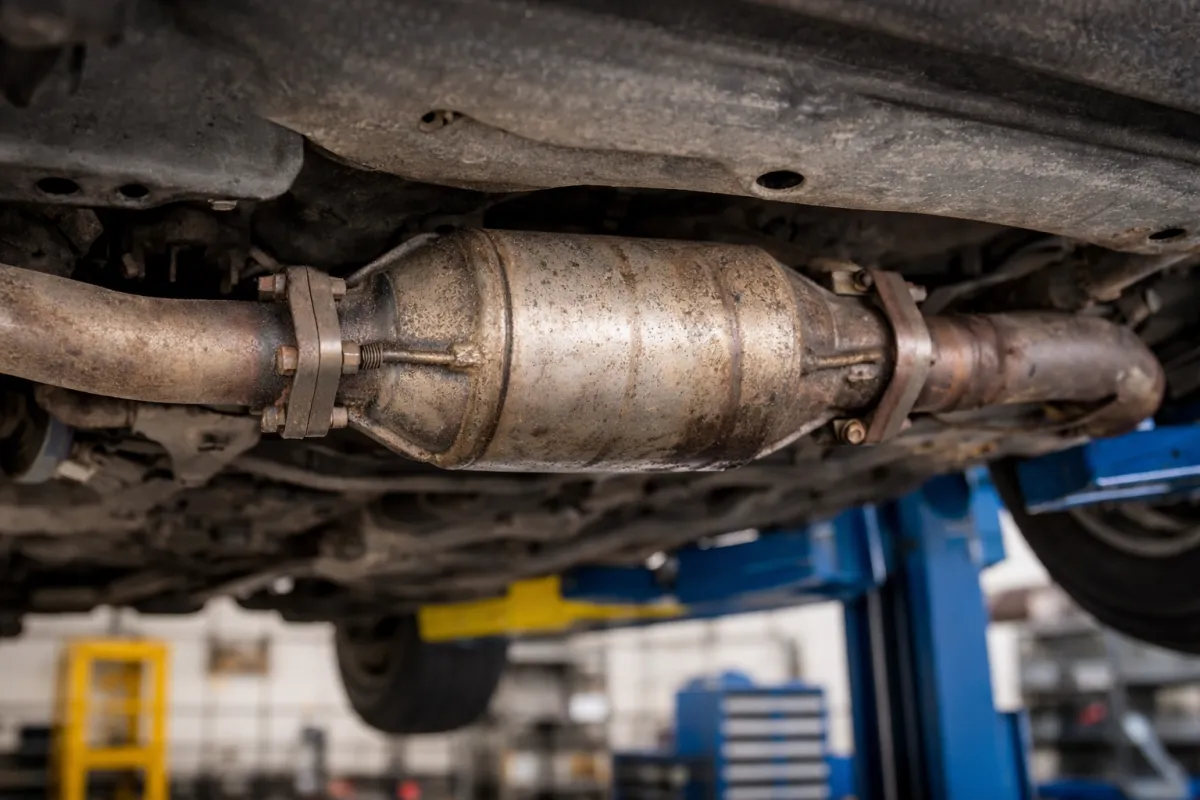
The most common cause, particularly past 120,000 miles. The catalyst — a honeycomb coated with platinum, palladium, and rhodium — degrades with age and heat cycles until its oxygen-storage capacity fades and the code sets. A converter that dies of old age at 150,000+ miles is normal wear. A converter that dies at 60,000 was almost always killed by something else — which is why causes 4 and 5 below matter so much.
2. A Failing Downstream Oxygen Sensor
The second most common cause, and the cheapest on the list. An aging downstream sensor gets slow and "lazy" — its voltage starts wandering even though the exhaust behind the cat is clean. The computer can't tell a lazy sensor from a dead converter, so it blames the converter. Sensors are wear items; 80,000–100,000 miles is a normal service life.
3. An Exhaust Leak Ahead of or Around the Converter
A cracked manifold, blown flange gasket, rusted flex pipe, or leaking sensor bung lets outside air get pulled into the exhaust stream between pulses. That extra oxygen skews the sensor readings and can flip the efficiency calculation into failing territory. Common in rust-belt states, and one of the most satisfying P0420 fixes — a $30 gasket can make the code disappear.
4. Engine Misfires Slowly Cooking the Cat
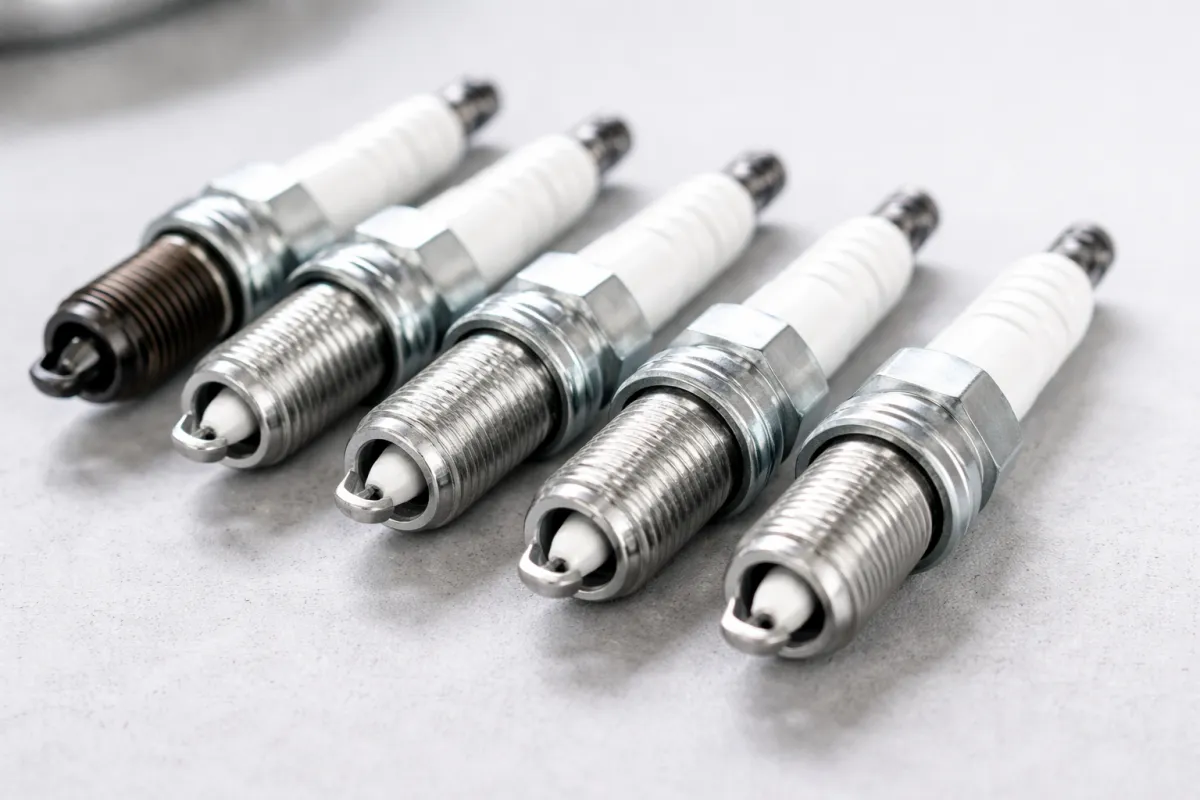
A misfiring cylinder sends unburned fuel down the exhaust, where it ignites inside the converter, overheating the substrate a little more with every event. If you have (or recently had) P0300-series codes alongside P0420, treat the misfire as the root cause — fix the plugs, coils, or injectors first, or the replacement converter will die the same death.
5. Oil or Coolant Contamination
An engine burning oil (worn valve seals, rings, bad PCV) or leaking coolant into the cylinders (head gasket) coats the catalyst with compounds that permanently poison it. Blue-gray smoke, disappearing coolant with no visible leak, or oil consumption over a quart per 1,000 miles are the tells. Like misfires, this is a root cause — a new cat behind a contaminating engine is a countdown timer.
6. ECU Calibration — the Threshold Itself
Less common, but real: automakers occasionally set the catalyst monitor's threshold too aggressively and later issue a software update (TSB) to fix it. Before condemning parts on a vehicle known for chronic P0420 complaints, have a dealer or well-equipped shop check for an ECU calibration update for your exact VIN.
7. A Cheap Aftermarket Converter Already on the Car
If your car already had its converter replaced — especially with a bargain universal unit — the "new" cat may not have enough precious-metal loading to keep the monitor happy. Many budget converters barely clear the threshold on day one and drop below it within months. If P0420 came back within a year of a cheap cat install, the cat itself is the prime suspect. More in the buying guide below.
8. Fuel Quality and Additives
The rarest cause on the list, but documented: contaminated fuel or heavy use of certain off-brand additives can temporarily or permanently degrade catalyst efficiency. If the code appeared right after a fill-up at an unfamiliar station, run the tank down, refill with quality fuel, clear the code, and see if it returns before spending anything.
How to Diagnose P0420 Without Throwing Parts at It
The worst way to handle P0420 is to buy a converter because a parts-counter code reader said "catalyst efficiency." The best way costs almost nothing and takes an afternoon.
Step 1 — Pull ALL the codes, not just P0420. Misfire codes (P0300–P0308), lean/rich codes (P0171, P0172), or upstream sensor codes change the whole diagnosis — P0420 accompanied by other codes is almost never a converter problem first. Fix everything else, clear, re-evaluate.
Step 2 — Watch the O2 sensor voltages live. Any $25 Bluetooth OBD2 dongle and a free app can graph both sensors. What you're looking for:
- Upstream sensor: should oscillate rapidly, roughly 0.1–0.9 volts, several times per second at cruise. That's normal closed-loop operation.
- Downstream sensor (healthy cat): should be comparatively flat and steady, typically hovering around 0.5–0.7 volts with only slow drift.
- Downstream sensor (dead cat): mirrors the upstream sensor — swinging up and down in near-lockstep with it.
If the downstream trace is flat, the converter is doing its job and P0420 is being caused by something else — start hunting sensors and leaks. If the downstream trace mirrors upstream, the converter genuinely isn't storing oxygen.
Step 3 — The temperature test. With the exhaust fully warmed up (a 15-minute drive, not idling), point an infrared thermometer at the converter inlet and outlet pipes. A working converter is doing chemistry inside, so the outlet should read noticeably hotter than the inlet — often 50–100°F or more. Outlet the same or cooler suggests an inactive catalyst. A supporting clue rather than a verdict, but combined with mirrored O2 traces it's fairly damning.
Step 4 — Smoke-test for exhaust leaks. A shop smoke machine (or a careful soapy-water spray on joints with the engine running) will reveal leaks at the manifold, flex pipe, and flange gaskets. Also wiggle the downstream sensor's wiring — chafed or heat-damaged harnesses cause more "converter failures" than anyone admits.
Step 5 — Rubber-mallet check. With the exhaust cool, a firm tap on the converter shell should produce a dull thud. A rattle means the substrate has broken apart internally — that converter is done, no further diagnosis needed.
If the evidence points at a sensor or a leak, you've just saved yourself four figures. If it points at the cat, you can buy the replacement with confidence instead of hope.
Start With the O2 Sensor?
Find Yours
The "Just Replace the O2 Sensor First" Myth — Handled Honestly
Every forum thread about P0420 contains the same advice: "Replace the downstream O2 sensor first, it's cheaper." Half of that advice is good.
Here's the honest version. If your downstream sensor is original with 100,000+ miles on it, replacing it is a reasonable, low-cost first move — you're replacing a wear item near the end of its life anyway, and lazy downstream sensors genuinely cause a meaningful share of P0420 codes. On an older car, that's not parts-swapping, that's maintenance.
But it becomes parts-swapping when you skip the ten minutes of live-data testing that would have told you the answer for free. If the downstream trace is clearly mirroring the upstream sensor with a responsive, healthy-looking waveform, the sensor is faithfully reporting a dead cat — and a new sensor will report exactly the same thing.
The rule: test first, then replace the sensor if the data is ambiguous or the sensor is old. And if you do replace one, use a quality unit — Denso, NGK/NTK, and Bosch all make original-equipment-grade sensors, while a no-name sensor can introduce the very signal problems you're trying to eliminate.
When It Really Is the Cat
Sometimes every arrow points the same way. That looks like:
- P0420 is the only code, and it returns within a few drive cycles every time it's cleared
- Downstream O2 voltage mirrors upstream on live data
- The converter outlet is not hotter than the inlet at full operating temperature
- The vehicle has 120,000+ miles on the original converter, or a budget aftermarket cat installed within the last couple of years
- Bonus confirmations: rattle on the mallet test, rotten-egg (sulfur) smell, sluggish acceleration, or a drop in fuel economy
When that's the picture, replace the converter — but first ask: why did it die? If the answer is "150,000 miles of honest service," bolt in a quality replacement and move on. If the car is burning oil, losing coolant, or misfiring, fix that first or budget for a second converter.
What P0420 Repairs Actually Cost, by Cause
Honest numbers, because this is where P0420 anxiety comes from. The spread between the cheapest and most expensive fix is enormous — which is exactly why the diagnosis steps above are worth your afternoon.
- Exhaust flange gasket / small leak: $15–$50 in parts, typically $100–$250 with labor
- Downstream O2 sensor: $50–$150 in parts, typically $150–$300 installed
- ECU reflash / TSB update: typically $100–$200 at a dealer or well-equipped shop
- Spark plugs + coil (misfire fix): $60–$250 in parts, typically $150–$500 with labor
- Aftermarket direct-fit catalytic converter: $200–$700 in parts, typically $400–$1,100 installed
- CARB-compliant converter (California): $400–$1,200 in parts, typically $700–$1,800 installed
- OEM catalytic converter: $700–$2,000+ in parts, typically $1,000–$2,500+ installed
- Oil/coolant contamination (root cause): varies widely — often $500–$3,000+ before the cat itself
Two notes. Converter pricing swings hard by vehicle: a common Civic or Camry direct-fit cat sits at the low end, while trucks, V6/V8s with multiple converters, and California-emissions vehicles cost substantially more. And labor on a bolt-in converter is modest (1–2 hours), but rusted hardware, welded-in converters, or manifold-integrated cats can double it.
If a shop quotes you a converter without showing you live O2 sensor data, ask for the data. A good shop will have it; a parts-swapper won't.
Need a Catalytic Converter?
Check What Fits Your Vehicle
Buying Guide: How to Replace a Cat Without Seeing P0420 Again
If the diagnosis landed on the converter, the buying decision determines whether you fix this once or twice.
Direct-Fit vs. Universal
A direct-fit converter is built for your exact year, make, model, and engine — flanges, hangers, and sensor bungs in the factory locations. It bolts in, seals properly, and puts the downstream sensor exactly where the monitor expects it. A universal converter is a bare catalyst body that must be cut and welded into your existing pipe. Universals are cheaper on the sticker, but once you pay for fabrication the savings usually vanish — and a misplaced sensor bung or imperfect weld can bring P0420 right back. Unless you're a competent welder, direct-fit is the sane default.
Federal (EPA) vs. CARB Compliance
This one is legal, not optional. If your vehicle is registered in California, the replacement converter must carry a CARB EO number approving it for your specific vehicle — a federal/EPA converter is illegal to install there, and a smog station will fail the visual inspection even with the light off. New York, Colorado, and Maine have adopted CARB rules for many model years too; check your state before ordering. CARB converters cost more because they carry heavier precious-metal loading — which also makes them better at keeping the monitor satisfied. Everywhere else, a 49-state EPA-compliant converter is fine.
Why the $90 eBay Cat Fails P0420 Again in 6 Months
A catalyst's cleaning ability comes from its precious-metal washcoat, and precious metals are exactly where bargain converters cut cost. A bottom-tier cat may carry a fraction of the platinum-group loading of an OE unit — enough to pass out of the box, but with so little margin that normal aging pushes it below the threshold within months. The pattern is depressingly consistent: cheap cat installed, light off for a season, P0420 back by winter, parts and labor paid twice. Established aftermarket names — Walker, Eastern Catalytic, and Davico among them — publish EPA/CARB compliance, load their converters to hold the monitor long-term, and back them with real warranties. On a repair with $150–$400 of labor attached, the converter is the wrong place to save $100.
One Last Check Before You Order
Confirm your converter configuration before buying: many vehicles have two or more converters, and P0420 points specifically to Bank 1 — the bank containing cylinder #1. Buying "a cat for a 2012 Explorer" without knowing which bank, or whether your model has front and rear cats per bank, is how the wrong part ends up in your garage.
FAQ / People Also Ask
Yes, in most cases. P0420 alone doesn't harm the engine or make the car unsafe, and many people drive with it for months. You will fail emissions testing while it's active, and if a clogging converter is the cause it can gradually sap power. If the light is flashing, stop driving — that's active misfire damage.