

AC Condenser Replacement Cost: Signs It's Failing & What You'll Pay
AC condenser replacement runs $1,300–$6,100 for most homeowners. Learn the warning signs, what drives cost, and how to save.
The Short Answer
Replacing an AC condenser costs $1,300–$6,100 for most homeowners, with the national average sitting around $2,900 including parts and labor — but refrigerant type, unit size, and whether you need permits can all push that number higher.
| Cost Factor | Typical Range |
|---|---|
| Full condenser replacement (parts + labor) | $1,300 – $6,100 |
| National average total cost | ~$2,900 |
| Labor only | $300 – $1,500 |
| HVAC permit | $250 – $400 |
| Condenser coil cleaning (repair alternative) | $75 – $200 |
| Refrigerant recharge (add-on) | $100 – $400 |
If your AC is blowing warm air and the outdoor unit sounds like it's auditioning for a percussion band, you're probably already searching this topic at 11pm in July. Fair enough. Let's get into it.
What Does an AC Condenser Actually Do?
The condenser is the outdoor unit of your split AC system — that big metal box humming in your backyard or on a concrete pad beside the house. It's where refrigerant releases the heat it pulled from inside your home, turning from a hot gas back into a liquid so the cycle can start again.
Inside it, you've got:
- Condenser coils — where heat dissipates to the outside air
- A compressor — the heart of the refrigerant circuit
- A condenser fan motor — pulls air across the coils
- Electrical components — capacitors, contactors, disconnect boxes
When people say "replace the AC condenser," they sometimes mean just the coil assembly, sometimes the entire outdoor unit. That distinction matters a lot for price, so clarify with your contractor upfront.
Signs Your AC Condenser Is Failing
Condensers don't usually quit without warning. Here's what to watch for:
Warm Air Despite a Running System
If the indoor unit is blowing but the air isn't cold, the condenser may not be rejecting heat properly. Could be a refrigerant leak, a failed compressor, or blocked coils.
The Outdoor Unit Is Making Unusual Noises
A healthy condenser hums. Rattling usually means debris inside the unit or a loose fan blade. Grinding or screeching often points to a failing fan motor or compressor bearings. Bubbling or hissing is classic refrigerant leak territory.
Oily Residue Around the Unit
Refrigerant travels with compressor oil. If you see oily staining on the coil fins or around refrigerant line connections, assume a leak until proven otherwise.
Short Cycling
The system starts, runs for two or three minutes, then shuts off — over and over. This often means the compressor is overheating, which can be caused by dirty coils, low refrigerant, or a failing capacitor.
Ice Formation on the Unit
Counter-intuitive, but ice on the outdoor unit usually means restricted airflow or low refrigerant pressure — not that it's "too cold."
Quick check before you call anyone: Turn the system off for 30 minutes, then inspect the outdoor unit. Clear any grass clippings, leaves, or debris from the fins. Restart and see if performance improves. I've seen "failing" condensers come back to life with a garden hose rinse and five minutes of fin-straightening. It's not a guarantee, but it saves the diagnostic fee sometimes.
What Drives AC Condenser Replacement Cost?
Unit Size and Tonnage
Residential condensers are rated in tons of cooling capacity — typically 1.5 to 5 tons for a home. A 1.5-ton unit costs significantly less than a 4-ton unit, both in equipment price and refrigerant volume.
Refrigerant Type (This Is Changing Fast)
This is the biggest cost variable right now, and it's something most homeowners aren't aware of.
As of January 1, 2025, R-410A — the refrigerant that's powered most residential AC systems for the past two decades — can no longer be manufactured or imported for new equipment under the EPA's AIM Act. Its global warming potential of 2,088 far exceeds the new 700-GWP limit.
New replacement condensers now use R-454B (GWP 466) or R-32 (GWP 675). Both are classified as A2L refrigerants — slightly flammable, which requires updated installation practices and compatible equipment throughout the system.
What this means for your wallet: If you have an existing R-410A system and replace only the condenser, you need a condenser that's compatible with R-410A (still available from existing inventory for now, per the EPA's amended rule effective July 2026). But if you're going full system replacement, you're likely moving to A2L equipment, which can carry a modest cost premium. That gap is narrowing as manufacturers scale up production.
Matched vs. Mismatched Systems
HVAC manufacturers strongly prefer you replace the condenser and air handler as a matched system. Mixing an old R-410A air handler with a new A2L condenser isn't just inefficient — it can void warranties and create refrigerant compatibility issues. A full matched system replacement costs more upfront but avoids headaches.
Labor and Local Market
Labor varies dramatically by region. An HVAC tech in rural Tennessee charges differently than one in San Francisco. The $300–$1,500 labor range is real — it reflects genuine geographic and complexity variation, not contractor padding.
Permits
Most municipalities require an HVAC permit for condenser replacement. Budget $250–$400 for this. Some contractors include it in their quote; others charge it as a line item. Always ask.
Repair vs. Replace: How to Decide
Not every condenser problem requires full replacement. Here's a reasonable framework:
- Unit is under 8 years old and a single component failed (capacitor, contactor, fan motor) → Repair. These parts run $50–$400 installed and can add years of life.
- Coil is leaking but the compressor tests good → Coil replacement or repair might make sense if the unit is under 10 years old.
- Compressor has failed → At this point, replacement of the full outdoor unit usually wins economically. A compressor replacement alone can cost $1,200–$2,500 installed, and you're still left with an aging system.
- System is 12+ years old and using R-410A → Replacement is almost always the smarter call financially, especially given refrigerant availability changes.
Personally, I'd put the dividing line at roughly 50% of replacement cost: if repair quotes exceed half of what a new unit would cost, replace it. That's a standard rule of thumb in the HVAC trade and it holds up pretty well.
Major AC Condenser Brands Worth Knowing
The residential HVAC market has consolidated significantly. Daikin is the parent company of both Goodman and Amana, giving them a commanding presence — roughly 40% of the U.S. residential market through their family of brands. Rheem acquired Nortek Global HVAC in October 2024, adding Frigidaire, Broan, and Maytag HVAC to its portfolio. York is now part of the Bosch Home Comfort Group following Bosch's acquisition of the Johnson Controls–Hitachi joint venture in August 2025.
What does this mean practically? Brand lineage matters less than unit tier and installation quality. A mid-tier unit installed correctly by a good tech will outperform a premium unit installed sloppily.
How to Avoid Overpaying
- Get three quotes. Not two — three. The spread is often surprising.
- Ask what refrigerant the new unit uses and whether your existing air handler is compatible.
- Confirm the permit is included or accounted for in the quote.
- Check efficiency ratings (SEER2). Higher SEER2 costs more upfront but reduces monthly energy bills — worth modeling if you're in a hot climate.
- Ask about manufacturer rebates. Several brands offer seasonal rebates on matched system replacements that your contractor can apply at the point of sale.
Automotive AC Condenser: A Different Animal
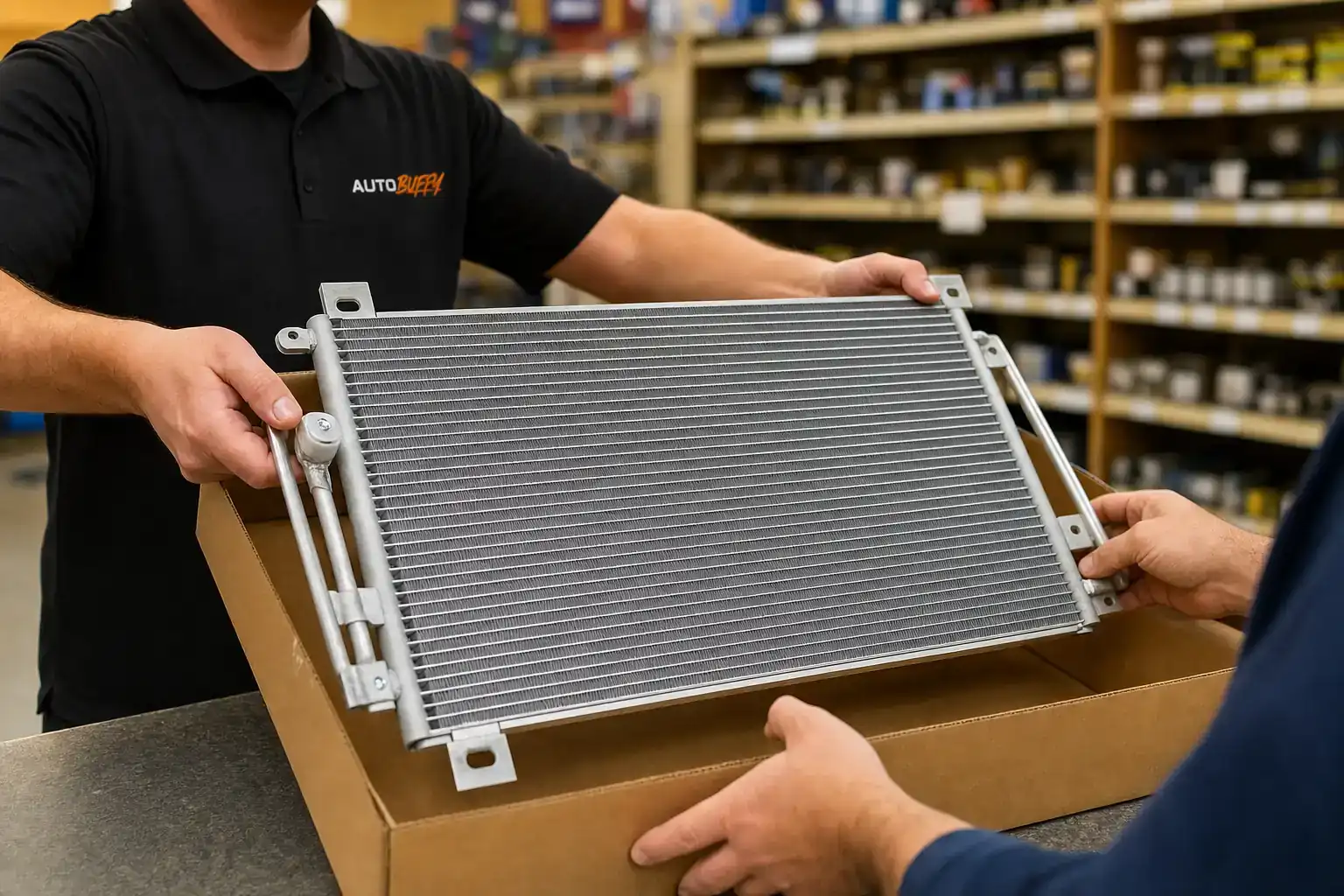
If you landed here researching your car's AC condenser rather than your home system, the basics are similar — the condenser is the front-mounted component that rejects heat from the refrigerant circuit — but the parts, costs, and installation are quite different. Vehicle AC condensers typically run $150–$500 for the part, plus 1–2 hours of labor at shop rates. They're also far more exposed to road debris, which is why they fail more often from physical damage than from wear.
For vehicle AC condenser replacement, use the part finder below to get the right part for your specific year, make, and model.
Find the right part for your vehicle
Guaranteed fit, ships free
FAQ / People Also Ask
The average cost is around $2,900, with most homeowners paying between $1,300 and $6,100 depending on unit size, refrigerant type, and local labor rates.


Comments
Loading comments...
Comments are moderated by the AutoBuffy team.