

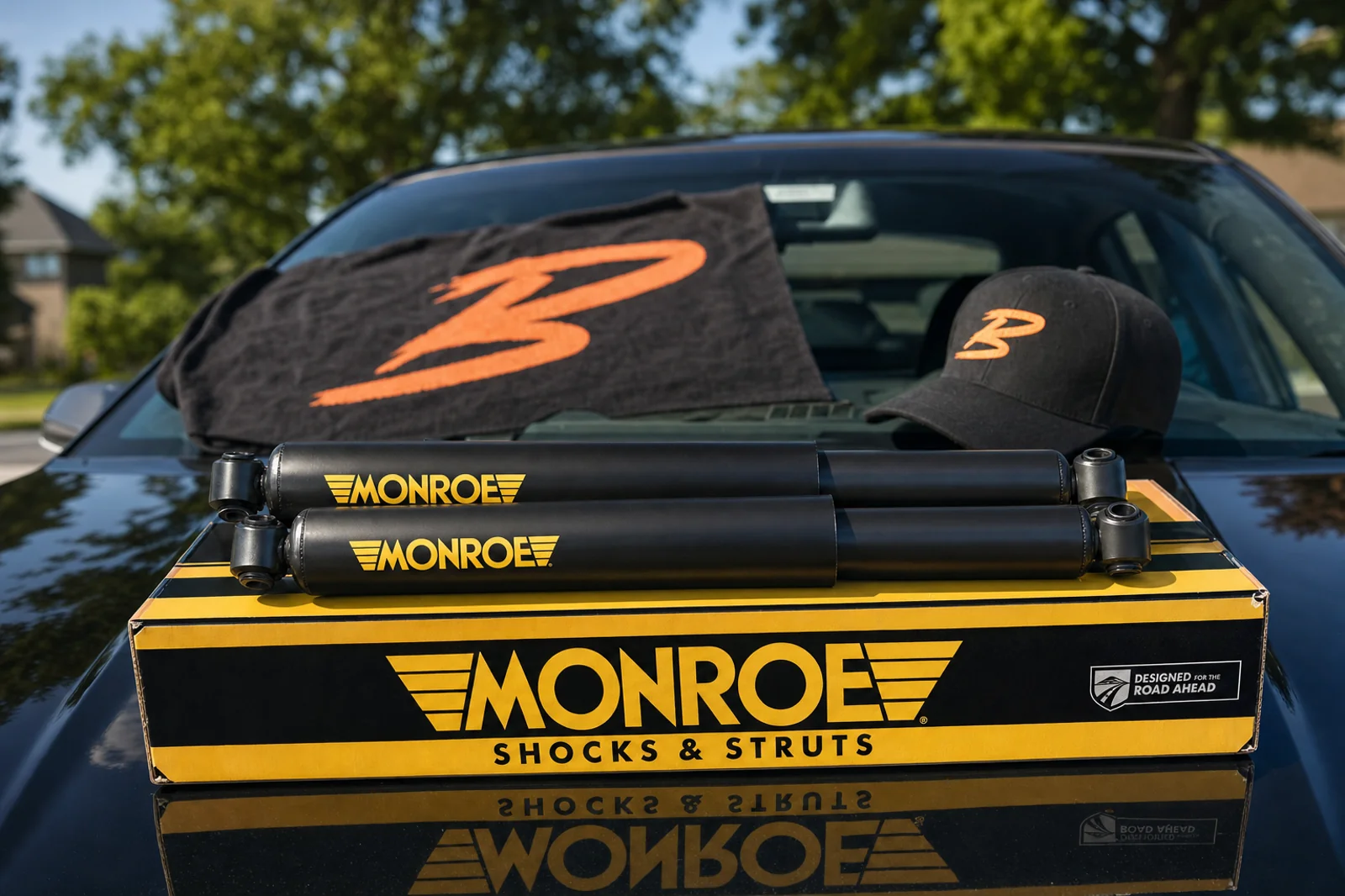
Are Monroe Shocks Good? Monroe Shock Absorber Lineup & Buying Guide (2026)
Monroe makes solid everyday shocks, but are they right for your vehicle? Full lineup breakdown, honest ratings, and smarter alternatives explained.
The Short Answer
Monroe shocks are a reliable, widely-available mid-tier option for everyday passenger cars and light trucks, but they're not the best choice for every vehicle—specialty platforms and heavy-duty applications often need a more purpose-built solution.
| Monroe Line | Best For | Typical Price Per Shock | Warranty |
|---|---|---|---|
| OESpectrum | OEM-style replacement, comfort | $40–$90 | 1 year |
| Reflex | Slightly sportier daily driving | $50–$110 | 1 year |
| Gas-Magnum | Light trucks, mild hauling | $55–$120 | 1 year |
| Adventure | Off-road-capable trucks/SUVs | $90–$160 | 1 year |
| Severe Service | Commercial, fleet, heavy-duty | $100–$200 | 1 year |
Who Actually Makes Monroe Shocks?
Monroe is a DRiV brand — DRiV is the aftermarket and ride-performance division of Tenneco, which is owned by the private-equity firm Apollo Global Management. That puts Monroe inside one of the largest automotive parts groups in the world. That scale has real advantages—Monroe parts are stocked virtually everywhere, pricing is competitive, and the brand has decades of engineering data behind it. The trade-off is that DRiV's portfolio spans dozens of brands and millions of SKUs, so Monroe's catalog prioritizes high-volume fitments. If your vehicle falls outside mainstream North American models, Monroe's coverage gets thin fast.
Breaking Down the Monroe Lineup
OESpectrum: The Everyday Workhorse
OESpectrum is Monroe's core OEM-replacement line. It's designed to restore factory ride quality rather than improve on it—which is exactly what most people want when their original shocks give out. The valving is tuned to match OEM specs, installation is straightforward, and the pricing is approachable. For a family sedan or crossover with 80,000 miles on it, OESpectrum is a sensible answer.
Reflex: A Mild Step Up
Reflex uses Monroe's "Intelligent Suspension" variable-rate valving. In plain terms, the shock stiffens its response as wheel velocity increases—so it's softer over small bumps but firms up when you hit a pothole hard or make a quick lane change. It's not a performance shock, but drivers who find OESpectrum too soft often prefer Reflex. The price difference is modest, maybe $10–$20 per shock.
Gas-Magnum: Light Trucks Done Adequately
The Gas-Magnum is Monroe's answer for pickup trucks and body-on-frame SUVs. It's a gas-charged twin-tube design that handles light towing and occasional bed loads reasonably well. Under sustained heavy hauling though—think 3/4-ton applications or frequent trailer work—it tends to run warm and fade. It's a decent shock for a half-ton commuter that occasionally hauls mulch. For anything more demanding, look elsewhere.
Adventure: Off-Road Without Breaking the Bank
The Adventure line uses a larger piston bore and longer travel than Gas-Magnum, and it's calibrated for trucks that actually see dirt roads. It won't compete with high-end remote-reservoir shocks, but for a lifted Tacoma or Jeep doing weekend trails, it's a legitimate option in its price class.
Severe Service: Fleet and Commercial Applications
This is Monroe's heaviest-duty offering—designed for fleet vehicles, emergency services, and commercial trucks that log hard miles. It's one of the few Monroe lines that gets close to specialty-grade engineering. That said, Monroe's Severe Service coverage for specific commercial platforms (cab shocks on semi-tractors, for example) is still narrower than what dedicated commercial specialists offer.
Where Monroe Falls Short
Honest answer: Monroe works well for the center of the bell curve. High-volume domestic vehicles with standard suspension setups? Great fit. But three categories consistently expose the brand's limits:
- European and luxury platforms — Land Rover air suspension systems, Mercedes-Benz rear shock setups, and similar vehicles need shocks engineered to tight tolerances. Monroe's coverage for these applications is patchy at best.
- Commercial truck cab shocks — Applications like International ProStar cab suspension require purpose-built dampers. Monroe doesn't manufacture for this segment meaningfully.
- Older specialty vehicles — A 1995–1999 Ford Explorer with specific suspension geometry, or a Cadillac with electronic damping, benefits from shocks built to those precise specs rather than generic fitments.
This is where application-specific brands fill the gap.
When a Specialist Brand Makes More Sense
The same logic applies to commercial vehicle operators. A fleet manager replacing cab shocks on an International ProStar needs a part designed for that application's specific load cycles and geometry. Generic shocks mean faster wear and more downtime.
Monroe vs. Specialty Brands: One Honest Verdict
For a 2018 Honda Accord, a 2020 RAM 1500 doing light duty, or a 2015 Toyota Camry? Monroe OESpectrum or Reflex is a perfectly sound choice. The brand earns its market share in that segment.
For a 2005 Range Rover, a commercial truck, a Mercedes-Benz with specific rear geometry, or any platform where Monroe's catalog comes up empty or relies on a loose fitment? A specialist brand with documented application engineering is the better call. I'd rather spend more once than replace shocks twice.
About 70% of shock absorber failures reported in owner forums trace back not to brand quality but to incorrect fitment—wrong mounting hardware, mismatched ride height, or incompatible valving. Getting the right part matters more than brand loyalty.
What to Check Before You Buy Any Shock
- Confirm axle-pair replacement. Don't replace one side and leave the other worn.
- Check for coilover or strut assembly requirements. Some vehicles need the full strut assembly, not just the shock insert.
- Verify ride height modifications. If your vehicle is lifted or lowered, standard-length shocks may not be correct.
- Look up the specific mounting hardware. Upper and lower bushings wear independently of the shock body and should be inspected at the same time.
- Compare warranty terms. A 1-year warranty on a $60 shock and a multi-year warranty on a $200 shock aren't equivalent value propositions.
Find the right part for your vehicle
Guaranteed fit, ships free
FAQ / People Also Ask
Monroe shocks are genuinely good for everyday passenger cars and light trucks. They're a reliable mid-tier brand with wide availability. Where they fall short is on heavy-duty applications—commercial vehicles, air suspension platforms, and performance trucks—where specialist brands tend to out-perform them.


Comments
Loading comments...
Comments are moderated by the AutoBuffy team.