

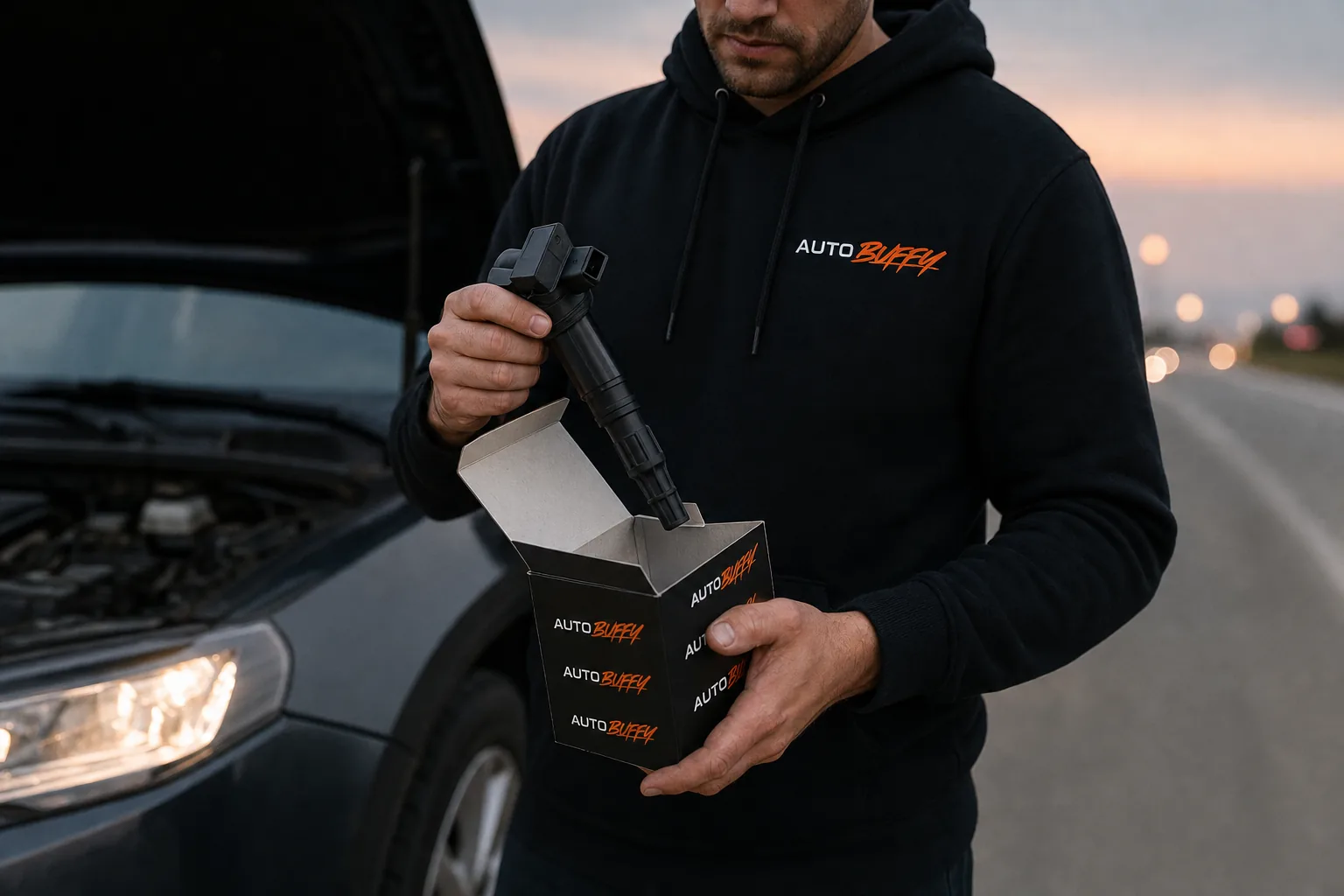
Bad Ignition Coil Symptoms: How to Tell Which Coil Is Dead
Misfires, rough idle, and a flashing check engine light all point to a bad ignition coil. Here's how to diagnose exactly which one died.
The Short Answer
A bad ignition coil most commonly causes a cylinder-specific misfire code (P0301–P0308), a rough or shaky idle, noticeable power loss under acceleration, and a check engine light that may flash if the misfire is severe.
| Symptom | Severity | What It Means |
|---|---|---|
| Rough/shaky idle | Moderate | One cylinder not firing consistently |
| Flashing check engine light | High — act now | Active misfire damaging catalyst |
| Misfire code P030X | Diagnostic | Number after P030 = dead cylinder |
| Hesitation under acceleration | Moderate | Coil breaking down under load |
| Fuel smell from exhaust | High | Raw fuel reaching the exhaust system |
| Hard starting / long cranking | Moderate | Coil weak or dead at cold startup |
| Reduced fuel economy | Low–Moderate | Engine compensating for lost cylinder |
What an Ignition Coil Actually Does
Your engine's ignition coil is a transformer. It takes the 12 volts from your battery and steps it up to somewhere between 20,000 and 40,000 volts — enough to arc across a spark plug gap and ignite the air-fuel mixture in the cylinder. On most cars built in the last 20 years, there's one coil sitting directly on top of each spark plug. That's the coil-on-plug (COP) setup, and it's great for diagnostics because each coil only covers one cylinder.
When a coil weakens or fails, that cylinder misfires. Sometimes it misfires on every stroke. Sometimes it only breaks down under heat or load, which makes it tricky to catch.
The Symptoms Worth Knowing
Rough Idle That Wasn't There Before
This is usually the first thing people notice. The engine sits there at a stoplight shaking or vibrating in a way it just didn't used to. If the idle smooths out once you're moving and the RPMs climb, that's a classic sign of a single-cylinder misfire — the remaining cylinders can mask it at higher RPM, but at idle the missing cylinder is obvious.
A Flashing Check Engine Light
Don't ignore this one. A steady check engine light means there's a stored fault. A *flashing* check engine light means the engine is actively misfiring right now, severely enough to overheat and melt your catalytic converter. Pull over somewhere safe, avoid hard acceleration, and get it diagnosed the same day. Replacing a catalytic converter costs far more than a coil.
Cylinder-Specific Misfire Codes
Plug an OBD2 scanner in and look at what codes are stored. A P0300 is a random or multiple-cylinder misfire. A P0301 means cylinder 1, P0302 means cylinder 2, and so on up to P0308 on an eight-cylinder engine. That code is your roadmap. It doesn't *prove* the coil is the cause — a bad injector or a burned valve can trigger the same code — but it tells you exactly where to look.
Hesitation or Stumble During Acceleration
Some coils work fine at idle but break down under the increased electrical demand of acceleration. You'll feel it as a brief stumble or hesitation when you push the throttle. This heat-and-load sensitivity is a strong indicator of a coil that's failing internally even if it hasn't completely quit yet.
Poor Fuel Economy
When a cylinder doesn't fire, the ECU often dumps extra fuel trying to compensate. You might not notice 10–15% worse mileage on a short trip, but it shows up over a full tank. If your MPG dropped and you haven't changed your driving habits, combine that clue with the others.
How to Pinpoint Exactly Which Coil Is Dead
Step 1: Pull the Codes
Borrow or buy an OBD2 scanner — they're inexpensive and useful for life. A P030X code narrows it to one cylinder immediately. Write down all stored codes before clearing anything.
Step 2: Do the Coil Swap Test
This is the single most reliable DIY test. Take the coil from the cylinder flagged in the code and swap it with a known-good coil from an adjacent cylinder. Clear the codes, take the car for a short drive, then re-scan. If the misfire code *followed the coil* to the new cylinder, the coil is your problem. If the misfire stayed on the original cylinder, look at the spark plug or injector instead.
No special tools required. Most COP coils are held down by one or two bolts and unplug with a tab-style connector.
Step 3: Check the Spark Plug Underneath
While you have the coil off, pull the spark plug and look at it. A plug that's fouled black with carbon, cracked, or has a gap way outside spec will kill even a healthy coil. Worn plugs make coils work twice as hard, and in my experience that's the single biggest reason coils fail before 100,000 miles — the plugs should've been changed at 60,000 but weren't. Replace the plug when you replace the coil.
Step 4: Multimeter Test (Optional Confirmation)
Measure resistance across the primary windings (low-voltage terminals) and secondary windings (between the primary terminal and the spark plug tower). Values outside the manufacturer's specified range confirm a failed coil. This is worth doing if you want to be thorough or if the swap test isn't practical on your engine layout.
When to Replace All Coils at Once
If your vehicle has 80,000+ miles on it and you've never touched the coils, replacing just the one failed unit is a short-term fix. Heat cycling and age affect all the coils equally. Once one goes, the others aren't far behind. Buying a full set at once saves you labor costs and repeat diagnostic trips over the next 12 months.
It's not a rule — it's just math. One labor charge for four coils beats four separate labor charges over two years.
What Happens If You Ignore It
A misfiring cylinder sends unburned fuel into the exhaust. That fuel ignites inside the catalytic converter, which runs hotter than it was designed to handle. Sustained misfires melt the substrate inside the cat, and a new catalytic converter on most vehicles runs anywhere from $300 to over $1,500. The coil costs a fraction of that.
Beyond the cat, raw fuel in the cylinder can wash the oil film off the cylinder walls. Over time, that accelerates ring wear and leads to oil consumption issues. A failed coil is a simple fix. Let it go long enough and it becomes an expensive engine problem.
Choosing a Replacement Coil
Use the part finder below to confirm the correct coil for your exact year, make, model, and engine size before ordering.
Find the right part for your vehicle
Guaranteed fit, ships free
FAQ / People Also Ask
Technically yes, but you really shouldn't. A misfiring cylinder dumps raw fuel into the exhaust, which can destroy your catalytic converter in as little as a few miles of driving. Get it fixed quickly.
Comments
Loading comments...
Comments are moderated by the AutoBuffy team.