

Bad Rack and Pinion Symptoms: What to Look For Before It Gets Worse
Clunking, wandering steering, or fluid on your driveway? Here's how to spot a failing rack and pinion—and when to replace it.
The Short Answer
A bad rack and pinion most commonly shows up as clunking noises when turning, a loose or wandering steering wheel, power steering fluid leaking onto your driveway, or steering that suddenly feels stiff—and ignoring these signs long enough turns a $400 repair into a genuine safety emergency.
| Symptom | When You'll Notice It | Urgency |
|---|---|---|
| Clunking / knocking on turns | Low-speed turns, parking lots | High — inspect soon |
| Loose or wandering steering | Highway driving | High — safety concern |
| Power steering fluid leak | Parked on driveway | Medium-High |
| Stiff or heavy steering effort | Any speed | High — especially if sudden |
| Burning smell after driving | After stop-and-go traffic | Medium |
| Uneven or rapid tire wear | Tire rotation / inspection | Medium |
| Steering wheel off-center | Straight-line driving | Medium |
What Does the Rack and Pinion Actually Do?
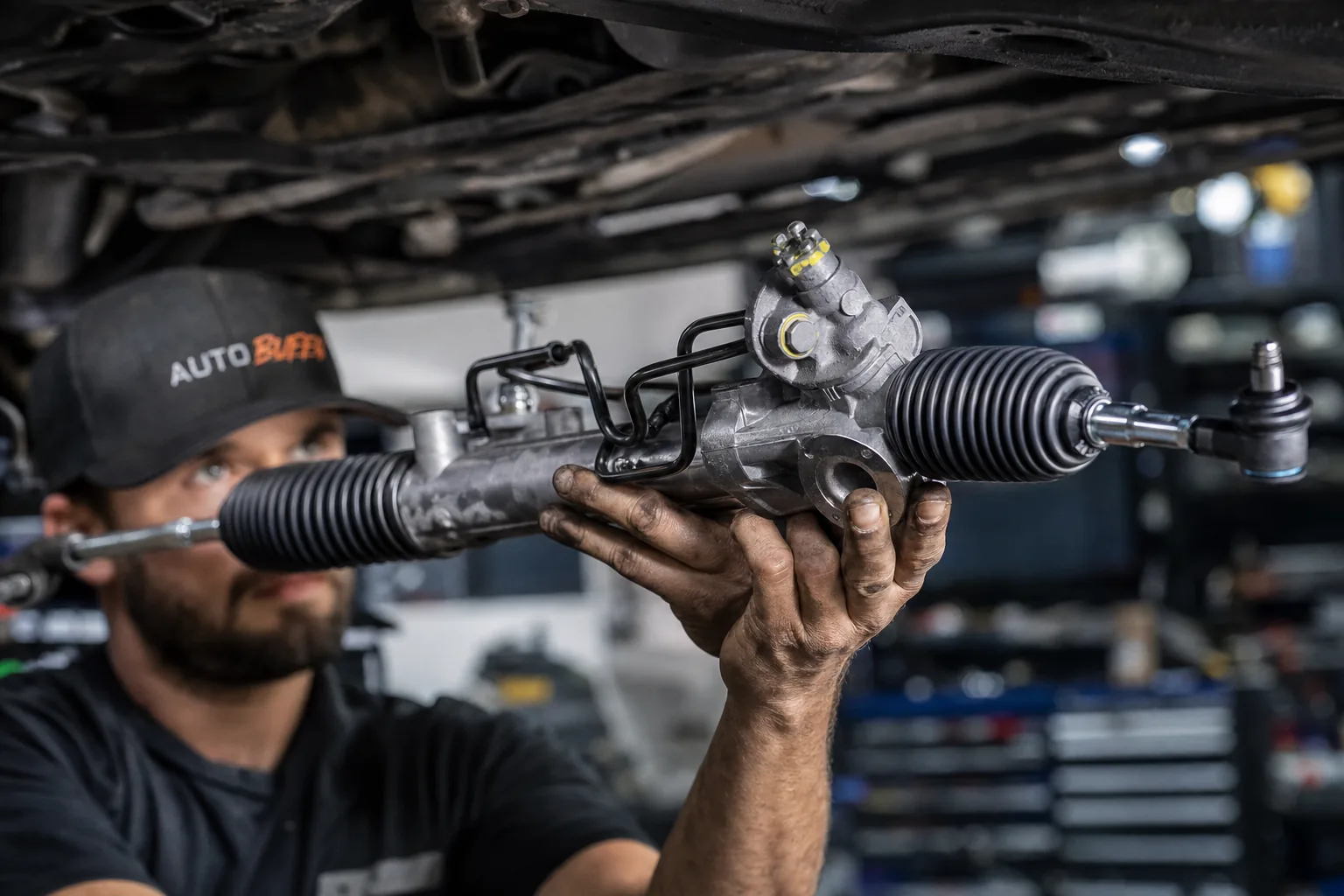
Before diagnosing it, it helps to understand what you're dealing with. The rack and pinion is the heart of your steering system. When you rotate the steering wheel, the motion travels down the steering column and turns a small gear (the pinion). That pinion meshes with a long toothed bar (the rack), pushing it left or right to turn your front wheels. On hydraulic systems, power steering fluid amplifies your input so the wheel feels light. On electric power steering (EPS) systems, a motor does that job instead.
The rack lives in a harsh environment—road vibration, water, road salt, and temperature swings all attack it over time. When it starts to go, your car will tell you. You just have to know what to listen for.
The 7 Symptoms of a Failing Rack and Pinion
1. Clunking, Knocking, or Popping When Turning
This is the one most drivers notice first. A worn rack develops looseness between the rack teeth and the pinion gear. That slop translates into a mechanical knock you can feel through the wheel and hear in the cabin—usually most obvious at low speeds, in parking lots, or when navigating tight turns.
Don't confuse this with a worn CV axle (which clunks only under acceleration in a turn) or worn sway bar links (which thunk over bumps). A rack knock shows up specifically when you're *turning* the wheel, regardless of whether you're moving or sitting still.
2. Loose, Wandering, or Vague Steering Feel
If your car used to track straight and tight and now drifts or requires constant small corrections, the rack may be worn past its internal tolerances. RepairPal lists steering wander as one of the primary indicators of internal rack wear. The vague "numb" feeling is the rack's worn gear mesh failing to translate your steering inputs precisely.
This symptom matters most at highway speeds. A rack that feels fine in a parking lot can feel genuinely scary at 70 mph when you need fast, precise corrections.
3. Power Steering Fluid on Your Driveway
On hydraulic systems, the rack has seals that keep fluid pressurized inside. When those seals wear out, fluid leaks—usually from behind the steering boots (the accordion-shaped rubber sleeves at each end of the rack). You'll see reddish or amber fluid near the center of the front axle line.
Check your power steering reservoir. If it's consistently low, the rack is the most likely culprit. According to NHTSA vehicle inspection guidance, fluid loss in steering systems is a flagged safety concern and should be addressed promptly—not just topped off repeatedly.
4. Stiff or Heavy Steering Effort
A sudden increase in steering effort—especially if it comes and goes—points to either the power steering pump or the rack. If the pump tests fine, the rack's internal valving (which controls fluid pressure assistance) may be failing. On EPS-equipped cars, a faulty rack position sensor can cause the assist motor to underprovide help, making the wheel feel like you've lost power steering entirely.
Worth noting: this symptom can also come from low fluid alone. Check the reservoir first. If topping it off doesn't fix it within a short drive, suspect the rack or pump.
5. Burning Smell After Stop-and-Go Driving
When a hydraulic rack's seals are failing, the power steering pump has to work harder to maintain pressure. In heavy traffic, this can overheat the fluid and produce a faint burning or acrid smell—sometimes mistaken for a belt or clutch. If you smell it and also notice any of the other symptoms above, the rack and its associated fluid condition should be your first stop.
6. Uneven or Accelerated Tire Wear
A worn rack that can't hold precise alignment—particularly toe setting—will scrub the inside or outside edges of your front tires faster than normal. If you're replacing tires more often than expected or your shop keeps pointing out feathered wear patterns, internal rack slop can be the root cause. A new rack paired with a proper four-wheel alignment will sort this out.
7. Steering Wheel Sitting Off-Center
After a bad pothole hit or curb strike, a rack can bend or shift slightly. You'll notice the steering wheel isn't centered when driving straight. This can also be a pure alignment issue, but if it appeared alongside noise or steering feel changes, the rack itself warrants inspection.
What Causes a Rack and Pinion to Fail?
- Worn internal seals — the most common cause in high-mileage vehicles; seals dry out and crack
- Contaminated fluid — old, dark power steering fluid carries metal particles that accelerate wear
- Impact damage — a hard hit on a pothole or curb can crack the housing or bend the rack bar
- Road salt corrosion — the rack sits low and exposed; northern climates take a real toll on the housing and boots
- Neglected boot tears — if a torn steering boot goes unnoticed, water and grit enter the rack and destroy it from inside out
How Much Does Rack and Pinion Replacement Cost?
Expect to pay roughly $150–$600 for the part (remanufactured units sit toward the low end, new OE-quality units toward the high end) and $200–$500 for labor at most independent shops. That puts the typical all-in cost between $350 and $1,100. Luxury vehicles, trucks with complex steering setups, or EPS-integrated racks can push past that range.
A front-end alignment, which is not optional after any rack replacement, typically adds $80–$150. Don't skip it—your tires will thank you inside of 10,000 miles.
Should You Rebuild or Replace?
Rack rebuild kits exist and can work when only the seals have failed on an otherwise undamaged unit. But rebuilding a rack requires clean working conditions, specific seal installation tools, and experience—it's not a typical DIY job. For most drivers, a quality remanufactured or new rack is the more reliable path. The labor cost is the same either way, so the part cost difference rarely justifies the rebuild risk.
One Honest Opinion
In my experience, the single biggest mistake drivers make is ignoring a slow power steering fluid leak for months, assuming it's minor. By the time the rack is knocking audibly, the internal gear surfaces are already scored. Catching it at the first wet spot on the driveway—when it might be a $15 boot repair—beats replacing the entire rack for $700. Check your steering boots at every oil change. It takes about 20 seconds.
Sources
Find the right part for your vehicle
Guaranteed fit, ships free
FAQ / People Also Ask
The most common signs are clunking or knocking noises when turning, a steering wheel that feels loose or wanders, power steering fluid leaking under the car, stiff or heavy steering, and a burning smell after driving. Any combination of these warrants an inspection.

Comments
Loading comments...
Comments are moderated by the AutoBuffy team.