

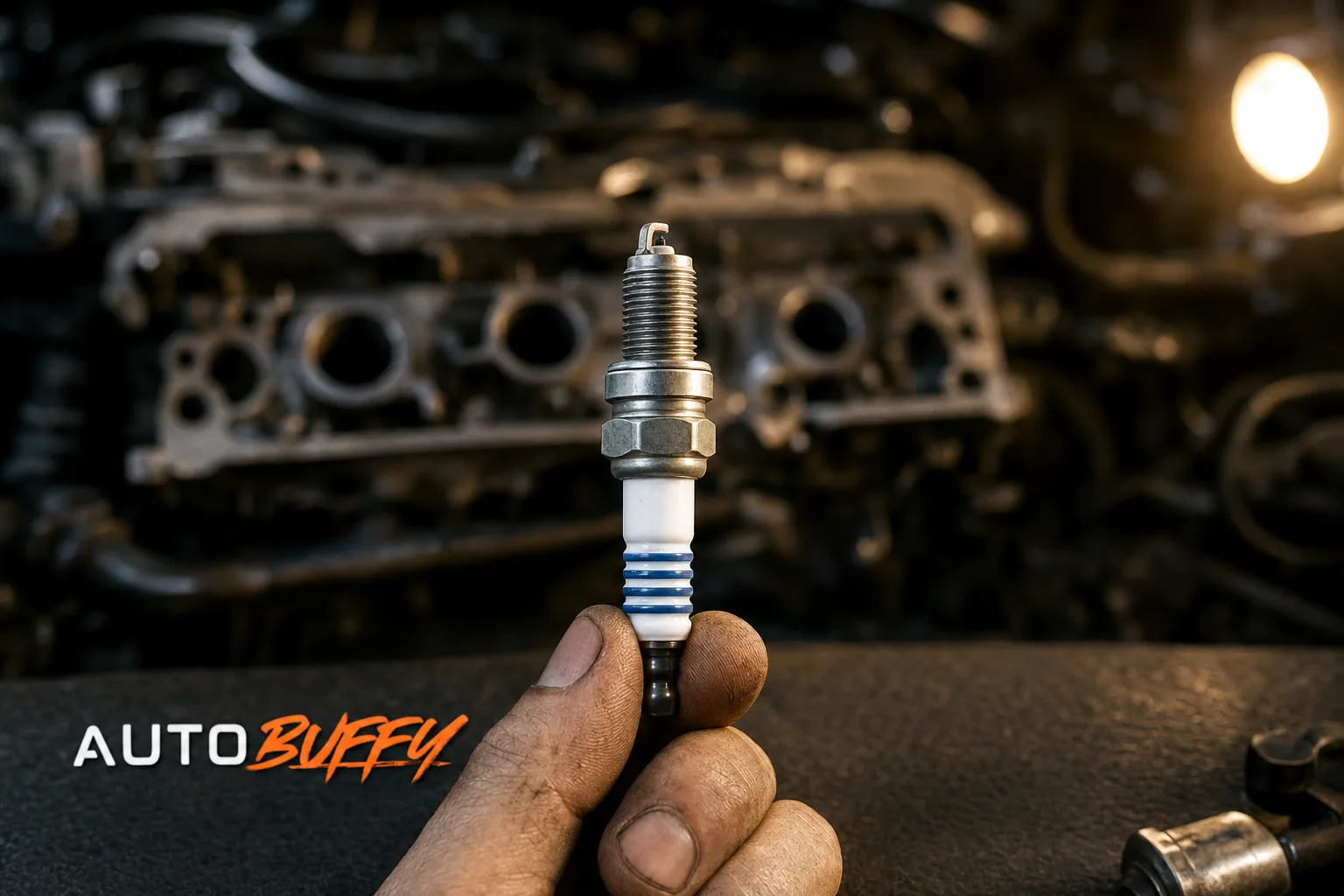
Bad Spark Plug Symptoms: Signs It's Time to Replace Them
Misfires, rough idle, poor fuel economy — bad spark plugs cause all of it. Learn the 7 key warning signs and when to replace before damage spreads.
The Short Answer
Bad spark plug symptoms include engine misfires, rough idle, sluggish acceleration, hard starts, a sudden drop in fuel economy, and a check engine light — any one of these warrants a plug inspection immediately.
| Symptom | Likely Misfire Code | Urgency |
|---|---|---|
| Rough / uneven idle | P0300–P0308 | High |
| Slow / hesitant acceleration | P0300–P0308 | High |
| Hard starting (cranks long) | None or P0300 | Medium–High |
| Check engine light on | P0300–P0308 | High |
| Fuel economy drops 10–30% | None initially | Medium |
| Strong fuel smell from exhaust | None or P0300 | High |
| Engine stalling at stops | P0300–P0308 | High |
If you're seeing two or more of these at once, the odds are very high you need new plugs. Keep reading to understand exactly what's happening inside the cylinder — and what to do about it.
How a Spark Plug Actually Works (And Why It Fails)
A spark plug has one job: fire a precisely timed electrical arc across a small gap, igniting the compressed air-fuel mixture in the cylinder. That's it. But it does this thousands of times per minute, at temperatures exceeding 1,500°F (815°C), under enormous pressure.
Over time, the electrode tip wears down, deposits build up, and the gap widens. When the gap gets too large or the electrode too corroded, the plug either misfires or fires at the wrong time. Neither is good.
Plug life varies a lot by material:
- Copper plugs: roughly 20,000–30,000 miles
- Platinum plugs: roughly 60,000–75,000 miles
- Iridium plugs: roughly 80,000–120,000 miles
Your owner's manual gives the spec for your engine. Don't exceed it, and don't go cheaper than what's specified — a hotter or colder heat range than your engine needs causes its own set of problems.
The 7 Clearest Bad Spark Plug Symptoms
1. Engine Misfires
This is the big one. A misfire means the air-fuel mixture in a cylinder didn't ignite when it was supposed to. You'll feel it as a brief stumble or jerk — sometimes subtle, sometimes violent. Your OBD-II port stores misfire codes (P0300 through P0308) that tell you exactly which cylinder is skipping. If that code shows up repeatedly on the same cylinder, swap the plug first before condemning the coil.
2. Rough or Unstable Idle
Sit at a red light and feel the steering wheel vibrate? Count the rhythm — if it pulses regularly, one cylinder is probably not contributing. A healthy idle is smooth. A rough idle with a consistent pattern almost always points to ignition. Worn plugs are the first suspect; coils and fuel injectors come after.
3. Sluggish Acceleration
Press the gas and nothing happens for a second — then it lurches forward. That delay is often the engine trying to compensate for weak or missing ignition events. You might also notice the engine feels "flat" on the highway compared to how it used to pull. Fuel trims can only do so much to cover for a misfiring plug.
4. Hard Starting
If the engine cranks and cranks before catching, the plugs may not be generating enough spark voltage to ignite a cold mixture. This is especially common in cold weather with older copper plugs that have corroded electrodes. Don't let this symptom go — repeated long cranking puts stress on the starter motor and battery.
5. Check Engine Light
The EPA estimates misfiring plugs can reduce fuel economy by up to 30% — and the engine control module (ECM) notices. Before the MPG drop becomes obvious to you at the pump, the ECM logs misfire events and eventually trips the check engine light. Use an OBD-II scanner to pull codes. P0300 is a random misfire; P0301–P0308 pinpoints the cylinder.
6. Poor Fuel Economy
You're filling up more than usual and nothing else has changed. Incomplete combustion wastes fuel. The unburned hydrocarbons go out the exhaust instead of pushing the piston down. Fueleconomy.gov notes that keeping up with tune-ups — which includes plugs — can improve gas mileage by an average of 4%, and fixing a serious misfire can improve it significantly more.
7. Fuel Smell from the Exhaust
If unburned fuel is making it past the combustion chamber and into the exhaust stream, you'll smell it. This is a sign of a significant misfire and it's urgent — unburned fuel can destroy a catalytic converter in a matter of days. Catalytic converter replacement runs anywhere from $800 to $2,500+. A full set of iridium plugs costs a fraction of that.
What a Fouled Plug Actually Looks Like
Pull the plug and read it — mechanics have been doing this for over a century for a reason. The deposit color tells you the story:
- Light tan or grayish tip: Normal. This plug is fine.
- Black, dry, sooty deposits: Carbon fouling — usually from a rich-running engine, short trips, or an air filter issue.
- Black, wet, oily deposits: Oil fouling — oil is getting past the rings or valve seals. The plug isn't your only problem here.
- Blistered, white, or melted electrode: Overheating — wrong heat range, detonation, or a cooling system issue.
- Worn, rounded electrode tip: Normal wear. The gap has grown beyond spec. Time to replace.
Can Ignoring Bad Plugs Cause Real Damage?
Yes — and this is where people underestimate the cost. A misfire sends raw, unburned fuel into the exhaust. The catalytic converter tries to burn it off, overheats, and can melt internally. NHTSA data includes catalytic converter failure as a documented downstream consequence of prolonged engine misfires. Beyond the cat, you're also stressing ignition coils (each coil works harder trying to fire a degraded plug), oxygen sensors, and potentially cylinder walls from uncontrolled combustion.
The math is simple: a set of plugs costs $20–$100 in parts. Ignoring bad plugs can lead to $800–$2,500+ in catalytic converter repairs, $100–$400 per ignition coil, and labor costs that compound fast. My honest take — if you're over 60,000 miles on a set of platinum plugs and the car is showing even one of the symptoms above, just replace them. The diagnostic time alone often costs more than the parts.
How to Confirm It's the Plugs (Not the Coils)
Misfire symptoms overlap between plugs and ignition coils. Here's a quick way to isolate the fault:
- Pull the misfire code — note the cylinder number (e.g., P0302 = cylinder 2).
- Swap the spark plug from cylinder 2 with the plug from cylinder 4.
- Clear the codes and test drive.
- If the misfire code moves to P0304, the plug was the problem. If it stays at P0302, suspect the coil on cylinder 2.
This swap test costs nothing and takes about 20 minutes. Do it before buying coils.
When to Replace Spark Plugs (Schedule, Not Just Symptoms)
Don't wait for symptoms if you're near the service interval. RepairPal pegs typical spark plug replacement as a routine scheduled service, not an emergency repair — which is exactly right. Plugs are cheap preventive maintenance. A rough rule of thumb:
- Every 30,000 miles — copper plugs
- Every 60,000 miles — platinum plugs
- Every 90,000–120,000 miles — iridium plugs
Check your owner's manual for the exact spec. Some turbocharged engines want fresh plugs sooner because of the higher combustion pressures involved.
Sources
- Fueleconomy.gov — Keeping Your Car in Shape
- RepairPal — Spark Plug Replacement
- NHTSA — Vehicle Safety & Maintenance
Find the right part for your vehicle
Guaranteed fit, ships free
FAQ / People Also Ask
The most common signs are engine misfires, rough idle, sluggish acceleration, hard starting, poor fuel economy, a lit check engine light, and in some cases a strong fuel smell from the exhaust.


Comments
Loading comments...
Comments are moderated by the AutoBuffy team.