

Bad Starter Symptoms: How to Tell If Your Starter Is Failing
Clicking, grinding, or your car just won't crank? Learn the top bad starter symptoms, what causes them, and how to know it's time for a replacement.
The Short Answer
If your car clicks but won't crank, cranks slowly, or intermittently refuses to start, a failing starter is one of the most likely causes — and catching it early can save you from being stranded.
| Symptom | What It Sounds/Feels Like | Likely Cause |
|---|---|---|
| Single loud click, no crank | One clunk, engine doesn't turn | Solenoid firing, motor not spinning |
| Rapid clicking | Fast click-click-click | Low voltage reaching starter |
| Grinding noise on crank | Metal-on-metal grinding | Worn drive gear / flywheel damage |
| Slow, labored cranking | Engine turns but sluggishly | Worn starter motor brushes |
| Intermittent no-start | Works sometimes, fails randomly | Heat soak or loose connection |
| Starter spins, engine doesn't | Whirring with no crank | Freewheeling drive gear (bad bendix) |
| Smoke or burning smell | Acrid smell from engine bay | Shorted starter or stuck solenoid |
What Does the Starter Actually Do?
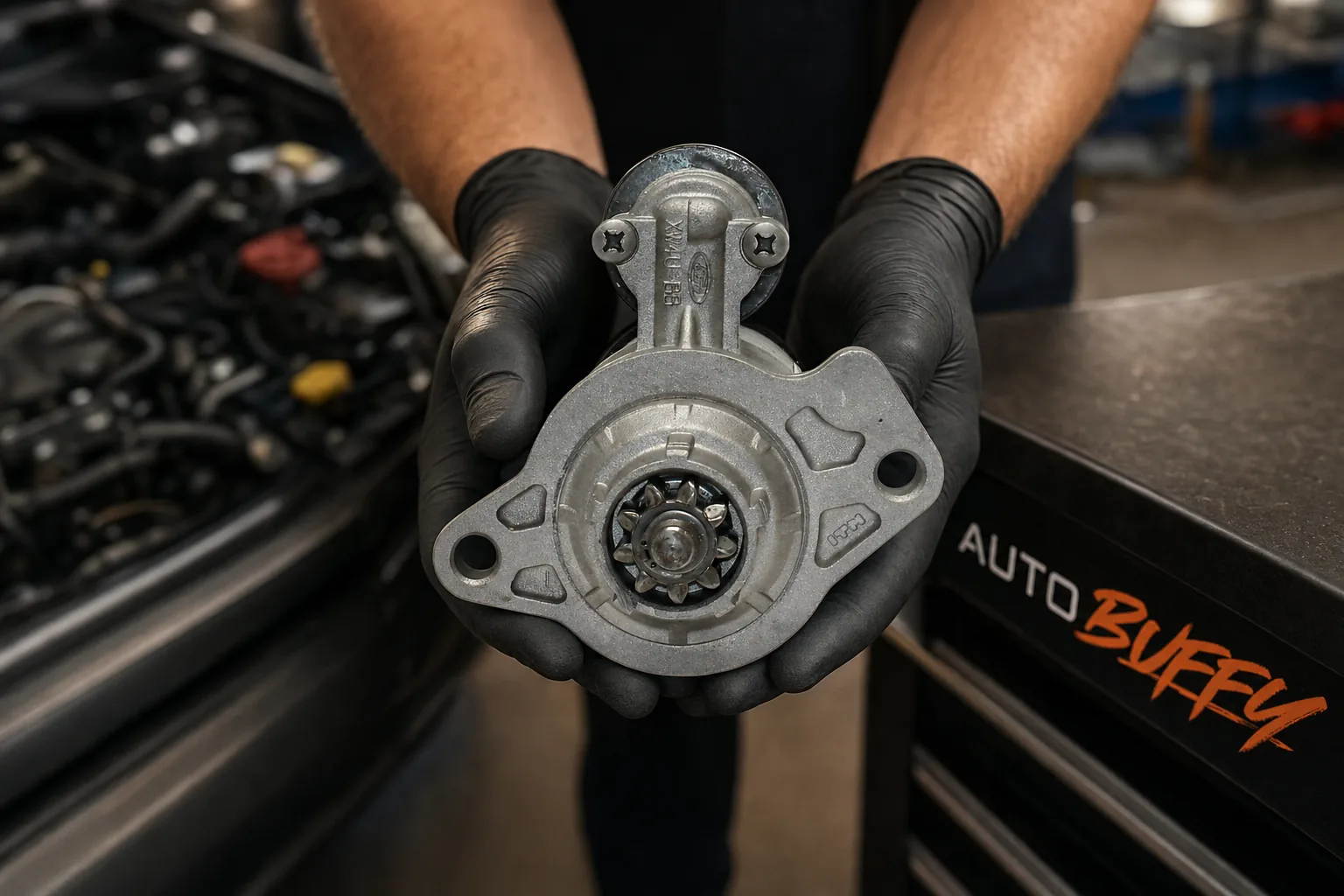
Before diagnosing symptoms, it helps to understand what you're dealing with. The starter is an electric motor that draws high current from your battery to physically spin the engine's crankshaft fast enough to fire. It engages through a small gear (called the bendix or drive pinion) that meshes with the teeth on your flywheel or flexplate. The whole event lasts about one second — but a lot can go wrong in that second.
The starter has two main components that fail: the solenoid (which acts as a high-current relay and also pushes the gear forward) and the motor itself (which does the actual spinning). Knowing which part is failing narrows your diagnosis considerably.
The 7 Most Common Bad Starter Symptoms
1. One Click and Nothing
This is the classic bad starter sound. You turn the key, hear a single firm *clunk* from the engine bay, and then silence. The solenoid is energizing — it has enough voltage to snap shut — but the motor isn't spinning. This usually means the motor windings are burnt or the brushes inside are worn past their serviceable limit.
2. Rapid Clicking
A rapid series of clicks — sometimes described as sounding like a cricket — almost always means voltage isn't sufficient to hold the solenoid contacts closed. The solenoid chatters open and shut rapidly. This is *more often a battery or connection problem* than the starter itself, so test your battery before condemning the starter. That said, a starter with high internal resistance due to wear can also cause this by loading the battery down below its threshold.
3. Grinding When Cranking
A grinding noise on startup usually means the drive gear isn't fully engaging the flywheel ring gear before spinning. This can be caused by a worn bendix spring, a sticky solenoid plunger, or — in worse cases — chipped teeth on the flywheel itself. Ignore this one long enough and you'll be looking at a flywheel replacement on top of the starter, which is a significantly bigger job.
4. Slow or Labored Cranking
When the engine turns but sounds like it's moving through molasses — slower than usual, with less authority — the starter motor is losing efficiency. Worn brushes increase internal resistance, reducing how much torque the motor can produce. Cold weather amplifies this because battery output drops in the cold at the same time the oil thickens. If slow cranking only happens in winter, test your battery first. If it happens year-round and the battery is healthy, the starter is likely on its way out.
5. Intermittent Starting Problems
Your car starts fine three days in a row, then refuses on the fourth. No pattern, no warning. This is one of the most frustrating bad starter symptoms to diagnose precisely because it's not consistent. Heat soak is a common trigger — starters mounted low on the engine block can get cooked after a hot run, and a marginal motor that works when cool will fail once it absorbs heat. If your no-start problems happen most often after a short warm trip (stop for gas, try to restart), heat soak is high on the suspect list.
6. Freewheeling (Starter Spins, Engine Doesn't)
You hear the starter motor whirring freely — a high-pitched spinning sound — but the engine never catches. The motor is running, but the drive gear isn't engaging the flywheel. This points to a failed one-way clutch inside the bendix mechanism. The starter needs replacement.
7. Smoke or Burning Smell
If you smell something burning near the front of the engine or see smoke after attempting to start, stop cranking immediately. A stuck solenoid can hold the starter engaged continuously, causing the motor to overheat and burn. This can also happen if someone holds the ignition key in the "start" position for too long while troubleshooting a no-start. Either way, continuing to crank risks a fire.
Don't Confuse These With a Bad Starter
A few common mix-ups worth calling out:
- Dead battery — The most frequent false positive. Test the battery first with a load test, not just a voltage reading. A battery can show 12.4V at rest and still collapse under load. RepairPal's battery guide is a solid reference for understanding what a healthy battery looks like under test.
- Bad ground strap — A corroded or loose engine-to-chassis ground can mimic virtually every symptom above. Inspect both ends of every ground cable before replacing the starter.
- Neutral safety switch — If your automatic-transmission vehicle won't crank in Park but does in Neutral (or vice versa), the neutral safety switch is the culprit, not the starter.
- Ignition switch failure — If no power reaches the starter solenoid at all, the ignition switch or its relay may be the weak link. You can test this with a multimeter at the solenoid's small trigger wire.
How to Test a Starter Before Replacing It
You don't have to guess. Here's a simple sequence:
- Load-test the battery. Most auto parts stores do this free. A battery that fails under load explains most starter symptoms instantly.
- Check connections. Inspect battery terminals, the main cable to the starter, and all ground straps. Clean any visible corrosion.
- Voltage drop test. With a multimeter, check voltage at the starter motor's main terminal *while cranking*. You should see within 0.5V of battery voltage. A big drop means resistance in the cable or connection.
- Tap test (anecdotal, not a fix). Lightly tapping the starter body with a wrench while someone tries to start the car can temporarily free stuck brushes. If this works once, it won't work forever — the starter still needs replacement. But it confirms the diagnosis.
- Bench test. A removed starter can be bench-tested at most parts stores. This definitively tells you if the motor and solenoid function correctly.
Pro tip: According to NHTSA vehicle safety data, electrical system failures are among the most common causes of vehicle breakdowns. Getting ahead of a failing starter before it strands you is always cheaper than a tow.
What Does a Starter Replacement Cost?
Expect to pay $80–$350 for the part depending on your vehicle's make, model, and engine. Labor typically adds $150–$400 at an independent shop, putting most complete jobs in the $250–$650 range. Dealer labor rates can push that higher. Vehicles where the starter is buried under an intake manifold or requires subframe work take longer and cost more.
Remanufactured starters are a legitimate, cost-effective option for most applications — just make sure any remanufactured unit you buy has been tested and includes a warranty. Use the part finder below to see what fits your specific vehicle and compare options for your exact application.
Sources
Find the right part for your vehicle
Guaranteed fit, ships free
FAQ / People Also Ask
The most common sounds are a single loud click, rapid clicking, or a grinding/whirring noise when you turn the key. A single click often means the solenoid has power but the motor isn't spinning. Rapid clicking usually points to low battery voltage reaching the starter. Grinding suggests the drive gear isn't engaging the flywheel properly.
Comments
Loading comments...
Comments are moderated by the AutoBuffy team.