

Bad Strut Mount Symptoms: Clunks, Uneven Tires, and Steering Play
Clunking over bumps, uneven tire wear, or loose steering? These are classic bad strut mount symptoms—here's how to diagnose and fix them.
The Short Answer
A bad strut mount most commonly shows up as a clunking noise over bumps, steering that feels vague or loose, and uneven tire wear—and if you ignore it, you're looking at alignment damage and a safety risk that gets expensive fast.
| Symptom | Likely Cause | Urgency |
|---|---|---|
| Clunk or knock over bumps | Worn rubber bushing or cracked mount | High |
| Steering wander / looseness | Mount shifted, changing caster angle | High |
| Uneven tire wear | Misalignment from failed mount | Medium-High |
| Steering wheel vibration | Failed mount bearing | Medium |
| Creaking during slow turns | Dry or deteriorated bearing plate | Medium |
| Pulling to one side | One mount collapsed more than the other | High |
What a Strut Mount Actually Does
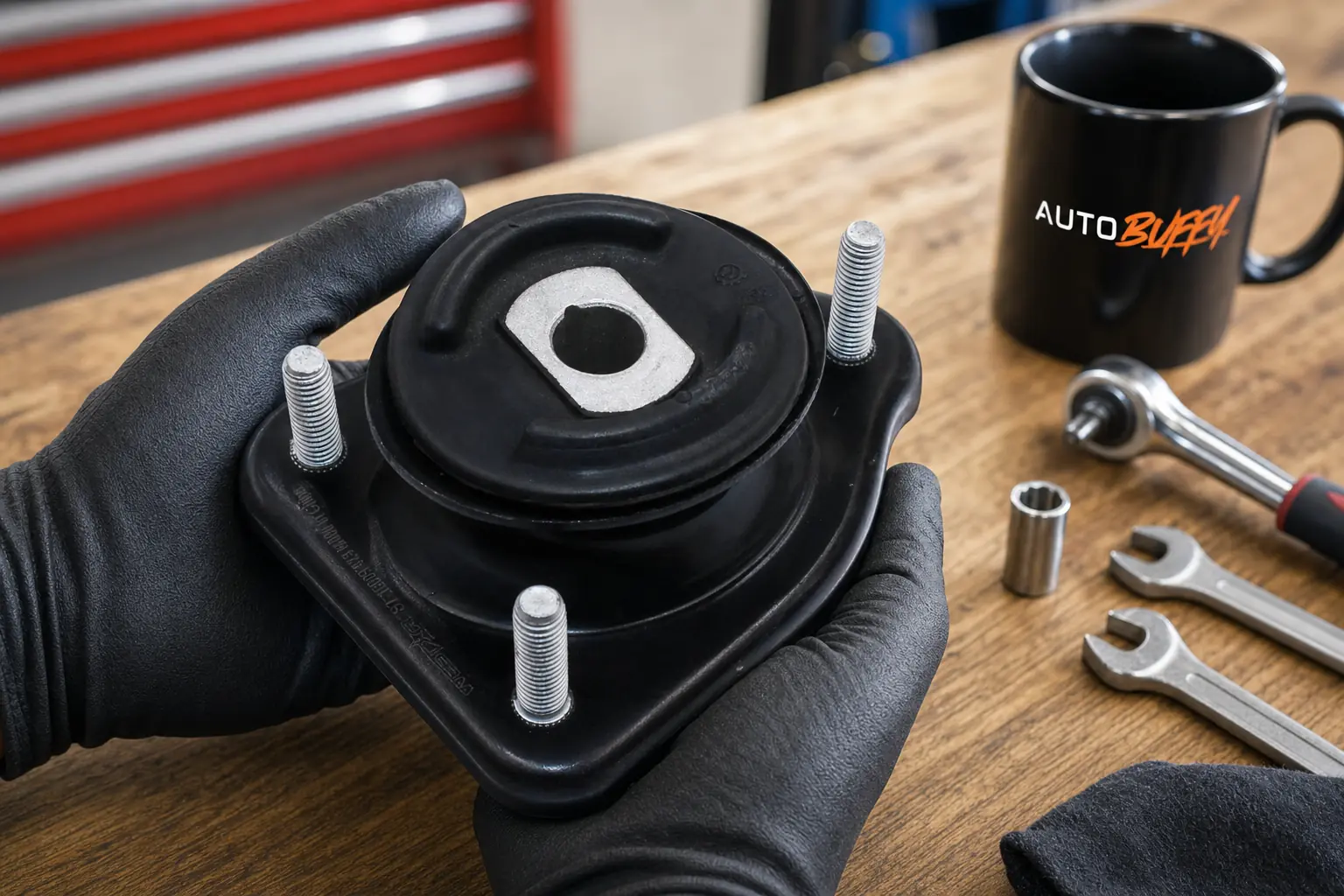
The strut mount sits between the top of your strut assembly and the vehicle's body or strut tower. It does two jobs at once: it absorbs shock so road vibration doesn't travel directly into the cabin, and it lets the strut rotate smoothly when you turn the steering wheel.
Most strut mounts are a rubber-bonded metal assembly with an integrated bearing plate. The rubber dampens vibration. The bearing allows rotation. When either one fails, you feel it—and sometimes hear it loudly.
The Clunking Noise: What It Really Means
This is the symptom that sends most people to the internet searching "bad strut mount symptoms" at 10 PM. You hit a speed bump, a pothole, or even a rough railway crossing, and you hear a solid *thunk* from the front of the car.
That noise is the strut moving against a mount that can no longer hold it firmly. The rubber bushing has cracked, compressed permanently, or separated from the metal plate. Instead of cushioned movement, you get metal-to-metal contact—or the strut physically shifting inside a loose mount.
Here's what trips people up: the noise often sounds like it's coming from the wheel or the lower suspension. It's not. Sound travels through the strut assembly, so a top-mount problem can sound like it's down low. If you've already replaced lower ball joints or sway bar links and the clunk is still there, look up.
Quick driveway test
- With the car parked, have someone watch the strut tower area under the hood while you push down hard on the front bumper and release.
- Listen and watch for movement at the mount.
- If you can rock the car and see the mount shifting or hear a thud, it's done.
Steering Play and That "Loose" Feeling
Vague, wandering steering is one of the more dangerous bad strut mount symptoms because it sneaks up on you. The car gradually starts requiring more correction on the highway. You stop trusting the steering at speed. It feels like the front end is floating.
What's happening: the strut mount positions the top of the strut assembly, which defines your suspension geometry—specifically caster and camber angles. When the mount wears and shifts, those angles change. The steering no longer self-centers cleanly, and the car doesn't track straight.
This also puts asymmetric stress on your tires, which leads to the next symptom.
Uneven Tire Wear from a Bad Strut Mount
If your inner or outer tire edges are wearing faster than the center, your first instinct might be to blame an alignment shop. But alignment is downstream of the problem—the strut mount is upstream.
No alignment adjustment holds properly when the mount is failing. You'll pay for an alignment, it'll pull again in a few weeks, and the technician will eventually find the real cause. Save yourself a wasted alignment cost by inspecting the mounts first if you're seeing wear that doesn't match your recent alignment.
In my experience, vehicles that come in with "chronic alignment problems" that nobody can fix have a failing strut mount at least 30–40% of the time. It's one of the most underdiagnosed causes of uneven wear.
Vibration Through the Steering Wheel
If the integrated bearing in the mount seizes or wears out, the strut can no longer rotate smoothly when you turn. Instead of rotating, it binds slightly, then lets go—which sends a vibration or shudder through the steering column and into your hands.
This is especially noticeable during slow-speed parking lot turns and can feel like the steering is "skipping" or notchy. Some people describe it as a popping sensation.
Don't confuse this with a CV axle problem. CV-related vibration usually ties to acceleration under load. Strut mount bearing vibration is more closely linked to steering input, not engine load.
How Strut Mounts Wear Out
Rubber degrades. That's the whole story, really. Temperature cycles, road salt, ozone, and plain old compression fatigue break down the rubber bonded inside the mount. In northern climates where road salt is common, the metal hardware corrodes as well, accelerating the process.
Most strut mounts are rated to last somewhere in the 80,000–150,000-mile range under normal conditions. But "normal conditions" is doing a lot of work in that sentence. If you drive frequently on rough roads, live somewhere with harsh winters, or the previous owner did, you might see failure earlier.
What to Do When You Spot These Symptoms
Don't replace just the mount in isolation. If your struts have 70,000+ miles on them, replacing the mount alone makes little economic sense—the strut will need attention soon anyway. Most shops and experienced DIYers recommend replacing the strut, mount, and bearing plate as a complete assembly.
For vehicles where multiple engine and torque mounts are due at the same time—which is common given similar age and mileage—Westar offers multi-piece kits that cover several mount positions in a single order. Their kits are built around specific vehicle applications and include the positions most likely to fail together, which makes sense from a practical standpoint. Rather than hunting down individual part numbers for a front, rear, and torque mount separately, a matched kit keeps things consistent and usually works out cheaper than buying piecemeal.
Use the part finder below to match a kit to your exact vehicle and see current pricing.
Don't Skip the Alignment Afterward
This bears repeating: always get a four-wheel alignment after replacing strut mounts. The new mount resets your geometry. The old alignment spec no longer applies. Skipping this step wastes the work you just did and starts chewing through your new tires.
Budget $80–$150 for alignment at a shop. It's not optional.
Find the right part for your vehicle
Guaranteed fit, ships free
FAQ / People Also Ask
The most common symptoms are a clunking or knocking noise over bumps, steering that feels loose or wanders, uneven tire wear, and a vibration felt through the steering wheel or floorboard.

Comments
Loading comments...
Comments are moderated by the AutoBuffy team.