

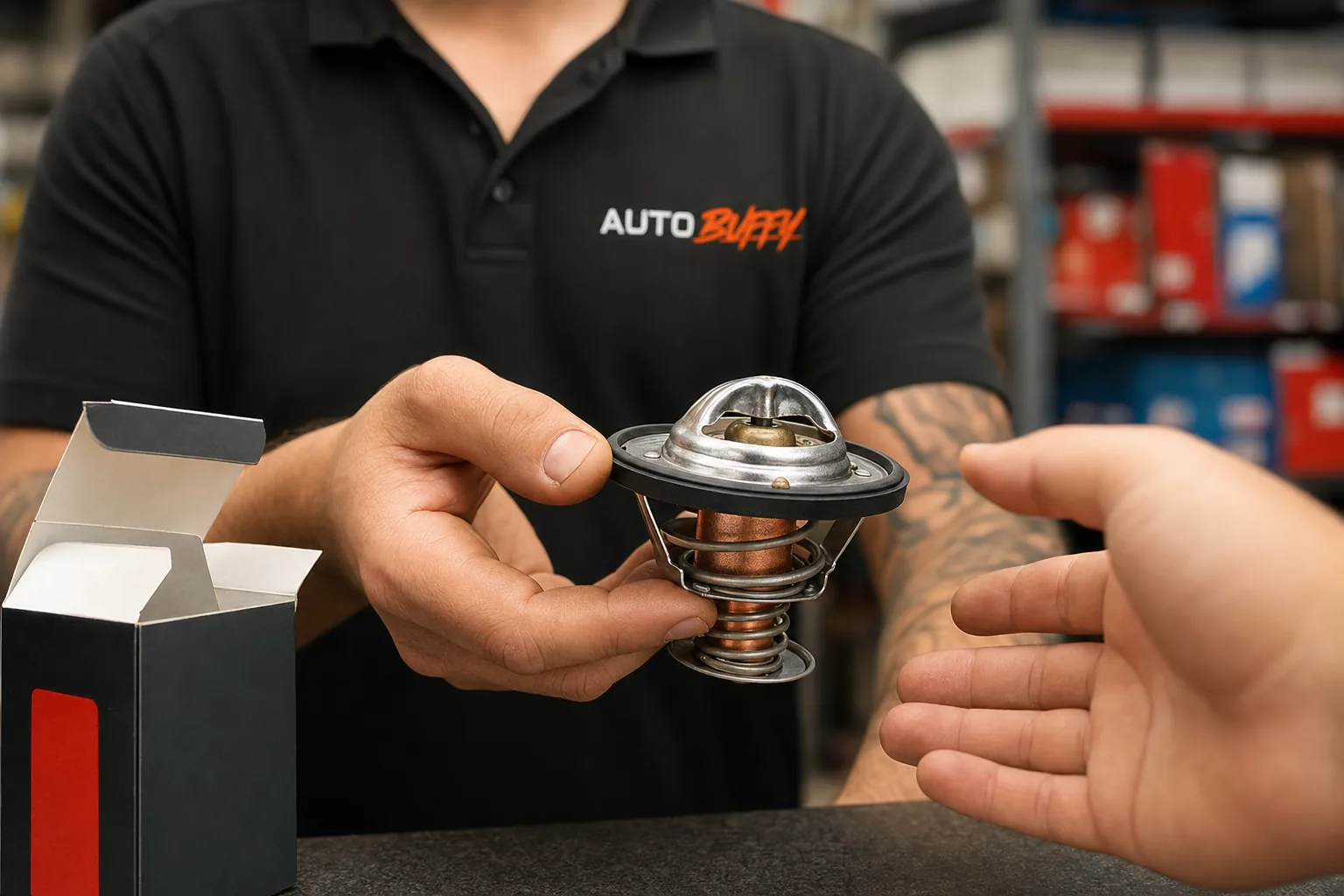
Bad Thermostat Symptoms: How to Tell Before You Overheat
A failing engine thermostat shows clear warning signs. Learn to spot them early before they turn into a costly overheating repair.
The Short Answer
A bad thermostat almost always shows up as an engine that overheats quickly, never fully warms up, has an erratic temperature gauge, or produces poor heater output—and catching any of these early can save you from a warped cylinder head.
| Symptom | Likely Cause | Urgency |
|---|---|---|
| Temp gauge spikes into the red | Thermostat stuck closed | Stop driving immediately |
| Engine never reaches normal temp | Thermostat stuck open | Fix within a week |
| Temp gauge swings up and down | Thermostat cycling erratically | Fix soon |
| Heater blows cold or lukewarm air | Thermostat stuck open | Fix within a week |
| Check engine light (P0128) | Coolant temp below threshold | Diagnose promptly |
| Coolant leaks near housing | Housing cracked from pressure | Fix soon |
What the Thermostat Actually Does
Your engine thermostat is a spring-loaded valve the size of a hockey puck. It sits between the engine and the radiator, and its one job is to keep coolant from circulating until the engine reaches operating temperature—usually somewhere between 180°F and 210°F depending on the vehicle.
When the engine is cold, the thermostat stays closed. Coolant circulates in a small loop, warming up fast. Once the coolant hits the thermostat's rated temperature, a wax pellet inside expands, the valve opens, and hot coolant flows out to the radiator to get cooled. It's simple physics, and it works reliably for years—until it doesn't.
When the thermostat fails, it typically fails in one of two positions: stuck open or stuck closed. Both are problems, but a stuck-closed thermostat is a genuine emergency.
The Most Common Bad Thermostat Symptoms
1. Engine Overheating (Thermostat Stuck Closed)
This is the dangerous one. If the thermostat won't open, hot coolant can't reach the radiator to shed heat. The engine temperature climbs fast—sometimes within 5–10 minutes of driving—and the temp gauge pushes toward the red zone.
If you see this, pull over. Running an overheated engine even for a few minutes can warp a cylinder head or crack the block. Either repair costs thousands of dollars. A thermostat costs under $60.
2. Engine Runs Cold or Takes Forever to Warm Up (Thermostat Stuck Open)
When the thermostat is stuck open, coolant flows constantly through the radiator even when the engine is cold. The engine takes much longer to reach operating temperature, or it never gets there at all. On a cold morning, you might notice the temp gauge sitting well below the normal range even after 10–15 minutes of driving.
This doesn't feel urgent—the engine isn't overheating—but a cold-running engine hurts fuel economy, produces more emissions, wears engine components faster, and keeps the ECU in a rich fueling mode it was never meant to run in long-term.
3. Erratic or Fluctuating Temperature Gauge
Sometimes the thermostat doesn't stick permanently in one position. It opens and closes at the wrong times, and the temp gauge reflects that chaos—climbing toward hot, dropping back, climbing again. If you notice the needle swinging around instead of sitting steady at the normal mark, a failing thermostat is high on the suspect list (along with a low coolant level and a faulty coolant temp sensor).
4. Cold or Lukewarm Air from the Heater
Your cabin heater uses the engine's hot coolant as its heat source. If the thermostat is stuck open and the coolant never gets hot enough, the heater core gets lukewarm coolant and blows tepid air. This is especially noticeable in winter. If your heater used to work fine and now it's underwhelming, check the coolant level first, then suspect the thermostat.
5. Check Engine Light with Code P0128
A thermostat stuck open is one of the most common triggers for the P0128 code—"Coolant Temperature Below Thermostat Regulating Temperature." The ECU monitors how quickly the engine warms up. If coolant temp doesn't rise to the expected threshold in the expected time window, it sets the code. Pull the code with a scanner before you start throwing parts at the problem.
6. Coolant Leaks Near the Thermostat Housing
A leaking thermostat housing gasket isn't a thermostat failure exactly, but it often happens at the same time. The thermostat housing takes thermal stress every time the engine cycles. Plastic housings crack. Gaskets harden and shrink. If you see coolant pooling or dried coolant residue near the thermostat housing, plan to replace both the thermostat and the housing gasket together.
How to Confirm It's the Thermostat (and Not Something Else)
Before you buy parts, do a quick diagnosis:
- Check coolant level first. Low coolant mimics thermostat symptoms. Top it off and see if the problem persists.
- Scan for codes. P0128 points strongly at the thermostat. Overheating codes alongside no-flow symptoms do too.
- Feel the upper radiator hose after the engine has run for 5–10 minutes. It should be hot. If it's still cool, coolant isn't flowing through the radiator—classic stuck-closed thermostat.
- Watch the temp gauge carefully during a cold start. Normal warm-up is gradual and steady. Spiking fast or never climbing are both red flags.
- Check the coolant temp sensor. A bad sensor can send false temp readings. If your gauge is the only symptom and the OBD live data shows a different coolant temp than the gauge, the sensor might be the real culprit.
In my experience, about 70% of P0128 codes on vehicles with over 80,000 miles trace directly back to the thermostat—it's the most likely cause and usually the cheapest fix to try first.
What to Look for in a Replacement Thermostat
Not all thermostats are equal. Here's what matters when you're shopping:
- OE temperature rating. Match the temperature rating your vehicle's manufacturer specifies. Installing a lower-rated thermostat (a common "trick" to run cooler) can actually confuse the ECU and trigger codes.
- Included gasket or O-ring. Quality thermostats come with the sealing hardware. Don't reuse the old gasket.
- Housing kits vs. thermostat-only. If your housing is plastic and looks brittle or stained, a kit that includes the housing is worth the extra few dollars.
Replacing the Thermostat: What to Expect
On most engines, this is a genuine DIY job. The thermostat housing is usually on top of the engine where the upper radiator hose connects. You drain some coolant, unbolt the housing (typically two or three bolts), swap the thermostat, install a new gasket with a dab of sealant if required, refill the coolant, and run the engine while watching for leaks.
Total time: 45 minutes to 2 hours depending on access. Labor at a shop typically runs $75–$200. The part itself is $15–$60 for most applications. It's one of the better cost-to-impact repairs in all of car maintenance.
One thing people miss: burping the air out of the cooling system after the job. Air pockets cause hot spots and can make it look like the thermostat still isn't working. Run the engine with the radiator cap off, squeeze the hoses, and let it fully cycle until the thermostat opens and the level stabilizes.
The Bottom Line
A bad thermostat is a small part that causes outsized problems when ignored. Overheating from a stuck-closed thermostat can total an engine. A stuck-open thermostat quietly kills fuel economy and puts stress on components that expect to run at the right temperature. The warning signs are clear—unusual gauge behavior, heater problems, P0128, coolant near the housing—and the fix is straightforward and affordable.
Don't wait until you're on the side of the road with steam coming from under the hood.
Find the right part for your vehicle
Guaranteed fit, ships free
FAQ / People Also Ask
Short distances, maybe. But a thermostat stuck closed can overheat your engine within minutes. A thermostat stuck open won't destroy the engine quickly, but it causes poor fuel economy, heater failure, and check engine lights. Don't ignore it.


Comments
Loading comments...
Comments are moderated by the AutoBuffy team.