

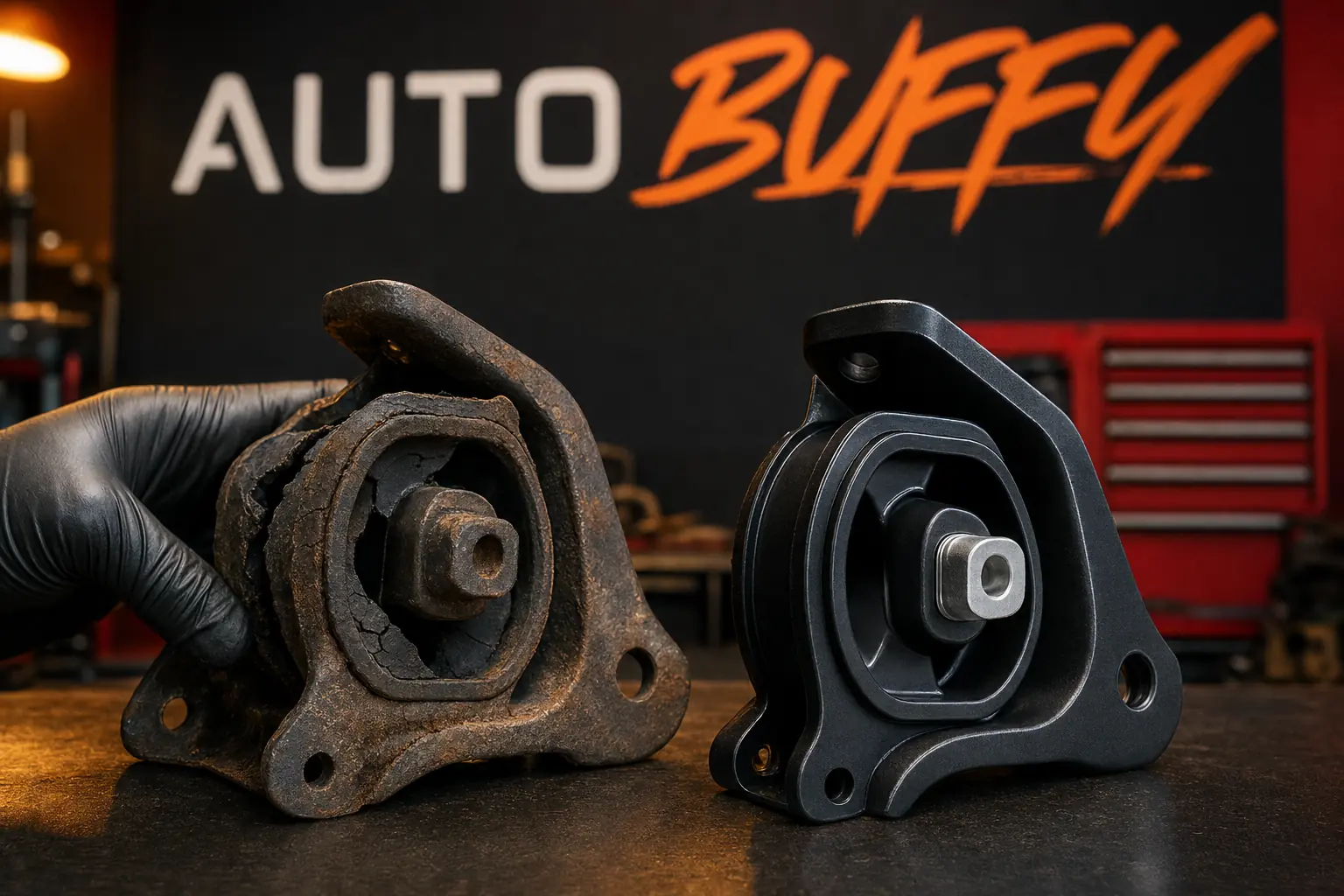
Bad Transmission Mount Symptoms & Replacement Cost
Clunking shifts, vibrations, hard gear changes — learn the signs of a failing transmission mount and what replacement actually costs.
The Short Answer
A bad transmission mount most often announces itself with a distinct clunk or thud when shifting gears, combined with vibrations through the floorboard and visible drivetrain movement under the hood.
| Symptom | When It Happens | Urgency |
|---|---|---|
| Clunking / thudding noise | Gear shifts (P→D, acceleration) | High |
| Cabin vibration | Idle, acceleration | Medium-High |
| Rough or delayed gear engagement | Any shift | High |
| Visible transmission movement | Under-hood inspection | High |
| Clunking over bumps | Road impacts | Medium |
| Exhaust rattle or scrape | Acceleration | Medium |
Typical replacement cost: $225–$500 all-in (parts + labor, most vehicles). Luxury and AWD platforms can run higher.
What Does a Transmission Mount Actually Do?
Your transmission mount is a rubber-and-steel bracket that bolts the transmission to the vehicle's subframe or crossmember. It has one job: hold the transmission in place while absorbing the torque, vibration, and movement the drivetrain generates during operation.
The rubber is the key ingredient. It's not just padding — it's specifically formulated for a given vehicle's weight, torque output, and resonance frequencies. When that rubber cracks, collapses, or gets saturated with oil, the transmission stops being controlled. It starts moving on its own.
Some vehicles use a single mount. Many use two, and some truck-based platforms use a combination of transmission mounts and a separate crossmember isolator. Knowing your configuration matters before you price out a repair.
The 6 Symptoms of a Bad Transmission Mount
1. Clunking or Thudding When Shifting
This is the loudest and most obvious symptom. You shift from Park to Drive, or you accelerate hard from a stop, and you hear a dull *clunk* — sometimes felt through the seat or floor. That's the transmission physically shifting position because the mount isn't holding it steady. The clunk is metal hitting metal once the slack runs out.
2. Excessive Cabin Vibration
Healthy mounts isolate drivetrain vibration from the chassis. Once the rubber fails, vibration travels straight through the mount hardware into the floorboard and seats. You'll feel it most at idle in gear and during low-speed acceleration. Some drivers describe it as the whole car shuddering during gear changes.
3. Rough or Hesitant Gear Engagement
If the transmission is shifting around on a collapsed mount, the shift linkage cable geometry changes. That can make gear selection feel vague, require extra force on the shifter, or cause the transmission to hesitate before engaging. Many people chase shift solenoids or transmission fluid before catching the mount.
4. Visible Transmission Movement
Pop the hood and have someone shift between Drive and Reverse while you watch the powertrain. On a good mount, the transmission barely moves. On a failed one, you'll see it rock noticeably — sometimes enough to pull at the CV axle boots or tug the exhaust flex pipe. If you see it moving, you already have your answer.
5. Clunking Over Bumps or Potholes
Road impacts send a jolt through the subframe. A failed mount lets the transmission bounce with that jolt rather than staying controlled. You'll hear a clunk that seems to come from under the center of the car — not from the wheels, not from the suspension, but from the drivetrain.
6. Exhaust Noise or Contact
When the transmission drops or shifts position, the exhaust system — which runs right alongside it — can move out of clearance with heat shields, the floor, or the tunnel. You might hear rattling, scraping, or a new exhaust resonance that wasn't there before. That's your cue to look at more than just the hangers.
How to Confirm It's the Transmission Mount
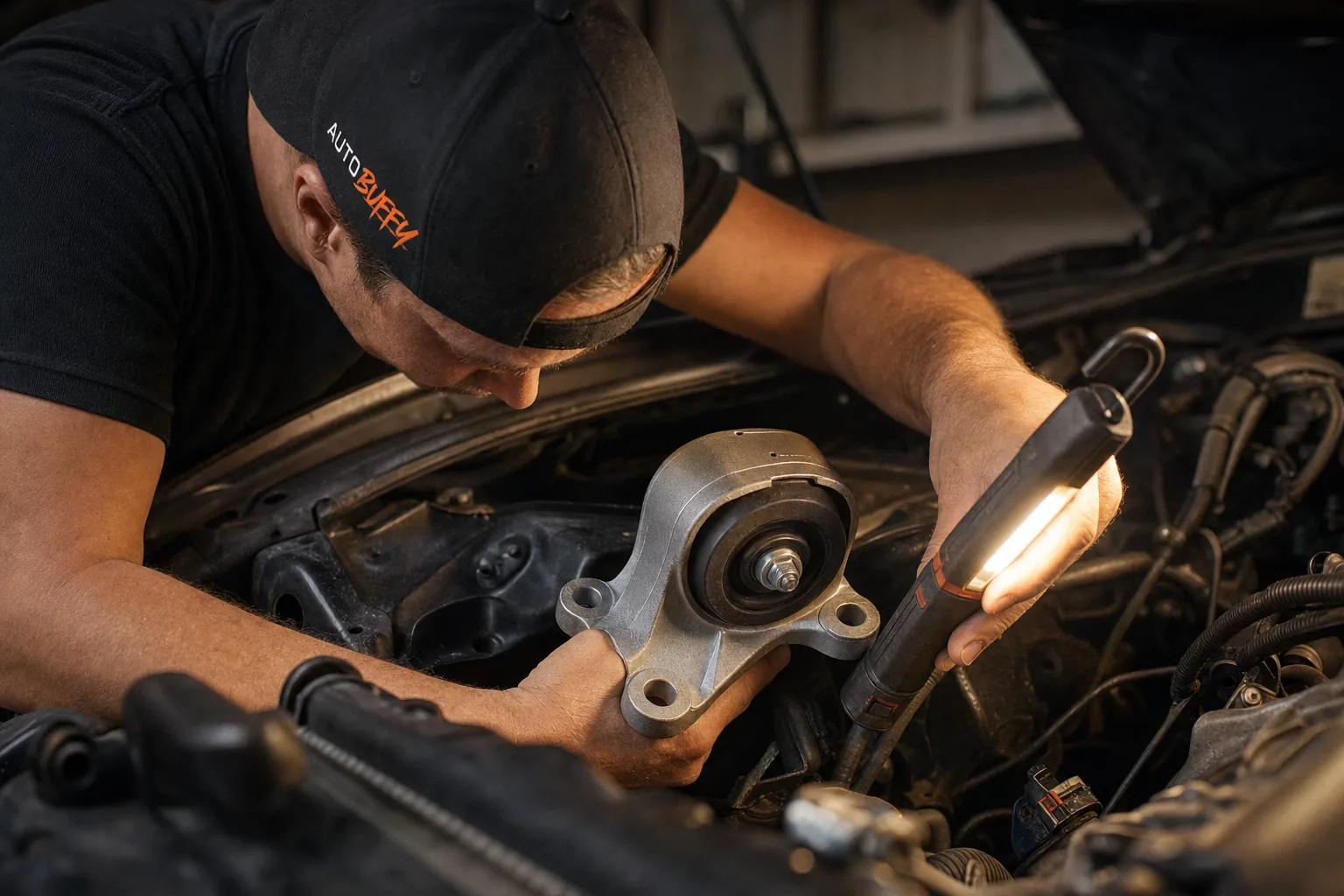
The fastest DIY check: put the car on jack stands (never just a floor jack alone), get under it safely, and look at the mount. You're looking for:
- Cracked, torn, or completely separated rubber
- Metal bracket sitting directly on metal with no rubber buffer visible
- Oil saturation — shiny, swollen rubber that's turned dark and soft
- The transmission resting lower than normal on one side
If the rubber is cracked but still somewhat intact, the mount is on its way out — it's not a "watch and wait" situation. A collapsed internal void you can't see from outside can fail the same way.
"A mount that looks 80% fine can be 0% functional if the internal bonding has let go. The outer shell can look intact while the rubber core has fully separated from the bracket." — common finding at shops doing mount replacements
Transmission Mount Replacement Cost Breakdown
Parts Cost
Transmission mount prices vary by vehicle complexity and application. For common front-wheel-drive platforms, single mounts typically run $150–$250. Luxury vehicles, larger trucks, and AWD configurations can push $250–$350+ for the mount alone. If your vehicle needs a kit (two or more mounts), kit pricing is usually more economical than buying individually.
Labor Cost
Most independent shops charge $75–$200 for transmission mount replacement on accessible configurations. A job where the mount is buried under subframe bracing or requires removing other components can run higher. Dealer labor rates add another 20–40% in many markets.
All-In Estimate
| Scenario | Estimated Total |
|---|---|
| DIY, single mount, accessible vehicle | $150–$300 (parts only) |
| Independent shop, single mount | $225–$450 |
| Independent shop, 2-mount kit | $300–$550 |
| Dealer, luxury/AWD vehicle | $400–$700+ |
These are real-world ranges. Your specific number depends on your vehicle, your region, and whether the shop finds collateral damage (torn CV boot, cracked exhaust flex pipe) during the job.
Why Westar for Transmission Mounts?
Westar has been making mounts — and *only* mounts — since 1946. That's not a marketing line; it's a manufacturing focus that matters. A company that specializes in isolation mounts develops application-specific rubber compounds rather than using a one-size-fits-many durometer across their catalog.
Their coverage spans a wide range of vehicles: Cadillac STS and SRX, Jeep Cherokee, Nissan automatics and manuals, Ford applications, Acura RDX, Land Rover LR2, Dodge Dart, and more. They also offer 2-piece and 4-piece transmission mount kits for vehicles where replacing just one mount doesn't make sense given the mileage and condition of the others.
If you're replacing a mount on a vehicle with 100,000+ miles, a kit is almost always the smarter call. The other mounts have lived through the same heat cycles and stress. You don't want to be back under the car in eight months.
Use the part finder below to confirm the right Westar mount for your specific year, make, model, and transmission type — and check today's pricing.
Can You Drive With a Bad Transmission Mount?
Technically, yes. Practically, no — not for long. Here's what happens progressively:
- Increased CV axle wear — the axle operates at an unintended angle
- Exhaust system damage — pipes and flex sections crack from contact
- Shift linkage misalignment — gear engagement gets worse
- Crossmember or subframe wear — metal-on-metal contact eventually damages the chassis
A $200 mount caught early beats a $1,200 repair bill for a torn axle or cracked exhaust manifold. That's not a scare tactic — it's just what the repair tickets show.
Find the right transmission mount for your vehicle
Guaranteed fit, ships free
FAQ / People Also Ask
The most common signs are a clunking or thudding noise when shifting gears, excessive vibration felt through the cabin or floor, the transmission visibly shifting or rocking under the hood, and rough or delayed gear engagement.

Comments
Loading comments...
Comments are moderated by the AutoBuffy team.