

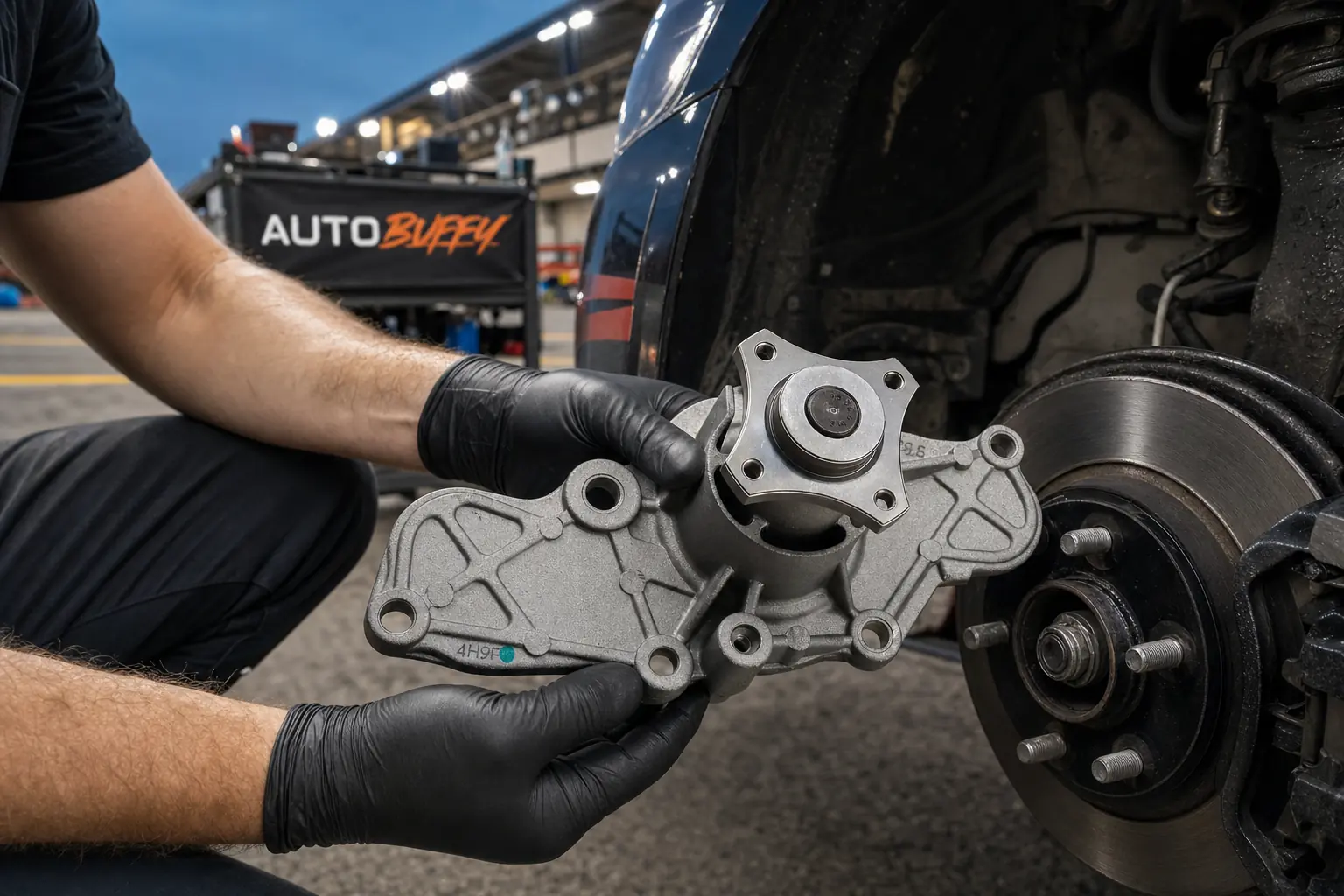
Bad Water Pump Symptoms: 6 Warning Signs Before It Fails
Catch a failing water pump early with these 6 warning signs—before a $150 part turns into a $3,000 engine repair.
The Short Answer
A bad water pump typically announces itself through six specific symptoms: a coolant leak at the pump, a whining or grinding bearing noise, engine overheating, visible steam under the hood, a wobbling pump pulley, and discoloration or deposits around the weep hole.
| Warning Sign | What You'll Notice | Urgency |
|---|---|---|
| Coolant leak near front of engine | Puddle or stain below the pump | High |
| Whining/grinding noise | RPM-linked sound from pump area | High |
| Engine overheating | Temp gauge climbing, warning light | Stop driving immediately |
| Steam under the hood | Vapor rising when engine is hot | Stop driving immediately |
| Wobbly or loose pulley | Visible wobble, rattling at idle | High |
| Weep hole discharge | Rust stains, dried coolant residue | Medium—monitor closely |
Catch any of these early and you're looking at a $250–$750 repair. Ignore them and a blown head gasket or cracked block can push that number past $3,000. Worth knowing the difference.
What Does a Water Pump Actually Do?
Your engine runs hot—combustion temperatures can exceed 2,000°F inside the cylinder. The water pump is what keeps that heat from destroying everything. It circulates coolant from the radiator through the engine block, absorbs heat, returns it to the radiator to cool down, and repeats the loop thousands of times an hour.
Most pumps are driven either by the timing belt or the serpentine belt. Timing-belt-driven pumps share replacement intervals with the belt (usually every 60,000–90,000 miles). Serpentine-driven pumps often last longer but are still wear items. When the pump's impeller corrodes, its bearing seizes, or its seal fails, the whole cooling loop breaks down—fast.
Sign 1: Coolant Leaking Near the Front of the Engine
This is often the first visible symptom. Coolant (usually green, orange, or pink depending on the type used) drips or puddles on the ground directly beneath the front of the engine. The leak might come from a failing gasket between the pump and the block, or from a cracked pump housing.
Don't confuse it with a radiator hose leak—trace it carefully. If the stain is directly under the pump housing or pulley area, start there.
Sign 2: Whining or Grinding Noise That Changes With RPM
A worn water pump bearing creates a high-pitched whine or a rough grinding sound. The key tell: the pitch and intensity change with engine speed. Rev the engine in park and listen. If the noise gets louder as RPM rises, the pump bearing is the prime suspect.
Some techs use a mechanic's stethoscope to pinpoint it. You can also press a long screwdriver handle against the pump housing (carefully) and hold the other end to your ear—worn bearings produce a distinct rumble compared to a healthy, quiet pump.
Sign 3: Engine Overheating
If the pump's impeller is severely corroded or the bearing has seized enough to slow rotation, coolant flow drops. The engine temperature climbs. You might see the gauge creep toward the red zone on the highway or sitting in traffic, or the warning light kicks on.
Here's the thing: overheating is not a symptom to wait out. Pull over, let the engine cool for at least 30 minutes, and don't restart without checking coolant level and the pump. A warped cylinder head can happen in under five minutes of running in the red.
Sign 4: Steam Rising From Under the Hood
Steam is what happens when coolant hits hot metal outside the cooling system. If the pump is leaking coolant onto the engine block or exhaust manifold, you'll see white vapor rising—sometimes with a sweet burning smell.
This is different from normal condensation on a cold morning. Steam under a warm hood means coolant is escaping somewhere it shouldn't be. Turn the engine off and investigate before driving further.
Sign 5: Wobbling or Loose Pump Pulley
Grab the water pump pulley with the engine off and cold. It should feel completely solid—no side-to-side movement, no up-and-down play. If it rocks even slightly, the bearing has failed enough to create slop in the shaft. That bearing will not recover; it'll seize or shed the belt if you keep driving.
In my experience, a pulley with even 2–3mm of wobble is a pump that's days away from completely letting go. Replace it before it makes that decision for you.
Sign 6: Weep Hole Discharge or Rust Staining
The weep hole is a small opening engineered into the pump body, usually near the bottom. Its job is to vent coolant when the internal shaft seal starts to break down—so you get a small warning leak instead of a sudden catastrophic one.
Look for rust-colored streaks, dried coolant deposits, or a mineral crust around that small hole. A small amount of dried residue can be normal on high-mileage pumps, but active dripping or significant staining means the seal is going. This is the symptom most drivers miss because it's not dramatic—until it is.
How to Confirm It's the Water Pump (Not Something Else)
Several cooling system parts can cause similar symptoms:
- Thermostat – causes overheating but no noise, no leak, no pulley wobble
- Radiator cap – bad cap causes coolant loss and mild overheating
- Hose failure – obvious leak but no bearing noise
- Head gasket – coolant in oil (milky, frothy dipstick), white exhaust smoke
If you have bearing noise plus a leak or weep hole residue, the pump is almost certainly the problem. Overheating alone needs more diagnosis before assuming the pump.
What Happens If You Ignore These Symptoms?
The water pump itself isn't the expensive part. It's what fails after the pump that costs real money:
- Sustained overheating warps the aluminum cylinder head (typical repair: $800–$1,500)
- A blown head gasket follows ($1,200–$2,500 at a shop)
- In worst cases, a cracked block means engine replacement ($2,500–$5,000+)
A water pump caught at the bearing-noise stage is a straightforward afternoon job. Caught at the cracked-block stage, you're shopping for a different car.
When to Replace the Water Pump Proactively
If your vehicle has a timing-belt-driven water pump and the belt is due for replacement, replace the pump at the same time—always. The labor to access both is nearly identical. Skipping the pump to save $80 in parts while spending $400 in labor makes no sense, and most experienced mechanics will tell you the same.
For serpentine-driven pumps, inspect the pulley and check for weep hole activity every time you do a coolant flush (typically every 30,000–50,000 miles or per your manufacturer's schedule).
Finding the Right Water Pump for Your Vehicle
Fit matters a lot here. Pump dimensions, impeller design, and gasket style vary widely by make, model, year, and engine. Using the part finder below ensures you get a pump that matches your engine's specs—wrong impeller diameter means reduced flow even if the pump physically bolts on.
Find the right water pump for your vehicle
Guaranteed fit, ships free
FAQ / People Also Ask
The six most common signs are coolant leaks near the front of the engine, a whining or grinding noise from the pump area, engine overheating, steam from under the hood, a wobbling or loose pump pulley, and coolant mixed with oil or a rust-colored discharge from the weep hole.


Comments
Loading comments...
Comments are moderated by the AutoBuffy team.