

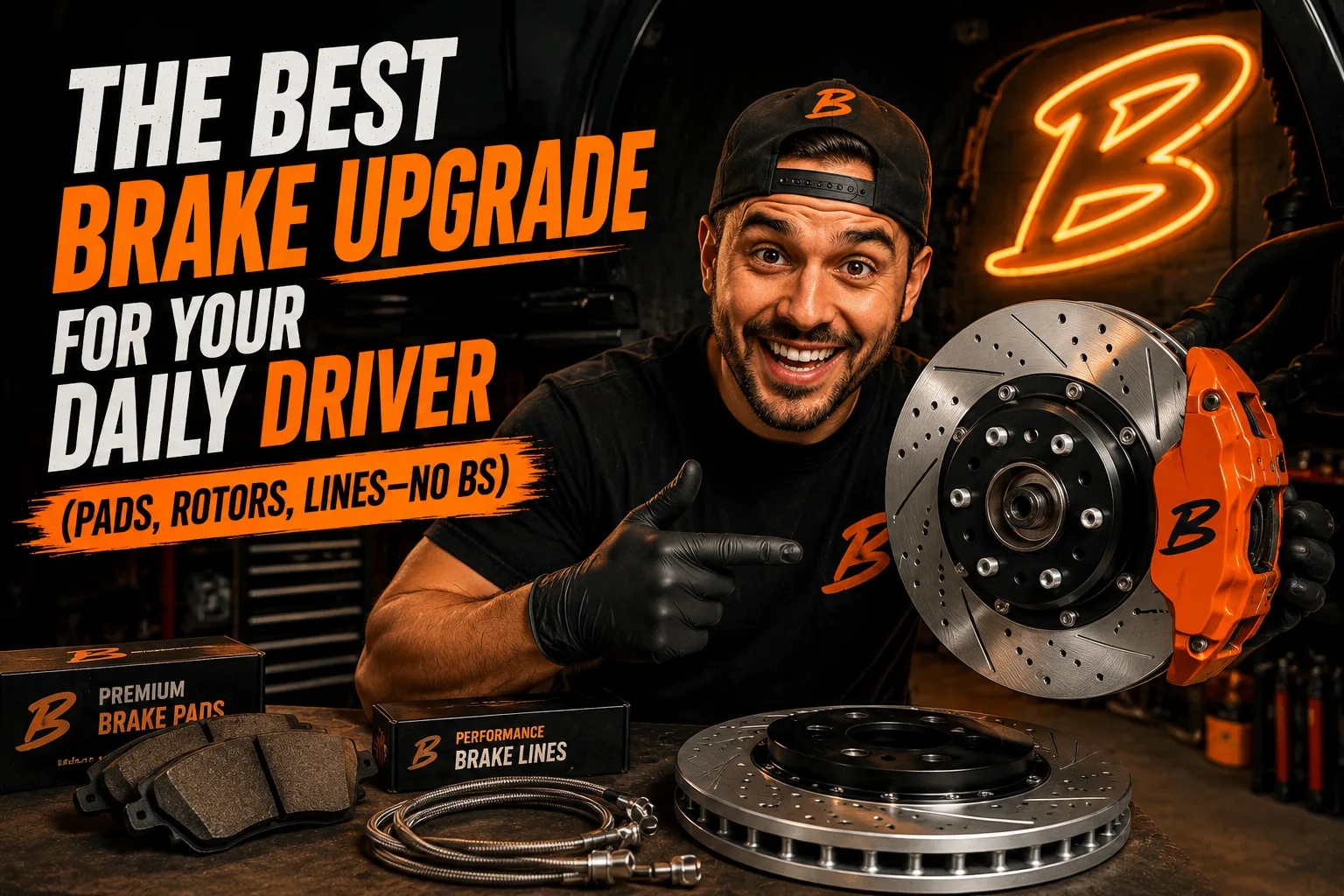
The Best Brake Upgrade for Your Daily Driver (Pads, Rotors, Lines — No BS)
Skip the big brake kit. For 95% of daily drivers, the smartest brake upgrade is quality ceramic pads, coated OE-spec smooth rotors, and fresh fluid. Honest tradeoffs, real costs, and when the fancy stuff actually makes sense.
The Short Answer
For roughly 95% of daily drivers, the best brake upgrade isn't a big brake kit. It isn't drilled rotors either, or anything with "race" stamped on the box. It's this:
- A quality set of ceramic brake pads from a reputable friction brand
- Coated, OE-spec smooth rotors (the coating fights rust, which is what actually kills rotors on a commuter)
- Fresh brake fluid, because the fluid in most cars on the road is years past its useful life
Do that and you get quieter braking. Way less dust on your wheels. A pedal that feels the same on Monday as it did the Monday before, and rotors that don't turn orange after the first rainy week. All for a fraction of what the "performance upgrade" path costs. Not the exciting answer, I know. It's the right one.
Everything below explains why, walks through the honest tradeoffs between pad and rotor types, and tells you when the fancy stuff actually earns its keep. Towing and mountain driving are real reasons. Commuting isn't. It also lays out what this should really cost you.
Ready to Upgrade?
Find Brakes That Fit Your Vehicle
Why the Big-Brake-Kit Obsession Is Wasted Money on a Daily
Walk into any car forum, ask about brakes, and within three replies somebody tells you to buy a big brake kit. Larger rotors, multi-piston calipers, the works. Here's what they leave out.
Your stopping distance is limited by your tires, not your calipers. Almost every modern car can already lock its brakes (or trigger ABS) from any legal speed. Once the brakes can overpower the tires, bigger brakes don't stop you any shorter. They just reach the tire's limit with a lighter shove on the pedal.
What big brakes actually buy you is heat capacity. The ability to make hard stop after hard stop from high speed without the pedal going long. That's huge on a race track. It's real on a loaded truck crawling down a mountain grade. It's worth nothing merging onto the highway and stopping at red lights, where your brakes spend most of their life barely above ambient temperature.
And the big-brake path costs you elsewhere on a daily. You often need bigger wheels just to clear the calipers. Pad and rotor replacements get pricier forever. Some kits fight the parking brake or throw ABS quirks. Aggressive track pads squeal and chew rotors when driven cold, which is exactly how a commuter treats them every single morning.
Put the money where it works: the parts that touch the road and the parts that wear. Good friction material. Good rotors. Good fluid, good tires. That's where the improvement you can actually feel is hiding.
Brake Pads: Ceramic vs Semi-Metallic vs Organic
The pad is the single biggest brake decision you'll make. The friction material sets your noise, your dust, your cold performance, and how fast your rotors wear. Three families, and each one is a trade. Not a good/better/best ladder.
Ceramic — the daily-driver default
Ceramic pads use ceramic fibers and non-ferrous fillers. For commuting, they're the right call for most people:
- Quiet. The best-behaved pad family for squeal and groan.
- Low dust, and lighter-colored dust that doesn't bake onto your wheels the way metallic dust does.
- Consistent feel across normal temperatures, with solid cold bite when the brakes are stone cold on a January morning. Which is exactly when a commuter needs them.
- Gentle on rotors in normal use.
The honest tradeoffs: ceramics generally don't shrug off extreme heat as well as semi-metallics, so they're not your pick for towing heavy or hammering down long mountain descents. They also tend to cost more than organics. Neither downside touches the school run or the office commute.
Semi-metallic — the work-truck and heavy-load pick
Semi-metallic pads blend steel fibers into the friction material. They're the workhorse when heat is the enemy:
- Better heat tolerance and fade resistance than ceramic or organic. This is why trucks that tow, and drivers who live on long downhill grades, should look here.
- Strong, firm bite once they're warmed up.
The tradeoffs are real, and you live with them every day. More noise, because metal on metal is just louder. Dark magnetic dust that clings to wheels. More rotor wear over the years. And a somewhat softer bite when the pads are dead cold versus a good ceramic. Don't tow, don't ride the brakes down grades? Then you're paying all that for heat capacity you'll never touch.
Organic (NAO) — the budget quiet option
Organic pads (non-asbestos organic) use materials like rubber, glass fiber, and resins. Cheapest of the bunch. Soft, quiet, easy on rotors. The catch is durability and heat. They wear faster than the other two families and fade first when you work them. For a light car driven gently on a tight budget, fine. For most people, spending the extra $20–40 on a quality ceramic set is money well spent. The pads last longer and behave better, so the real cost gap over time is smaller than the sticker suggests.
Bottom line on pads: ceramic for the commuter, semi-metallic for the tower and the mountain driver, organic only when the budget genuinely forces your hand.
Rotors: Smooth vs Drilled vs Slotted — the Honest Take
Rotor marketing is where the most money gets torched, so let's be blunt.
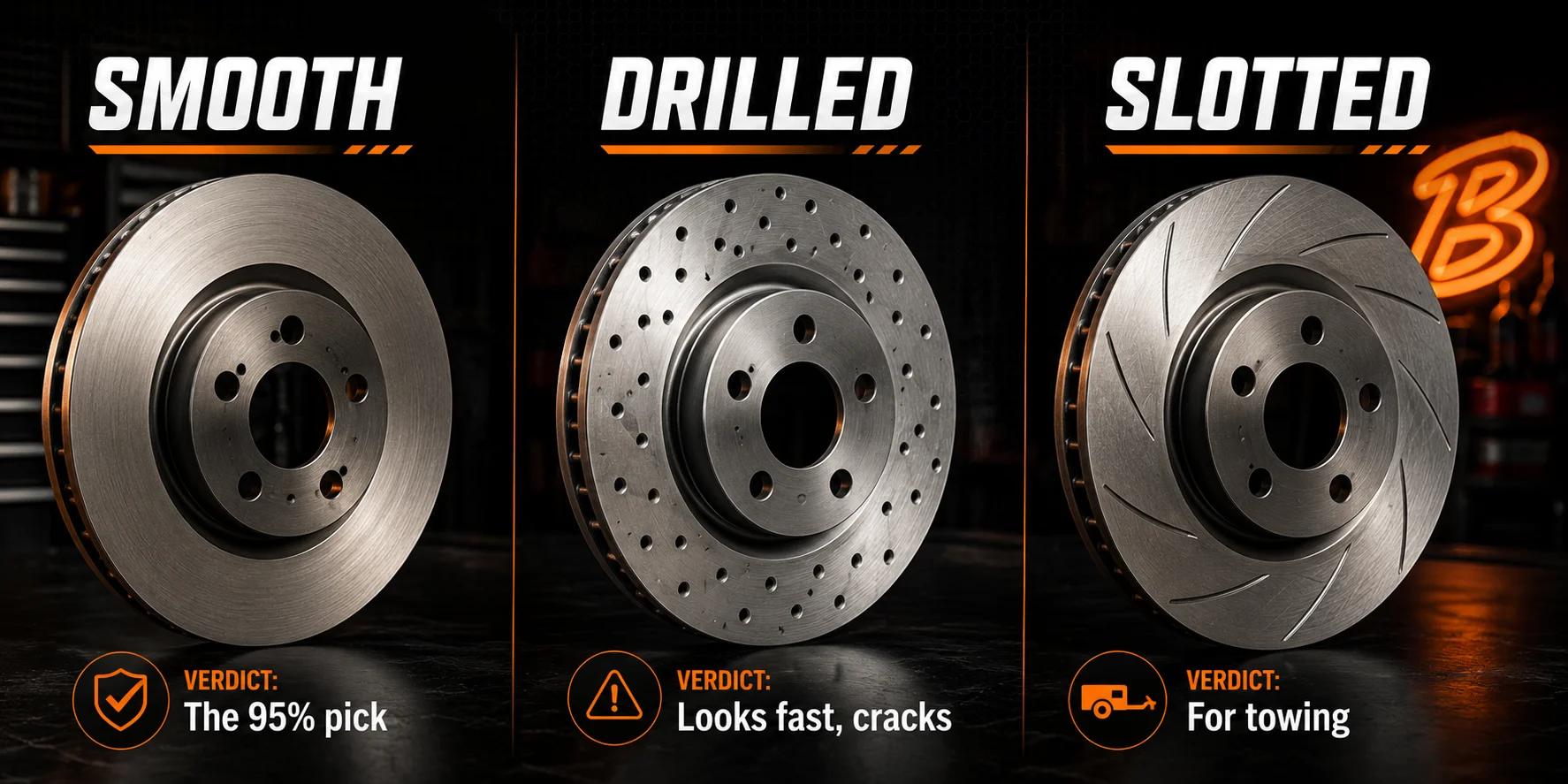
Drilled rotors look cool. That's mostly what they do.
Cross-drilled holes made sense decades ago, back when pad materials outgassed and needed somewhere to vent. Modern pads barely do that. On a modern street car, the holes mostly just cut rotor mass and create stress points. Drilled rotors are known for developing small cracks around those holes under repeated hard heat cycling. That's why you'll find plenty of serious track drivers who avoid them outright. If you love the look behind your wheels, that's a legit reason to buy something, and we won't pretend otherwise. Just buy them for the look. Not for a performance story that doesn't hold up.
Slotted rotors have a real job — for some people
The machined slots wipe the pad face, shed water, dust, and gas from the pad-rotor interface, and help keep bite consistent under heavy, repeated braking. Do you tow a trailer, haul heavy loads, or regularly descend long grades? Then slotted rotors (or drilled-and-slotted, where the slots do the actual work) are a defensible upgrade paired with semi-metallic pads. The tradeoffs: slightly faster pad wear, sometimes a faint rhythmic whir under braking, higher cost. For a commuter, they're harmless but pointless.
Smooth coated rotors are the right answer for most people
A plain, smooth-faced rotor has the most friction surface area, the most metal (so the most heat capacity for its size), no stress risers, and the lowest price. The one upgrade that genuinely matters on a daily is the coating. A full-body corrosion coating on the hat, edges, and cooling vanes. Here's the why: commuter rotors rarely die from heat. They die from rust. The car sits outside, it rains, the faces flash-rust overnight, and over the years the vanes and edges corrode, pads wear unevenly, and you get vibration and noise. A coated rotor keeps the non-swept surfaces protected so the thing stays flat, quiet, and clean-looking its whole life.
Bottom line on rotors: coated smooth for the 95%, slotted for towing and mountains, drilled for looks only, eyes wide open.
Brake Lines: When Stainless Braided Actually Matters (Mostly Never)
Stainless braided lines swap the rubber flex hoses at each corner for Teflon-lined, steel-jacketed hoses that expand less under pressure. The theoretical payoff is a slightly firmer pedal.
Honest version: on a healthy modern car, the factory rubber lines expand so little that most drivers can't feel the difference in blind testing. Braided lines are worth a look in exactly two cases:
- Your rubber lines are old. Flex hoses are a wear item. If yours are original on a car that's 10–15+ years old, cracked at the surface, or bulging under a hard pedal, replace them. And at that point braided lines cost little more than fresh rubber ones, so buy whichever you like.
- You genuinely drive the car hard. Track days, aggressive canyon runs, the kind of driving where the marginal pedal-feel gain and heat resistance actually count for something.
What matters far more than the hose material is the fluid inside it. Brake fluid drinks moisture over time, which drops its boiling point and corrodes the system from the inside out. If your fluid has never been changed and it's been more than a few years, a flush will do more for your pedal than any hose ever will. And it costs less.
Match the Brakes to How You Actually Drive
- Commuter / errands (most people): quality ceramic pads + coated smooth OE-spec rotors + fresh fluid. Stock lines are fine.
- Towing / heavy hauling: semi-metallic (towing-rated) pads + slotted or heavy-duty smooth rotors + fresh high-quality fluid; inspect hoses.
- Mountain roads, long descents: semi-metallic or heavy-duty ceramic pads + slotted or premium smooth rotors. Fresh fluid is critical here.
- Spirited weekend driving: performance ceramic or dual-purpose pads + premium smooth or slotted rotors + a fluid flush; braided lines defensible.
Notice what shows up on every single row: fresh fluid and quality friction. Notice what shows up on none of them. A big brake kit.
What a Brake Job Actually Costs
Numbers move around by vehicle, region, and parts choice, but here's the honest landscape for a typical sedan or crossover, per axle.
DIY: A quality ceramic pad set usually runs about $35–80. A pair of coated smooth rotors lands around $80–160. Add fluid and you're generally looking at roughly $120–250 per axle in parts for good-quality components. Often less if you grab pads and rotors together as a matched kit. And the job itself is one of the friendliest wrenching tasks there is: basic hand tools, a jack and stands, a caliper piston tool, an afternoon. First time I did pads and coated rotors on a Camry it took me about an hour a corner. Half that once I knew the layout.
At a shop: Labor plus parts markup usually puts a per-axle pad-and-rotor job somewhere in the $300–600 range, with dealers and premium vehicles running higher. That's not a rip-off. It's what professional labor costs. But it does mean the DIY route often saves $200–400 per axle, which is exactly the budget gap between mediocre parts and genuinely good ones.
One warning that cuts both ways. The $89 "brakes special" some chains advertise usually means the cheapest possible pads slapped onto your old rotors. And at the far end, a $1,500 drilled-rotor "stage kit" on a commuter is money that would transform the car if you spent it on tires instead.
The Brands We Carry, Positioned Honestly
We sell brakes, so take this for what it is. But we'd rather match you to the right part than upsell you into the wrong one.
- PowerStop. Best known for complete matched kits: pads, coated rotors, and hardware in one box, from daily-driver kits up to towing-oriented ones. Want one part number that covers the whole axle refresh? This is the convenient path.
- Brembo (OE-line replacement). Brembo supplies brakes to a lot of automakers, and its aftermarket OE-replacement rotors and pads bring that pedigree at normal-part prices. A solid "buy nice, not twice" pick for smooth rotors. You don't need their racing catalog for a commuter.
- Motorcraft and ACDelco. The OE-match play. If your Ford or GM braked exactly the way you liked when it was new, replacing like-for-like with the original supplier's parts is a completely legit strategy. Often the quietest one, too.
- Detroit Axle. The value pick. Complete pad-and-rotor kits at aggressive prices. The right call for a high-mileage commuter, a teen's first car, or any vehicle where the math says "good and affordable" beats "premium."
- Dynamic Friction. A friction-focused brand with a wide catalog spanning budget to premium lines. Handy when you want to pick your exact pad compound and rotor style à la carte instead of taking a pre-matched kit.
Every one of these makes a sensible daily-driver setup. What separates them is convenience, budget, and OE-match preference. Not some hidden performance hierarchy.
Replace vs Upgrade: Which One Do You Actually Need?
Quick gut check before you spend a dollar:
- Squealing, grinding, a pulsing pedal, or pads visibly thin? That's a replacement, and it's due now. Do it with the quality-ceramic-plus-coated-rotor combo and you've upgraded and repaired in one job.
- Brakes work fine but dust up your wheels and squeak now and then? That's a comfort upgrade. Worth doing at your next pad change, not tonight.
- Brakes fade when towing or on long descents? That's a genuine capability gap. Move up the table: semi-metallic pads, slotted or heavy-duty rotors, fresh fluid.
- Brakes feel vague or the pedal goes soft? Don't throw pads at that. Check the fluid first, then the hoses, then have the system inspected. A soft pedal is a hydraulic symptom, not a friction one.
The wrong move is fixing a hydraulic problem with friction parts, or "upgrading" healthy brakes out of boredom. Diagnose first. Spend second.
Bed In Your New Brakes (Don't Skip This)
New pads and rotors need a controlled break-in, called bedding in, that transfers an even layer of pad material onto the rotor face. Skip it and you get the number-one cause of "my new brakes vibrate and squeal" complaints on parts that were perfectly good.
Here's the general procedure, and always follow the specific instructions your pad manufacturer puts in the box:
- Find a safe, empty stretch of road.
- Do a series of moderate slowdowns from around 30–35 mph down to walking speed. Not full stops. Leave space between runs so the brakes can breathe.
- Follow with several firmer slowdowns from around 45–50 mph, again without coming to a dead stop or holding the pedal at rest.
- Then drive gently for several minutes with barely any braking so everything cools evenly.
- Don't sit with the pedal clamped on hot brakes at a light right after. That's how you imprint pad material unevenly and create the exact vibration you were trying to avoid.
Ten minutes of care here is the whole difference between brakes that feel great for years and a comeback job.
The Bottom Line
The best brake upgrade for a daily driver is boring, and that's the point. Quality ceramic pads, coated smooth rotors, fresh fluid. Save the slotted rotors for the trailer-hitch crowd. Save the semi-metallics for the mountain grades. Save the braided lines for aging hoses or track days. And save the big brake kit budget for tires, which will out-stop any caliper you can bolt on.
Complete Kits for Your Car
Check Fitment
FAQ / People Also Ask
No — for street driving, smooth rotors are the better choice. Drilling removes metal and creates stress points that can develop cracks under repeated hard heat cycles. Modern pads do not need the outgassing relief that made drilling useful decades ago. Drilled rotors are a cosmetic choice; smooth coated rotors are the functional one.


Comments
Loading comments...
Comments are moderated by the AutoBuffy team.