

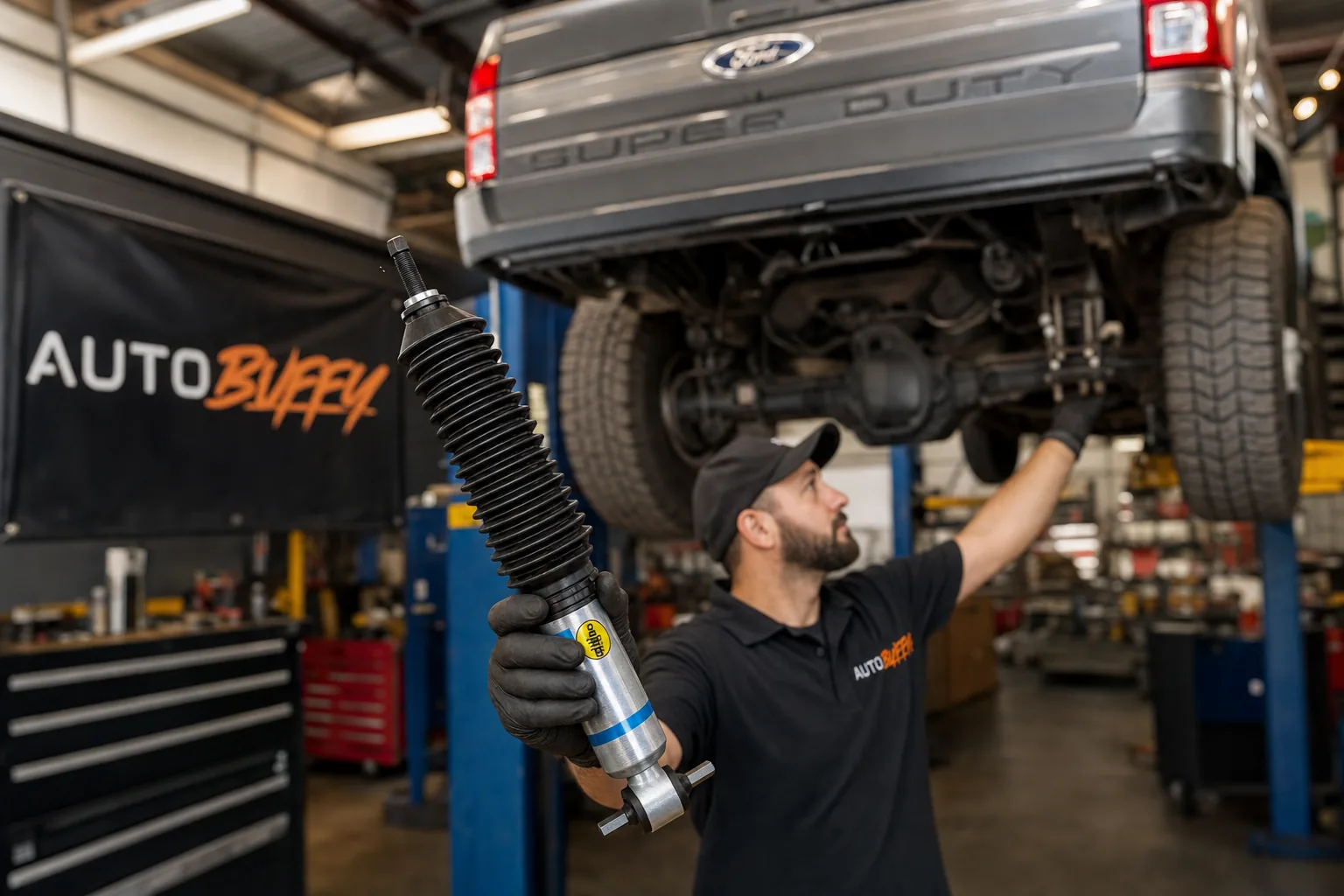
Best Shocks for the Ford F-250 Super Duty: What Actually Works
Hunting for the best shocks for your F-250? We break down what to look for, top brands, and how to avoid a rough, wallowing ride—with or without a load.
The Short Answer
For most F-250 Super Duty owners, Bilstein monotube shocks deliver the best balance of towing stability, ride quality, and longevity — but the right shock for your truck depends on how you actually use it.
| Use Case | Recommended Shock Type | Typical Cost (Set of 4) | Key Benefit |
|---|---|---|---|
| Daily driver, light hauling | OE-replacement twin-tube | $150–$280 | Smooth, quiet, budget-friendly |
| Regular towing / heavy hauling | Heavy-duty monotube | $280–$500 | Heat resistance, reduced sway |
| Lifted F-250 (2–4 in.) | Lifted-application shock | $300–$600 | Correct travel for your ride height |
| Off-road / trail use | Remote-reservoir or piggyback | $500–$900+ | Maximum heat dissipation, long travel |
Why the F-250 Chews Through Shocks Faster Than a Half-Ton
The Super Duty is a different animal than a 1500-series truck. It's heavier, rated for serious payloads, and the suspension is tuned to handle work — not just commuting. That engineering tradeoff means the factory shocks take a beating. A loaded F-250 bouncing down a job-site access road puts more stress on a shock absorber in one afternoon than some sedans see in a year.
RepairPal data shows shock absorber replacement is one of the more common suspension services on trucks in this class. That's not a knock on Ford's engineering — it's just the reality of working trucks. The good news: aftermarket shocks have never been better, and the right set genuinely transforms how this truck feels whether it's empty or loaded to the gills.
What to Look For: The Specs That Actually Matter
Piston Diameter
Bigger is better here. Factory F-250 shocks typically run a 36mm–46mm piston. Performance replacements often step up to 46mm or even 60mm. A larger piston displaces more fluid per stroke, which translates to more consistent damping force — especially when the shock heats up under sustained use.
Monotube vs. Twin-Tube
Twin-tube shocks are the most common design and work perfectly well for trucks that don't regularly see heavy loads. They're quieter and often more comfortable on light surfaces. Monotube shocks run cooler under hard use because the gas charge and oil are separated by a floating piston — there's no aeration (the foaming that kills damping feel when a shock gets hot). If you tow anything over 5,000 lbs with regularity, the monotube design earns its price premium.
Valving for Loaded vs. Unloaded
One thing F-250 owners often overlook: a shock valved for a loaded truck can feel stiff and jarring when the bed is empty. Some manufacturers offer position-sensitive or load-adaptive valving that adjusts damping based on suspension travel. It's worth paying attention to whether a shock is tuned for work use, daily driving, or both.
Ride Height Compatibility
This matters a lot on Super Dutys because leveling kits are enormously popular. A stock-valved, stock-length shock on a 2.5-inch leveled truck won't have correct geometry or travel. Always match the shock to your actual ride height, not just your year and trim.
The Brands Worth Knowing for the F-250
Bilstein has earned its reputation on heavy trucks honestly. Their 5100 series covers stock-height and mild-lift F-250 applications, while the 6112/6112 series handles more aggressive builds. The monotube design handles heat exceptionally well — in independent testing cited by truck enthusiast communities, Bilstein units consistently show less fade after repeated hard compressions than twin-tube competitors. My honest take: if you tow regularly and want to buy shocks once, Bilstein is worth the extra $80–$120 over a basic replacement set.
Monroe offers the Reflex and OESpectrum lines for the F-250, both designed as direct OE-match replacements. They're a solid, proven choice if you're replacing worn shocks on a truck that mostly sees highway miles and light loads. Monroe's product pages detail application-specific valving, and their fit coverage for Super Duty generations is extensive.
KYB produces the Gas-a-Just (monotube) and Excel-G lines, both of which cover a wide range of F-250 model years. KYB has a strong reputation in the OE supply chain — they supply shock absorbers to several manufacturers directly — so their replacement parts tend to be very close to factory spec. Good choice if OE-like feel is your priority.
Rancho makes a compelling case for off-road and mixed-use F-250s. Their RS5000X and RS9000XL series are popular with owners who split time between paved roads and trail or job-site terrain. The RS9000XL offers nine externally adjustable damping settings, which lets you dial in softness for an empty highway run and firmness when you're pulling a trailer. That adjustability has real value on a truck that wears many hats.
How Much Should You Expect to Spend?
Shock costs scale with design complexity and intended use. Here's an honest breakdown:
- Budget OE replacements (twin-tube, daily use): $35–$70 per shock, or $140–$280 for a set of four
- Mid-range heavy-duty (monotube, towing-focused): $70–$125 per shock, $280–$500 for a set
- Performance / adjustable (Rancho RS9000XL, Bilstein 6112): $100–$225 per shock, $400–$900 for a set
- Remote-reservoir / off-road (Fox, King, etc.): $150–$400+ per shock
Labor at a shop typically runs $150–$350 total for all four. It's one of the more DIY-friendly suspension jobs on the F-250 — especially the rears, which are usually two bolts each and come out in 20 minutes.
DIY or Shop? What to Know Before You Start
Replacing shocks on a stock-height F-250 is genuinely beginner-accessible. You'll need:
- Ratchet set (metric and standard)
- Torque wrench (shock mounting bolts should be torqued to spec, not just "tight")
- Jack and jackstands rated for a Super Duty's weight
- Penetrating oil — the factory hardware on older trucks can be stubborn
The fronts are slightly more involved, but on most F-250 generations the shock and spring are separate components (unlike a coilover), so you don't need a spring compressor just to swap shocks. Check a model-year-specific repair guide at AutoZone's repair help section before you start.
One thing worth emphasizing: torque matters. Under-tightened shock mount hardware on a heavy truck can back out under load, and that's a safety issue. Use a torque wrench and check your service manual or a trusted repair database for the spec.
When to Replace: Don't Wait for the Bounce Test to Fail
The old "push down on the bumper and count bounces" test isn't reliable on a truck this heavy. By the time an F-250 fails that test badly, the shocks are very far gone. Watch for these earlier warning signs instead:
- Trailer sway that feels worse than it used to
- Front end rising or squatting more noticeably under load or braking
- Cupped, scalloped wear on the tires (a classic worn-shock symptom)
- Visible oil streaking down the shock body
- Loose, vague steering feel over rough pavement
If you're seeing two or more of these, it's time. Worn shocks on a truck rated to haul and tow heavy loads aren't just uncomfortable — they extend stopping distances and reduce control in emergency situations, something NHTSA consistently flags as a real-world safety factor in suspension-related incidents.
Sources
- RepairPal — Shock Absorber Replacement Cost
- Monroe — F-250 Shock Absorber Products
- Ford-Trucks.com — Suspension & Shock Discussions
- AutoZone DIY — How to Replace Shocks & Struts
- NHTSA — Vehicle Safety & Suspension
Find the right part for your vehicle
Guaranteed fit, ships free
FAQ / People Also Ask
Most mechanics recommend inspecting shocks every 50,000 miles and replacing them by 80,000–100,000 miles on a work truck. If you tow or haul frequently, plan on the shorter end of that range.
Comments
Loading comments...
Comments are moderated by the AutoBuffy team.