

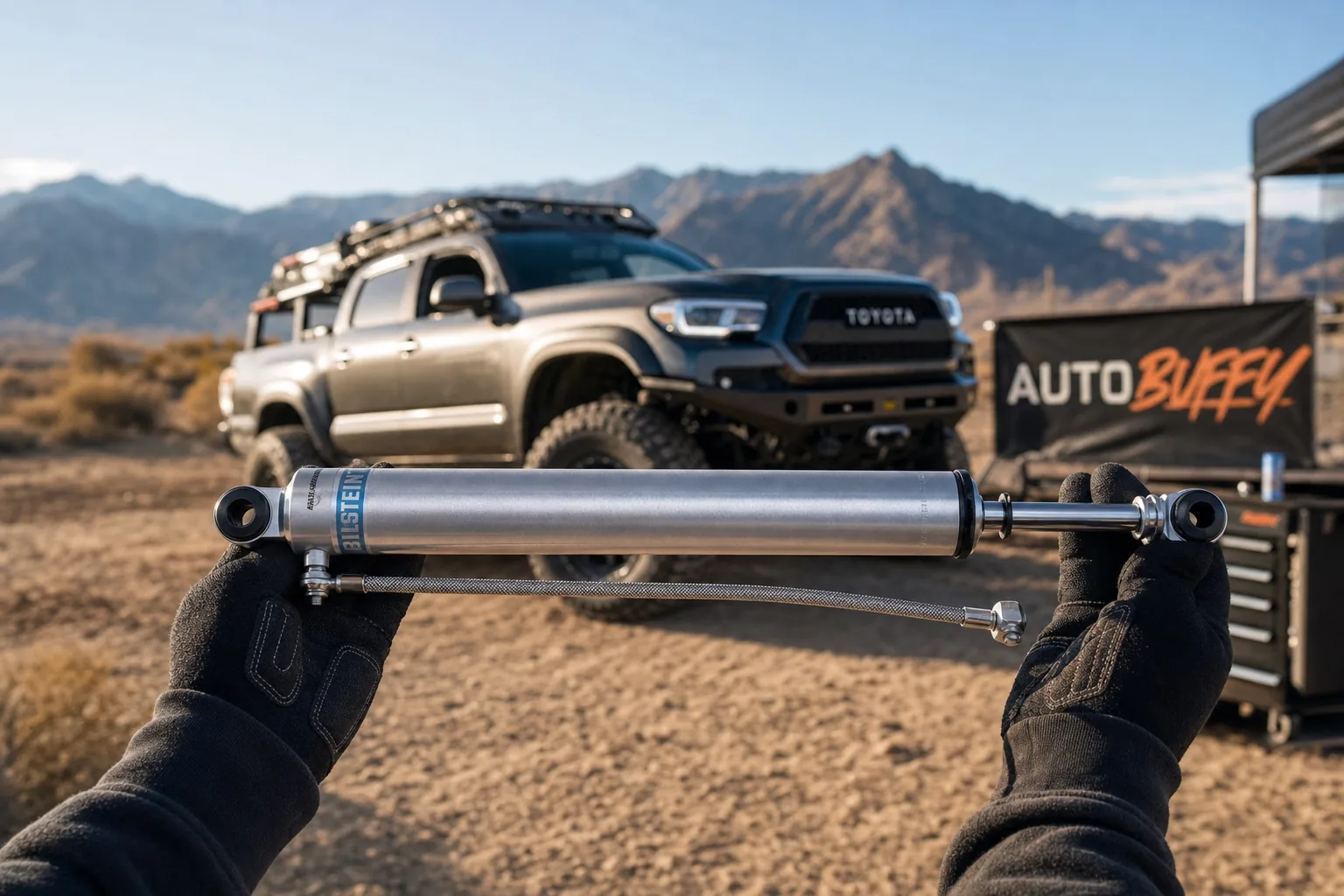
Best Shocks for the Toyota Tacoma: What Actually Works On and Off Road
From daily commutes to weekend trails, the right shock absorbers transform your Tacoma's ride. Here's what to buy and why — backed by real specs.
The Short Answer
The best shocks for your Toyota Tacoma depend on how you use the truck — quality OE-replacement twin-tubes handle daily driving just fine, but if you wheel it regularly or run a lift, a monotube upgrade from Bilstein, Fox, or Rancho will make a meaningful, measurable difference.
| Use Case | Recommended Type | Typical Cost (Set of 4) | Key Benefit |
|---|---|---|---|
| Daily driver, stock height | Twin-tube OE replacement | $150–$280 | Quiet, affordable, OE feel |
| Mixed street/trail, stock–2" lift | Monotube (e.g., Bilstein 5100) | $280–$450 | Heat resistance, better control |
| Serious off-road, 2–3" lift | Extended-travel monotube | $400–$650 | Wheel articulation, fade resistance |
| Adjustable/performance | Remote-reservoir or adjustable | $500–$950+ | Tunable damping, max capability |
Why Tacoma Shocks Wear Faster Than You'd Expect
The Tacoma's body-on-frame construction and relatively long suspension travel make it more capable than most pickups its size — but that same capability means the shocks work harder. Owners who mix highway miles with weekend dirt roads put their shocks through constant heat cycling. Stock twin-tube units start showing fade between 50,000 and 80,000 miles on mixed-use trucks, sometimes sooner on lifted examples where the shock is already operating closer to full extension.
There's another thing most buyers overlook: if your Tacoma has been lifted and you didn't replace the shocks with length-matched units, the factory shocks are binding or overextending every single mile. That accelerates wear and hurts ride quality in both directions.
Understanding the Two Main Shock Types for Tacomas
Twin-Tube Shocks
Twin-tube shocks have an inner working tube surrounded by an outer reserve tube. They're the factory standard on most Tacoma trims and they do the job well for normal driving. They're lighter on the wallet, tend to be quieter on pavement, and are straightforward to install.
The limitation shows up under repeated, aggressive hits — the kind you get on a rocky trail or a washboard dirt road. The fluid can aerate (mix with air), causing temporary fade. For a truck that lives on pavement 90% of the time, this rarely matters. For off-road use, it does.
Monotube Shocks
A monotube shock packs everything into a single tube with a floating piston separating oil from pressurized gas. The oil doesn't aerate because gas and oil never share the same chamber. This keeps damping consistent lap after lap on a trail.
Monotubes run cooler, respond faster to small road inputs, and generally last longer under abuse. The trade-off is a slightly firmer initial feel on smooth roads — not harsh, but noticeable if you're coming from stock. For any Tacoma owner who wheels more than a few times a year, the upgrade is worth it. According to industry testing data cited by enthusiast publications, monotube shocks can reduce fade by up to 50% compared to twin-tubes under sustained off-road use.
Top Shock Options for the Toyota Tacoma
For Daily Driving and Light Trails: KYB Excel-G / Gas-a-Just
KYB makes two lines worth considering for the Tacoma. The Excel-G is a quality twin-tube that matches or exceeds OE specs — a smart choice if you're replacing worn shocks and want the stock feel back without overpaying. The Gas-a-Just is KYB's monotube offering, adding more controlled damping for a modest price jump. Both are well-documented for Tacoma fitment and widely available.
For Mixed Use and Mild Lifts: Bilstein 5100 Series
Bilstein's 5100 is probably the most-discussed shock in Tacoma communities, and the numbers back the reputation up. It's a monotube shock available in multiple ride-height settings — you can actually adjust front preload to dial in 0–2.5 inches of lift depending on your setup. Bilstein backs these with a lifetime warranty for the original purchaser.
My honest opinion: if you're running a mild lift and want a single shock that handles both highway and trail duty without making you choose, the 5100 series is the answer for the majority of Tacoma owners. It's not the flashiest option, but it's consistently the one owners replace with... another set of 5100s.
For Serious Off-Road: Fox 2.0 Performance Series
Fox shocks sit at the higher end of the price range for good reason. The 2.0 Performance Series uses a digressive piston that softens compliance over small bumps while staying controlled during big hits. Fox also makes extended-travel versions for lifted Tacomas in the 2–3 inch range.
The TRD Pro Tacoma comes with FOX-branded shocks from the factory, which tells you something about where Fox sits in the off-road credibility hierarchy.
For Budget-Conscious Owners: Monroe Reflex / OESpectrum
Monroe positions its OESpectrum and Reflex lines as OE-quality replacements. They're not performance upgrades — they're solid, straightforward replacements for drivers who want reliability without spending upgrade money. If your Tacoma is a work truck that stays on pavement, this tier makes complete financial sense.
For Maximum Adjustability: Rancho RS9000XL
Rancho's RS9000XL is a 9-position adjustable monotube shock. You turn a dial on the shock body and change damping from a soft, comfortable setting to a firm, controlled one. It's a genuine advantage if you split time between freeway cruising with passengers and aggressive trail runs — you can match the shock to the situation rather than finding a compromise.
What Lift Height Changes About Your Shock Choice
This is where a lot of Tacoma owners get tripped up. Stock shocks are engineered for a specific extended and compressed length. Add a lift kit without upgrading shocks and you're asking the factory unit to operate outside its intended range. At best, you lose damping quality. At worst, you blow a seal.
| Lift Height | Recommended Action |
|---|---|
| Stock (0") | OE-replacement twin-tube or monotube |
| 1–2" | Bilstein 5100 (adjustable) or equivalent extended monotube |
| 2–3" | Brand-specific extended-travel shocks (Fox, Rancho, Bilstein) |
| 3"+ | Long-travel or remote-reservoir shocks; verify with your lift kit manufacturer |
Always cross-reference the shock's intended lift range with your actual measured lift before ordering.
Installation: What to Expect
Replacing Tacoma shocks is a moderate DIY job. Front shocks involve removing the upper strut mount bolt and lower control arm bolt — a floor jack, spring compressor (if needed), and basic hand tools handle it. Rear shocks are simpler: two bolts, and the old unit slides out.
Labor at a shop typically runs $150–$350 for all four corners, depending on your region and whether any hardware is seized. Penetrating oil on the mounting hardware the day before makes a real difference on older trucks with rust.
A straight shock-for-shock swap doesn't require an alignment. If you're changing ride height at the same time, budget for an alignment check — it's cheap insurance at $80–$120.
Sources
- RepairPal — Shock Absorber Replacement Cost
- KYB Official Site
- Bilstein Official Site
- Fox Shocks Official Site
- Monroe Official Site
- Rancho Shocks Official Site
- MotorTrend — Suspension Tech
Find the right part for your vehicle
Guaranteed fit, ships free
FAQ / People Also Ask
Most shocks last 50,000–100,000 miles on a Tacoma driven on normal roads. If you do frequent off-road runs, expect to inspect them closer to the 40,000–60,000-mile mark. Signs of wear include excessive body roll, nose dive under braking, and uneven tire wear.


Comments
Loading comments...
Comments are moderated by the AutoBuffy team.