

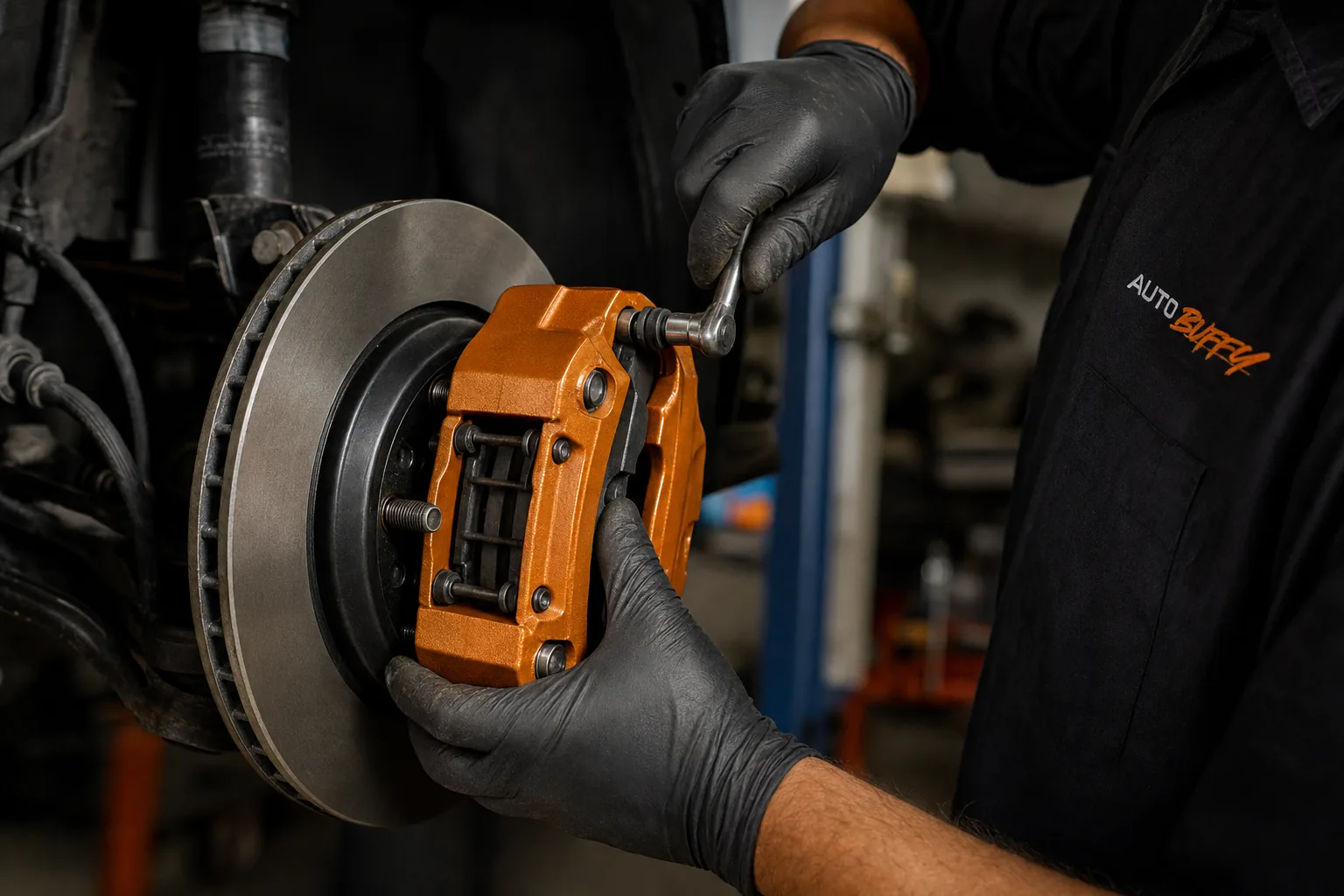
Brake Caliper Replacement Cost (2026): What Shops Charge vs. DIY
Brake caliper replacement typically runs $150–$800 per caliper at a shop. Here's what drives the price—and how to pay less.
The Short Answer
Brake caliper replacement costs $150–$800 per caliper at a shop (parts and labor), with most everyday vehicles landing between $200 and $450 for a single corner—and that number climbs fast if you also need new rotors and pads.
| Scenario | Typical Cost Range |
|---|---|
| Single caliper — economy/compact car (shop) | $150 – $300 |
| Single caliper — midsize car or truck (shop) | $250 – $500 |
| Single caliper — luxury or performance vehicle (shop) | $400 – $800+ |
| Axle pair (both front or both rear, shop) | $400 – $1,200 |
| DIY parts only (remanufactured, one caliper) | $40 – $150 |
| DIY parts only (loaded caliper, one corner) | $80 – $300 |
| Add brake pads + rotors same visit (labor savings) | Bundle saves $50–$150 |
What Actually Drives the Price Up or Down
Not all brake calipers are created equal, and the cost swing between a 2012 Honda Civic and a 2022 BMW 5 Series is enormous. Here's what's eating your budget.
Parts Tier: Remanufactured vs. New OE-Quality vs. OEM Dealer
Remanufactured calipers are the most common choice in the independent shop and DIY world. A core caliper is disassembled, cleaned, fitted with new seals, pistons, and bleeder screws, then pressure-tested. For most daily drivers, they work perfectly well and typically cost $40–$150 each.
New aftermarket calipers (OE-quality replacements) skip the reman process and are built fresh. They tend to run $70–$200 per unit for common applications and are worth considering when your original caliper failed unusually early.
OEM dealer parts sit at the top of the price ladder—sometimes $200–$600+ for a single caliper on European or luxury brands. You're paying for exact-spec fit and the dealer's margin. For most vehicles, it isn't necessary.
Labor Hours and Shop Rate
Labor is usually 1–2 hours per caliper at shop rates that RepairPal reports range from roughly $80–$150/hr depending on your region and shop type. Dealer labor rates can run $150–$200/hr or higher. That spread alone can add $100–$200 to your bill for the exact same job.
The good news: if you're already paying for pad and rotor work, the caliper swap adds relatively little incremental labor since the wheel is already off and the system's already open. Bundling jobs is one of the few times the shop is genuinely on your side.
Vehicle Make, Model, and Position (Front vs. Rear)
Front calipers handle roughly 70% of a vehicle's braking force, so they're physically larger and often pricier than rears. That said, rear calipers on many modern vehicles have an integrated parking brake mechanism—either a screw-drive piston or a small drum inside the rotor—which makes them more complex to replace and rebuild, sometimes making rear calipers cost *more* than fronts on the same car.
European brands (BMW, Mercedes-Benz, Audi, Volvo) and performance-oriented vehicles with multi-piston calipers or proprietary designs can see part costs alone exceed $400 per corner.
Shop vs. DIY: Honest Breakdown
If you're mechanically comfortable and own a basic tool set, a caliper replacement is genuinely a manageable Saturday job. Here's what the comparison looks like in practice.
Shop route:
- You pay parts markup (shops typically mark up parts 20–50%)
- You pay labor at shop rates
- You get a warranty on their work, usually 12 months/12,000 miles at minimum
- No bleeding skill required from you
DIY route:
- You pay retail parts cost (no markup)
- You need a jack, jack stands, a brake caliper wind-back tool (~$20–$40 rental or purchase), and brake fluid
- Rear calipers often require a special piston reset tool—a regular C-clamp won't cut it
- You must bleed the brakes properly or the pedal will feel spongy and unsafe
- My honest take: if you've never bled brakes before, watch two or three full videos *before* you start, not during. That single step is where most first-timers go wrong, and it's the difference between safe brakes and a very bad day.
Should You Replace One Caliper or Both?
This is one of the most common questions—and the answer most brake specialists land on is replace in axle pairs. Braking is a balanced system. A new caliper on one side and a worn, sticky caliper on the other creates unequal clamping force, which causes the vehicle to pull under braking. It's also extra wear on your fresh pads.
The part cost difference between replacing one caliper and replacing the pair is usually $40–$150 in parts, but you've already paid for the labor on one side. Adding the second caliper at the same visit costs maybe 30–45 extra minutes of labor. It's almost always the smarter long-term decision.
What Else Might Need Replacing at the Same Time?
Calipers rarely fail in a vacuum. When a shop pulls the caliper, they'll almost certainly flag one or more of these:
- Brake pads — A stuck or seized caliper accelerates pad wear. Expect $80–$200 for a quality set of pads.
- Brake rotors — Heat from a dragging caliper can warp or score rotors. Rotors run $30–$120 each for most vehicles; replacement is often recommended alongside a caliper.
- Brake hose — The flexible rubber hose connecting the hard brake line to the caliper can collapse internally, causing a "one-way valve" effect that keeps the caliper clamped. These run $20–$60 each and are worth inspecting any time the caliper comes off.
- Brake fluid flush — If fluid is contaminated or hasn't been changed in 2+ years, it's smart to flush it while the system is already open. Typically $80–$130 at a shop.
How to Save Money Without Cutting Corners
- Get at least two estimates. Labor rates and parts markups vary significantly between dealers, chain shops (Midas, Firestone, Meineke), and independent mechanics. RepairPal's estimator gives a solid benchmark for your area.
- Buy your own parts. Some shops will install customer-supplied parts, though they may not warranty the parts themselves. Ask upfront.
- Choose a loaded caliper for DIY. A loaded caliper (pads and hardware pre-installed) costs a bit more but removes multiple steps and ensures compatibility between the caliper and pads.
- Bundle the work. If your pads and rotors are due anyway, getting everything done in one visit saves on labor compared to separate appointments.
- Don't wait. A seized caliper that's caught early is a $300 fix. One that's been dragging for months can warp rotors, destroy pads, and generate enough heat to damage wheel bearings—turning a $300 repair into a $900+ bill.
Is It Safe to Keep Driving?
Short answer: no. A leaking caliper loses hydraulic pressure, which means reduced or unpredictable stopping power. A stuck (seized) caliper causes constant brake drag, overheating, and eventual brake fade—the terrifying experience of pressing the pedal and getting very little response. If you notice pulling, grinding, a burning smell near a wheel after driving, or visible fluid leakage near a wheel, stop driving and have the vehicle inspected.
According to NHTSA, brake system failures are among the leading mechanical contributors to crashes. This isn't a "fix it next month" situation.
Sources
Find the right part for your vehicle
Guaranteed fit, ships free
FAQ / People Also Ask
Expect to pay $150–$800 per caliper at a shop, parts and labor combined. Economy cars sit closer to $150–$300; luxury and performance vehicles can push past $600 per corner.

Comments
Loading comments...
Comments are moderated by the AutoBuffy team.