

Why Is My Car Overheating? The 8 Real Causes, Ranked
From a clogged radiator to a blown head gasket, here are the 8 real reasons your engine runs hot—ranked by how often they actually happen.
The Short Answer
A car overheats because something has interrupted the coolant system's ability to move heat away from the engine—and in the vast majority of cases, that something is a low coolant level, a failed thermostat, or a clogged or leaking radiator.
| Cause | How Common | Typical Repair Cost |
|---|---|---|
| Low / leaking coolant | Very common | $50–$400 depending on source |
| Faulty thermostat | Very common | $75–$200 |
| Clogged or damaged radiator | Common | $250–$650 |
| Bad radiator cap | Common | $10–$25 |
| Failing water pump | Moderate | $200–$500 |
| Cooling fan failure | Moderate | $150–$450 |
| Old or contaminated coolant | Moderate | $80–$150 flush |
| Blown head gasket | Less common (but serious) | $1,500–$3,000+ |
Why Ranking the Causes Matters
When your temperature gauge climbs into dangerous territory, the instinct is to panic. Resist it. Most overheating problems start with something cheap and fixable. The ranking below is built on real-world shop frequency—tackle causes 1 through 3 first before you assume the worst.
Cause #1: Low or Leaking Coolant
This is the one. A significant portion of overheating calls at repair shops trace back to nothing more exotic than coolant that's low or leaking out. Check your overflow reservoir when the engine is cold. If it's at or below the minimum line, you've got a starting point.
Leaks hide in sneaky places—a pinhole in a hose, a weeping water pump seal, a cracked reservoir. Sometimes you won't see a puddle on the ground because coolant evaporates quickly on a hot engine. Look for dried white or green residue around hose clamps and the radiator neck.
Cause #2: Faulty Thermostat
The thermostat is a spring-loaded valve that stays closed until coolant reaches operating temperature, then opens to let it flow through the radiator. When it fails stuck-closed, coolant never circulates to shed heat. Your temperature gauge climbs, the heater might actually blow hot (because coolant is hot but going nowhere), and you're heading for trouble fast.
Thermostats are inexpensive parts. If your car is overheating and you haven't replaced the thermostat in 60,000+ miles, do it now. It's cheap insurance even if the thermostat turns out to be fine.
Cause #3: Clogged or Damaged Radiator
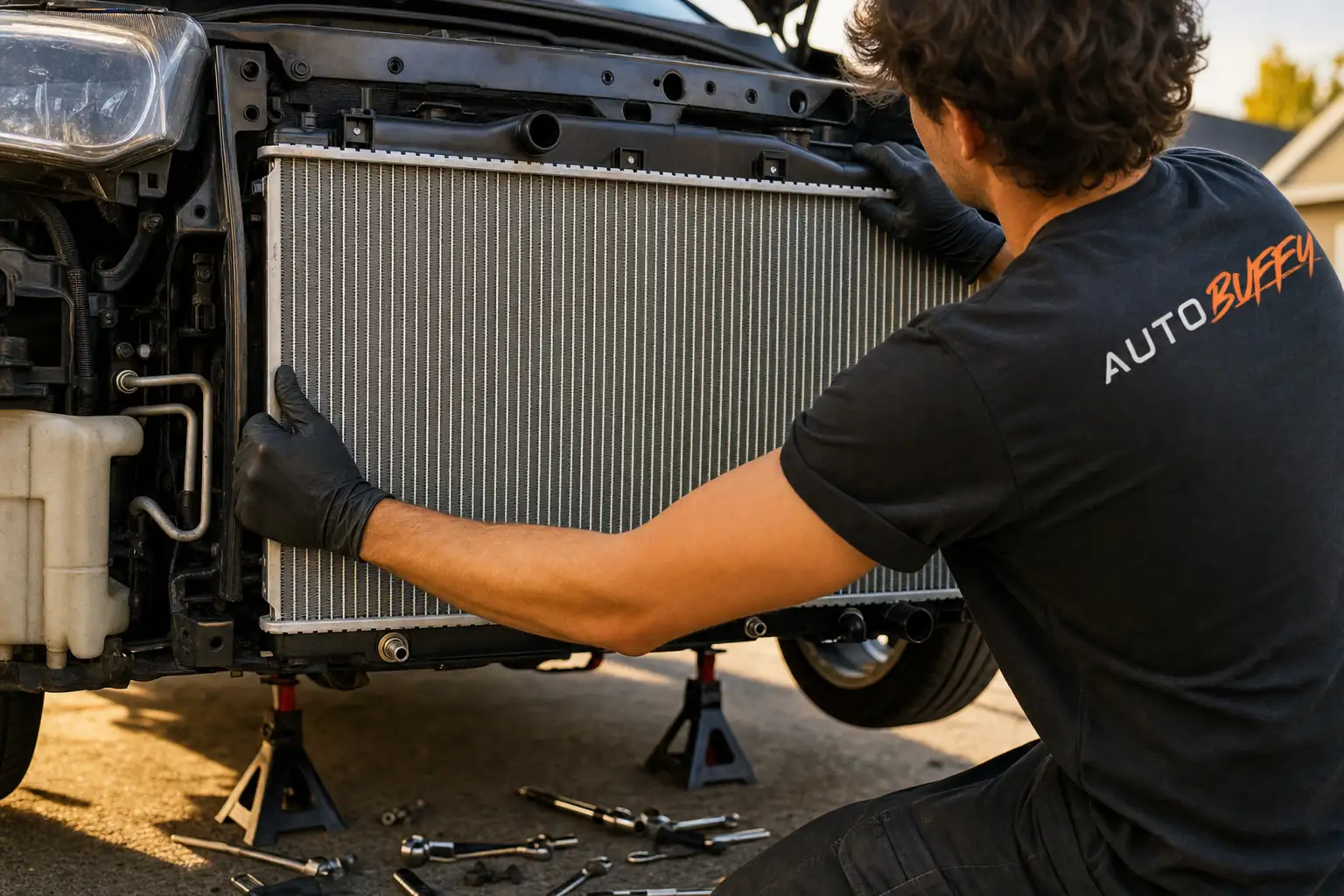
The radiator is your cooling system's workhorse. Coolant passes through dozens of thin aluminum tubes, fins shed the heat into airflow, and the cooled fluid cycles back to the engine. When those tubes get clogged with scale, rust, or debris—or when a collision bends the fins flat—cooling efficiency drops.
A partially clogged radiator often only overheats in demanding conditions: stop-and-go traffic, towing, 90-degree days. Drivers sometimes go months before the problem is obvious. A professional flush can sometimes clear minor buildup, but a radiator with physical damage or heavy internal scale usually needs replacement. Use the part finder below to check fit and current pricing for your vehicle.
Cause #4: Bad Radiator Cap
A 10-dollar part that most people never think about. The radiator cap maintains pressure in the cooling system—typically 13–16 PSI depending on the vehicle. Higher pressure raises the boiling point of coolant, letting it absorb more heat before it vaporizes. A cap that won't hold pressure effectively lowers that boiling point, and coolant steams off before it should.
Always replace the cap if you're replacing the radiator. It's not worth skipping.
Cause #5: Failing Water Pump
The water pump is the heart of the system—it physically pushes coolant through every passage in the engine, the heater core, and the radiator. When the impeller blades corrode (more common with old coolant), the bearing wears, or the seal starts leaking, flow drops and temperatures climb.
A worn water pump often announces itself with a whining or grinding noise from the front of the engine. Some vehicles use a timing belt-driven water pump, which means the replacement interval is tied to your timing belt service—check your owner's manual.
Cause #6: Cooling Fan Failure
At highway speed, ram air does most of the work of pushing air through the radiator. At idle or in slow traffic, the cooling fan is what keeps temperatures in check. Electric fans can fail outright (blown fuse, bad relay, failed motor), and mechanical fan clutches can slip, especially on older trucks and SUVs.
Here's an easy test: let the car idle until it's warm. The fan should kick on audibly. If it doesn't, start checking the fuse and relay before condemning the fan motor—it's often something that simple.
Cause #7: Old or Contaminated Coolant
Coolant doesn't last forever. The corrosion inhibitors break down over time, and old coolant becomes acidic. That acid attacks aluminum water pump housings, heater cores, and radiator tubes, leaving behind scale that restricts flow. It also causes electrolytic corrosion that can pit metal components.
Most manufacturers recommend a coolant flush every 30,000–50,000 miles or every 2–5 years. If you can't remember the last time yours was done, that's your answer.
Quick tip: Don't mix coolant types. Orange/red extended-life coolant and traditional green coolant use different inhibitor chemistries. Mixing them reduces effectiveness of both.
Cause #8: Blown Head Gasket
This is the one everyone fears, and it does belong on this list—but it's the least common starting point. Head gaskets usually fail *because* of overheating (causes 1–6 above), not out of nowhere. When a gasket fails, combustion gases enter the coolant passages, creating air pockets that block flow and drive temperatures up in a self-reinforcing cycle.
Signs: white sweet-smelling exhaust, milky oil on the dipstick, coolant disappearing with no visible external leak, or bubbles visible in the coolant reservoir. A combustion leak test (a block test using a chemical dye) confirms it without pulling the head. Repair costs are significant, which is exactly why you want to catch the overheating before it gets here.
What to Do the Moment Your Gauge Goes Red
- Turn off the A/C immediately and turn the heater to max heat—this pulls heat out of the engine through the heater core.
- If the gauge keeps climbing, pull over safely and shut the engine off.
- Wait at least 30 minutes before opening the hood or touching anything.
- Never open the radiator cap on a hot engine. The system is pressurized and will spray scalding coolant.
- Once cool, check the coolant level. If it's low, add coolant (or distilled water in a pinch) and look for visible leaks before driving.
The Radiator Is Usually Ground Zero
If you've traced your overheating problem to the radiator itself—whether it's clogged, cracked, leaking at the end tanks, or just worn out after 150,000 miles—replacement is the right call. Repairs on modern plastic-tank aluminum radiators rarely hold long-term.
A quality replacement radiator matched to your exact vehicle makes a real difference. Ill-fitting units can leak at the mounts, interfere with fan shrouds, or have incorrect inlet/outlet sizing. Make sure you're getting a confirmed fit before you order.
Find the right radiator for your vehicle
Guaranteed fit, ships free
FAQ / People Also Ask
Low coolant level is the single most common cause. It's often the result of a slow leak you haven't noticed yet—check the overflow reservoir and radiator cap first.


Comments
Loading comments...
Comments are moderated by the AutoBuffy team.