

Coil Pack vs Ignition Coil: What's the Difference and Which Do You Need?
Coil pack or ignition coil — they're not the same thing. Here's how each works, how to tell them apart, and how to pick the right one for your car.
The Short Answer
A coil pack and an ignition coil are not the same thing — a coil pack is a single moulded assembly containing multiple ignition coils, used in distributorless systems, while a standalone ignition coil traditionally worked with a distributor to fire all cylinders from one unit.
| Feature | Single Ignition Coil (distributor) | Coil Pack (distributorless) | Coil-On-Plug (COP) |
|---|---|---|---|
| Coils per vehicle | 1 | 1 assembly, multiple coils inside | 1 per cylinder |
| Uses distributor? | Yes | No | No |
| Firing method | Distributor routes spark | Waste spark system | Direct to each plug |
| ECU controlled? | Partially | Yes | Yes |
| Common era | Pre-late 1990s | Late 1990s–present | 2000s–present |
| Output voltage | 15,000–40,000 V | 15,000–40,000 V | 15,000–40,000 V |
If your check engine light is on and you've got misfire codes, knowing *which* ignition system your car uses is the first step. The wrong part ordered in frustration won't fix anything. Let's break this down properly. ---
What Does an Ignition Coil Actually Do? At its core, an ignition coil is an electrical transformer. Your battery puts out around 12 volts — nowhere near enough to jump the gap of a spark plug. The coil takes that 12 volts and steps it up to somewhere between **15,000 and 40,000 volts** depending on the engine and coil design. That spike of voltage is what creates the arc at the plug tip and ignites the air-fuel mixture. Every gasoline engine has ignition coils. What differs is *how many* and *how they're packaged*. ### The Traditional Single Coil Setup
On older vehicles — generally those built before the late 1990s — one ignition coil handled all cylinders. It fed high voltage to a distributor, which mechanically rotated to send that spark to each plug in firing order. Simple enough, but the distributor has a spinning rotor, a cap, and contacts that wear out over time. Mechanical timing also has limits. ---
What Is a Coil Pack? A coil pack is **a single housing that contains multiple ignition coils moulded together**. Instead of routing voltage through a mechanical distributor, a coil pack connects directly to the spark plugs — usually via short plug wires — and fires them electronically. This is called a **distributorless ignition system (DIS)**, and it uses a **waste spark** approach: each coil in the pack fires two cylinders at the same time — one on the compression stroke (the working spark) and one on the exhaust stroke (the "wasted" spark). The ECU or Ignition Control Module (ICM) sequences the firing precisely, with no rotating parts involved. Coil packs started replacing distributor setups in volume **during the late 1990s**. The benefits were real: fewer mechanical parts to fail, stronger and more consistent sparks, and far better ECU control over timing. ### Coil Pack vs. Coil-On-Plug: Don't Confuse These Two
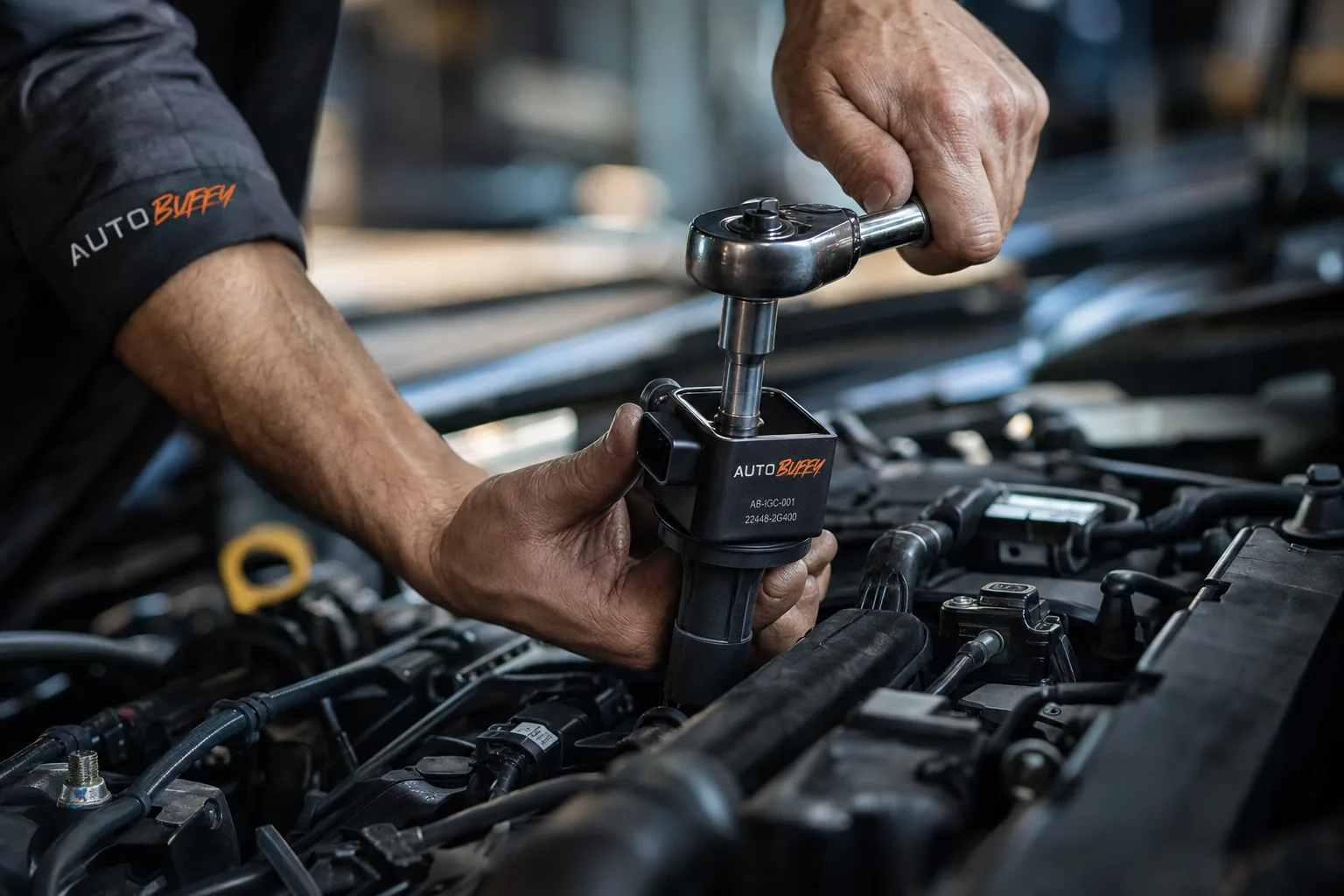
There's a third system worth knowing: coil-on-plug (COP). Modern vehicles increasingly use one individual coil mounted directly on top of each spark plug. No wires, no shared housing. Each cylinder gets its own dedicated coil, fully independent. COP is *not* the same as a coil pack. They're both distributorless, but a coil pack serves multiple cylinders from one assembly, while COP dedicates one coil per cylinder. This matters when you're ordering parts — replacing a COP coil means buying one coil per failing cylinder, not a whole pack. ---
How to Tell Which System Your Car Has
Pop the hood and look at the engine:
- One coil sitting directly on each spark plug (usually held by a single bolt) → Coil-On-Plug (COP)
- A single plastic housing with multiple terminals and short plug wires → Coil Pack (DIS)
- A round black cap with a central wire tower and several wires radiating out → Distributor with a single ignition coil
Your owner's manual will confirm it. So will a quick VIN search — use the part finder below and it'll tell you exactly what your vehicle takes. ---
Symptoms of a Failing Coil Pack or Ignition Coil
You'll usually know something's wrong before you pop the hood. The most common signs:
- Engine misfire — rough idle, stumbling or hesitation on acceleration
- Check engine light — typically misfire codes P0300 through P0312 (P0301 = cylinder 1, etc.)
- Poor fuel economy — unburned fuel is getting pushed out instead of ignited
- Hard starting — especially when cold
- Smell of raw fuel from the exhaust
One thing worth knowing: a failed coil in a COP system only knocks out the one cylinder it serves. A failed coil pack, on the other hand, can take down two or more cylinders at once, since multiple cylinders share that housing. > Don't ignore a misfire. Raw fuel in the exhaust stream overheats and destroys catalytic converters — a repair that can run $1,000 or more. Fix the coil first. ---
Should You Replace Just the Bad Coil or the Whole Set? For **coil packs**, replace the whole assembly. All the coils in there have the same miles on them. For **coil-on-plug systems**, the honest answer depends on mileage. If your car has 80,000+ miles and one COP coil has failed, the others are likely close. Many experienced technicians will replace the whole set while the engine's apart, especially if they're tucked under an intake manifold that took an hour to remove. At lower mileage, replacing just the failed unit is perfectly reasonable — but keep an eye on the others. ---
Choosing a Replacement: What to Look For
Fit matters more than brand loyalty with ignition coils. A coil that's "close enough" can have subtle winding differences that affect voltage output and cause misfires at high RPM. Stick to OEM-equivalent or OEM-supplier brands. DENSO is a name that comes up constantly in ignition systems, and for good reason — they supply original equipment ignition components to major automakers worldwide. Their replacement coils and complete coil-and-spark-plug kits cover a wide range of applications, from 4-cylinder imports to V8 trucks. If you want everything done at once, their bundled kits (coils plus plugs) are worth considering. NGK built its reputation on spark plugs, but their coil-on-plug ignition coils paired with Laser Iridium spark plugs are a strong combination for vehicles where NGK plugs are the OEM spec. They're particularly well-regarded for Japanese-brand vehicles. Delphi Technologies — now a brand under PHINIA following a 2023 spin-off — remains an active and respected name in the aftermarket ignition space. Their OEM heritage runs deep. My honest take: for most daily drivers, DENSO's bundled coil-and-plug kits represent good value because you're refreshing the whole ignition system in one shot rather than doing half a job. The numbers back it up — misfires are the #1 cause of catalytic converter failure, and doing coils without fresh plugs (or vice versa) at high mileage is leaving half the problem in place. ---
Typical Replacement Costs
| Job | Parts Range | Labor Estimate |
|---|---|---|
| Single COP coil (common import/domestic) | $20–$80 per coil | $50–$100 |
| Full COP set (4-cyl) | $80–$250 | $80–$150 |
| Full COP set (V6/V8) | $150–$500+ | $100–$250 |
| Coil pack replacement | $60–$300 | $50–$150 |
| Coil + plug bundle (all cylinders) | $200–$700+ | $100–$300 |
These are market ranges — actual pricing depends on your vehicle, your region, and where you buy. For your exact fit and today's pricing, use the part finder below. ---
The Bottom Line
"Coil pack" and "ignition coil" get used interchangeably all the time, even by parts counter staff. They're not the same thing. Knowing which ignition system your car uses — distributor, coil pack, or coil-on-plug — tells you exactly which part you need and how many you're buying. Get that wrong and you're shipping something back. If you've got misfire codes, don't guess. Use the finder below, plug in your vehicle, and get the right coil for your exact engine the first time. {partfinder:ignition coil|Find the right ignition coil for your vehicle|Guaranteed fit, ships free}
FAQ / People Also Ask
No. An ignition coil is the individual transformer that steps battery voltage up to the high voltage needed to fire a spark plug. A coil pack is a single moulded assembly that houses multiple ignition coils together in one unit. Every coil pack contains ignition coils, but not every ignition coil is part of a coil pack.

Comments
Loading comments...
Comments are moderated by the AutoBuffy team.