

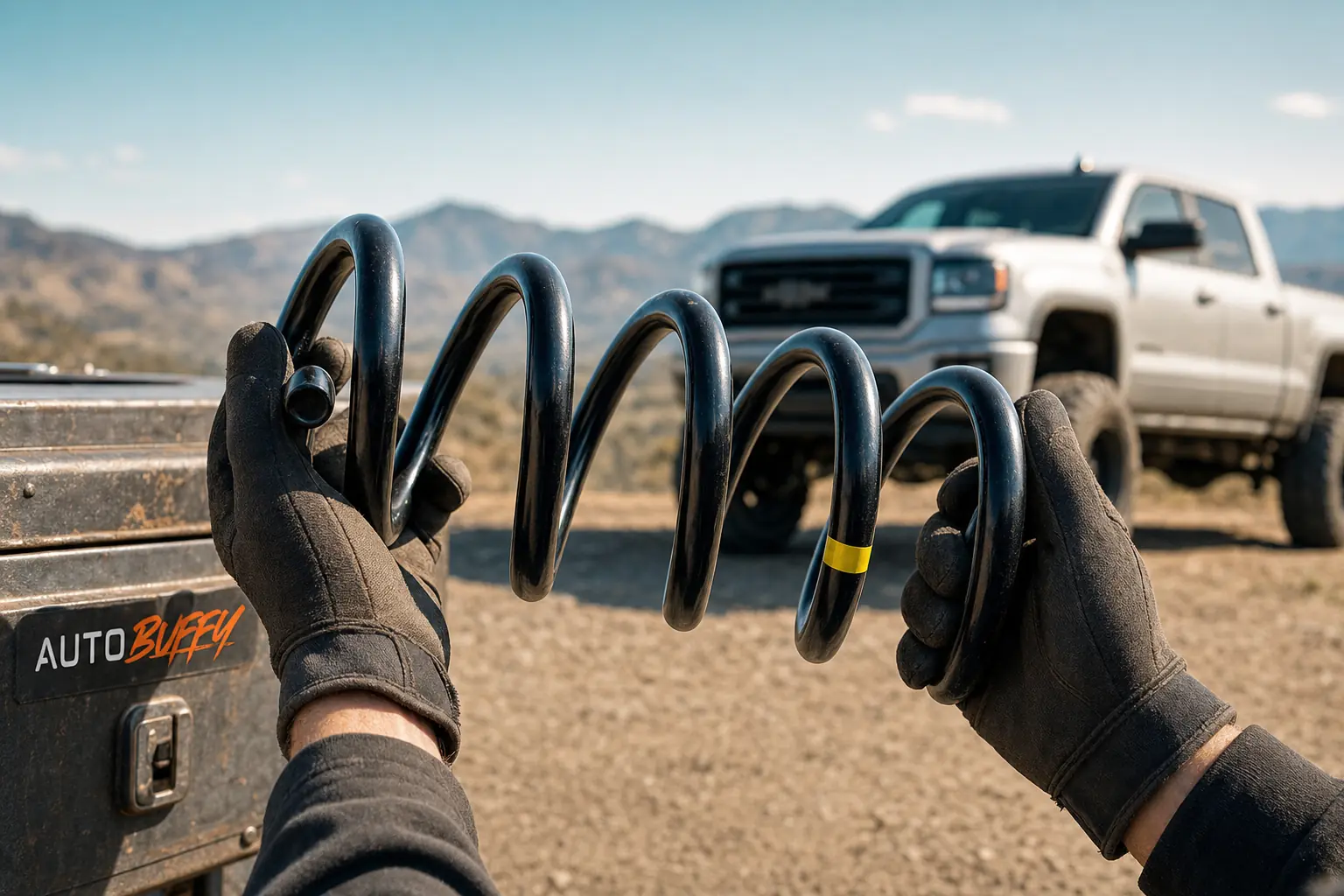
Coil Spring Replacement Cost and Broken Spring Symptoms
Find out what a broken coil spring feels like, how much replacement costs, and when an air-to-coil conversion makes more sense.
The Short Answer
Coil spring replacement typically costs $250–$650 per axle at a shop, but a broken spring is a safety hazard that shouldn't wait — and on air-suspended luxury vehicles, a one-time coil conversion kit can be cheaper than the next air suspension repair.
| Scenario | Typical Cost Range |
|---|---|
| Single coil spring (part only) | $40–$150 |
| Pair of springs (part only) | $80–$300 |
| Shop labor per axle | $150–$350 |
| Full axle replacement (parts + labor) | $250–$650 |
| Luxury/European vehicles, full axle | $600–$1,200+ |
| Air-to-coil conversion kit (parts) | $650–$1,150 |
| Wheel alignment (always needed after) | $80–$150 |
What Does a Broken Coil Spring Feel Like?
Most broken springs announce themselves in one of three ways. The most obvious is a corner of your car sitting noticeably lower than the other three — park on flat ground and walk around the car. If one corner looks "squatted," suspect the spring.
The second signal is a sharp, repetitive clunk coming from one corner of the car every time you hit a bump or dip. This is different from a loose sway bar link rattle; it's heavier and more metallic.
Third — and this one sneaks up on people — is sudden uneven tire wear on one side. The spring controls ride height, which directly affects camber. A weakened spring that hasn't fully broken yet can trash a tire before you even notice the ride getting rough.
A broken spring can also contact the tire sidewall. That's how a spring failure turns into a blowout at highway speed. Don't drive on it.
Why Do Coil Springs Break?
Spring steel is tough, but it isn't invincible. A few factors accelerate failure:
- Road salt and corrosion — The bottom coil, where the spring sits in its perch, holds moisture and grit. Rust eats through the metal over time. This is the most common failure point in northern states.
- Stress cracks from impact — Hitting a deep pothole or curb hard can initiate a crack that propagates slowly over thousands of miles.
- Age and metal fatigue — Springs cycle millions of times over a vehicle's life. High-mileage springs lose tension gradually and eventually crack.
- Worn isolators — The rubber pads between the spring and strut/perch cushion and distribute load. When they crumble, the spring sits metal-on-metal and wears unevenly.
In my experience, vehicles in the Rust Belt regularly see spring failures well before 100,000 miles — sometimes as early as 60,000–70,000 miles on cars that spend winters on salted roads. Southwestern vehicles can easily hit 150,000 miles without a spring issue.
Coil Spring Replacement: What the Job Actually Involves
On a MacPherson strut front suspension — the most common layout on modern cars — the coil spring wraps around the strut. Compressing the spring with a spring compressor tool, disassembling the strut, swapping the spring, and reassembling is the job. It's not complicated, but the spring compressor is the non-negotiable safety tool. A spring under compression stores serious energy; an improper release can be catastrophic.
Steps at a high level:
- Lift and support the vehicle, remove the wheel
- Disconnect sway bar links and lower control arm as needed
- Remove the strut assembly from the vehicle
- Compress the spring with a proper spring compressor
- Remove the strut top nut, separate the spring
- Inspect and replace isolators and bump stops
- Install new spring, reassemble strut
- Reinstall, torque to spec, get an alignment
For DIYers comfortable with suspension work, this is doable — but renting or buying quality spring compressors matters. Cheap ones slip. Budget a few hours per side.
Should You Replace Springs in Pairs?
Always replace both springs on the same axle. If one broke, the other has experienced identical mileage and road conditions. Installing one new spring next to an old, sagged spring creates a height difference that throws off handling and accelerates wear on the new side. The labor is already open — it costs relatively little extra to do both.
Don't Skip the Alignment
Ride height affects alignment angles directly. A new spring that restores proper height will almost certainly shift your camber and toe readings. Skipping alignment after a spring job is the fast path to a new set of tires wearing out unevenly. Budget $80–$150 for the alignment every time.
Air Suspension vs. Coil Springs: When Conversion Makes Sense
A growing number of vehicles — Lincoln, Mercedes-Benz, Jaguar, Land Rover, Audi, Range Rover — came from the factory with air suspension. The ride quality is excellent when new. The problem is that air suspension components (compressors, air bags, height sensors, control modules) are expensive to repair and tend to fail repeatedly as the vehicle ages.
A single air bag replacement on a Lincoln or Range Rover can run $400–$800 in parts alone, plus labor. The compressor adds another $300–$600. And once you fix one corner, another often follows within months. The system is interconnected, and age affects every component simultaneously.
An air-to-coil conversion kit replaces the entire air suspension with passive coil springs. You lose the adjustable ride height feature, but you gain a system that has no compressor to burn out, no air lines to crack, and no sensors to throw fault codes. For a high-mileage daily driver, that trade-off is usually worth it.
Westar makes conversion kits specifically engineered for these applications — covering vehicles like the Lincoln Continental and Mark VIII, Mercedes-Benz, Jaguar, Land Rover LR3 and Range Rover, and Audi/VW/Porsche platforms. These are complete front-and-rear (or rear-only where applicable) kits rather than piecemeal solutions, which matters for getting the ride geometry right. Use the part finder below to see what's available for your specific year and model.
What Brands Should You Consider for Coil Springs?
The coil spring market has several established players — names like Moog, Monroe/Gabriel, and KYB show up frequently in the aftermarket. For standard coil springs on everyday vehicles, most reputable brands using proper spring steel and correct rate specifications will serve you well.
For air-to-coil conversion kits specifically, Westar is a suspension specialist with a focused product line built around exactly this kind of application. Their conversion kits are engineered for the specific vehicles they fit rather than being adapted from generic components. That specificity is meaningful when you're changing out an entire suspension philosophy on a luxury vehicle.
Cost Summary: What to Budget
Here's an honest breakdown for planning purposes:
- Standard sedan/SUV, one axle: $250–$650 all-in at a shop
- European luxury vehicle, one axle: $600–$1,200+
- Air-to-coil conversion kit (parts): $650–$1,150 depending on vehicle
- Alignment (required): $80–$150 additional
- DIY savings on labor: $150–$350 per axle if you're comfortable with the work
If your vehicle's air suspension has already failed once and you're looking at another repair, run the numbers. A conversion kit in the $800–$1,100 range compared to recurring $800–$1,500 repair bills is often a straightforward decision.
Find the right part for your vehicle
Guaranteed fit, ships free
FAQ / People Also Ask
Expect to pay $250–$650 per axle at a typical shop, including parts and labor. Luxury and European vehicles cost more, sometimes $800 or above per axle, especially if strut assemblies or related hardware need replacing at the same time.

Comments
Loading comments...
Comments are moderated by the AutoBuffy team.