

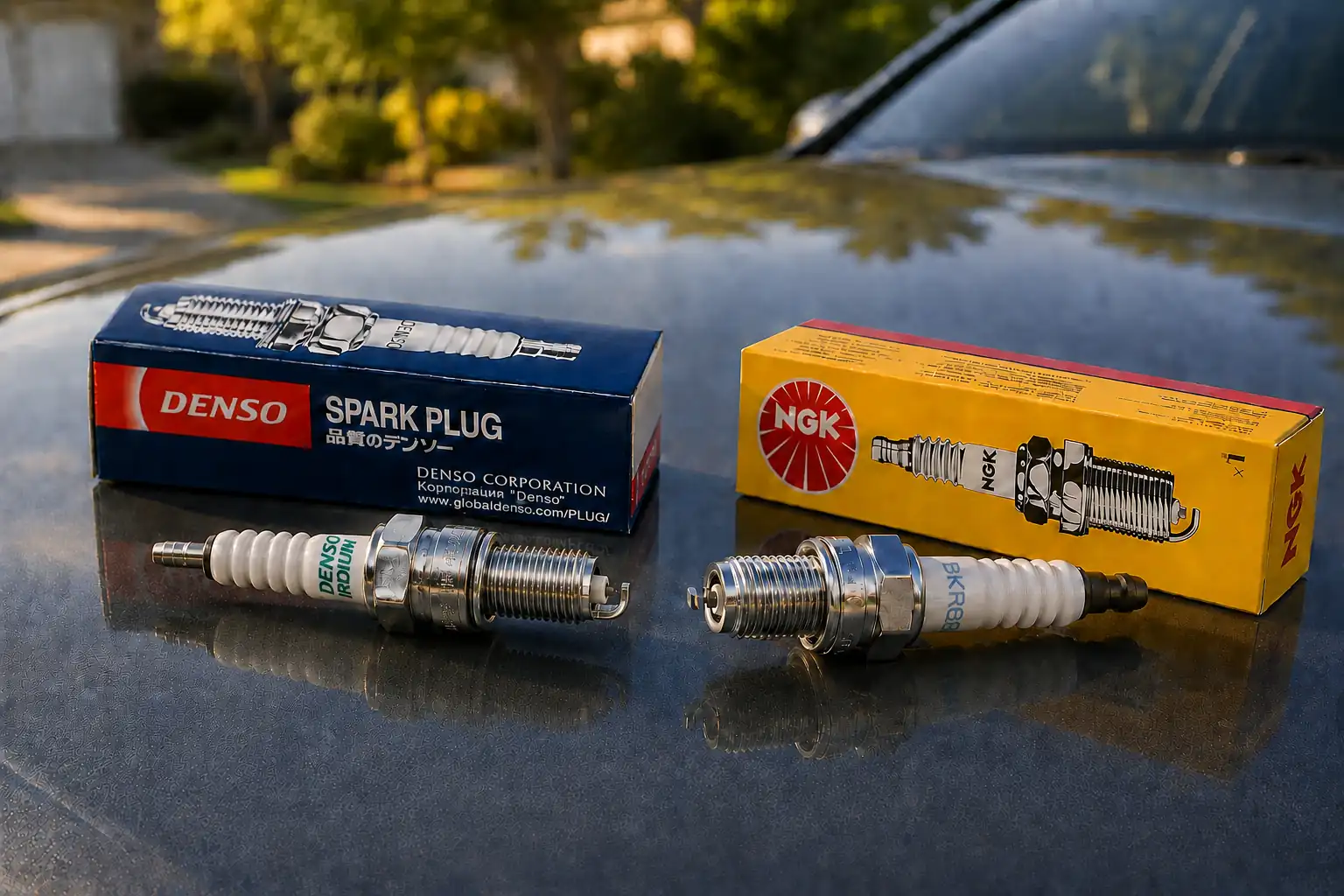
Denso vs NGK Spark Plugs: An Honest Comparison
Denso and NGK are the two dominant OEM spark plug brands. Here's how they compare on materials, longevity, price, and which one actually fits your engine best.
The Short Answer
Between Denso and NGK, there is no universally "better" brand — both supply OEM plugs to major automakers, and for most engines the right choice is simply whichever brand your vehicle came with from the factory.
| Category | Denso | NGK |
|---|---|---|
| OEM supplier for | Toyota, Lexus, many Honda models | Subaru, Nissan, many European & domestic engines |
| Tip materials offered | Copper, Platinum, Twin Tip Platinum, Iridium TT | Copper, G-Power Platinum, Laser Platinum, Laser Iridium |
| Iridium tip diameter | ~0.4 mm (Iridium TT) | ~0.6 mm (Laser Iridium) |
| Typical copper lifespan | 20,000–30,000 miles | 20,000–30,000 miles |
| Typical iridium lifespan | Up to 100,000 miles | Up to 100,000 miles |
| Price range (per plug) | ~$2–$20 depending on grade | ~$2–$22 depending on grade |
| Best for | Toyota/Lexus owners, Asian-market vehicles | Subaru, Nissan, Honda, European vehicles |
Why These Two Brands Dominate the Market
Walk into any auto parts store or browse any serious parts catalog and you'll find the same two names taking up the bulk of the spark plug shelf space: Denso and NGK. That's not a coincidence or just clever marketing.
Both brands supply ignition components directly to vehicle manufacturers. When your car rolled off the assembly line, there's a strong chance one of these two brands was already threaded into the head. That OEM relationship matters because it means engineers designed and validated those specific plugs for your engine's combustion chamber geometry, compression ratio, and heat management requirements.
According to RepairPal, spark plug replacement is one of the most common scheduled maintenance items across all vehicle types. With millions of plug changes done every year, the choice between Denso and NGK comes up constantly — and the answer really does depend on your specific vehicle.
How the Materials Stack Up
Copper Core Plugs
Both brands offer traditional copper-core plugs. These are the least expensive option and still work fine in older, naturally aspirated engines designed for them. Expect to replace them every 20,000–30,000 miles. If your vehicle's manual calls for a copper plug, don't "upgrade" yourself to iridium without checking — some older ignition systems are tuned for copper's specific resistance and conductivity characteristics.
Platinum Plugs
Denso's platinum lineup includes single and twin-tip (double platinum) designs. NGK's equivalent is their G-Power Platinum and Laser Platinum lines. Double-platinum plugs fire from both the center and ground electrode, which extends service life and improves performance in distributor-based ignition systems. Either brand's platinum plug in this category is a solid choice for a daily driver looking for a step up from copper without paying iridium prices.
Iridium Plugs: Where the Real Difference Lives
This is where the comparison gets interesting. Denso's Iridium TT features an extremely fine 0.4 mm center electrode tip. NGK's Laser Iridium uses a slightly wider 0.6 mm tip. In real-world driving, the difference in combustion efficiency is small enough that most drivers won't feel it. But on a modified or high-compression engine where every bit of ignition precision matters, Denso's thinner tip can produce a fractionally more focused spark.
Personally, I'd give Denso a slight edge in raw iridium tip engineering — their 0.4 mm TT design is genuinely impressive from a materials standpoint. But that edge is meaningful only in specific high-performance applications. For a stock daily driver? Both iridium options are outstanding.
OEM Fitment: The Most Practical Buying Guide
This is the single most useful piece of advice in this article: match the brand to your vehicle's OEM specification whenever possible.
- Toyota, Lexus: Denso is the factory supplier for a large portion of their lineup. Sticking with Denso means you're using a plug engineered to that engine's exact spec.
- Subaru, Nissan, many Honda models: NGK is widely used as OEM equipment. Cross-referencing to NGK first makes sense here.
- European vehicles (BMW, Mercedes, VW/Audi, Volvo): NGK supplies a significant share of European OEM ignition systems. Denso also has fitments here, but NGK coverage tends to be deeper.
- Domestic trucks and SUVs: Both brands have extensive coverage. Check the fitment guide — this is genuinely where it matters more which specific plug number matches your engine than which brand logo is on the box.
The NGK Spark Plugs website and Denso's parts portal both publish cross-reference tools where you can look up your vehicle and see the recommended plug number. Use them.
Heat Range: Don't Overlook This
Both brands use their own internal heat range numbering systems, and those systems run in opposite directions. A higher number in NGK's system generally means a colder plug. In Denso's system, a higher number means a hotter plug. This trips people up when they try to cross-reference manually.
Always use the manufacturer's cross-reference tool or a trusted parts fitment database — never try to match heat ranges by number alone across brands. Installing a plug that runs too hot causes pre-ignition and can damage pistons. Too cold and you get fouling and misfires. The NHTSA vehicle safety database documents cases where improper ignition components contributed to driveability and reliability complaints — it's not a theoretical risk.
Pricing and Value
Copper plugs from both brands run roughly $2–$5 each. Platinum steps up to about $5–$12. Iridium plugs land in the $10–$22 range per plug depending on the application. On a four-cylinder engine you need four plugs; on a V8 you need eight.
The math on iridium is straightforward: paying $15 per plug instead of $4 for a set of four costs you $44 more upfront, but if the iridium plug lasts 100,000 miles versus 25,000 miles for the copper, you're replacing copper four times in that span. Four copper changes at $16 in parts alone equals the same cost — and that ignores your labor or shop time. For most people driving modern engines, iridium or double-platinum is the smarter long-term spend.
Which Should You Actually Buy?
Here's a straightforward breakdown:
- You own a Toyota or Lexus → Start with Denso. It's what the engineers specced.
- You own a Subaru, Nissan, or a car with NGK OEM plugs → Go NGK.
- Your vehicle's OEM plug is from another supplier → Either brand works well. Cross-reference to the correct grade and heat range; that matters more than the badge.
- You're building a performance or forced-induction engine → Research the specific plug number for your setup. Colder heat ranges and precise tip diameters matter more at this level.
- You just want the longest possible service interval on a stock daily driver → Iridium from either brand. You'll get to 100,000 miles without a second thought.
Neither brand is a bad choice. The plug number and grade specification is what really does the work.
Sources
- RepairPal – Spark Plug Replacement Guide
- NGK Spark Plugs – Official Site
- Denso Aftermarket Parts
- NHTSA Vehicle Safety Complaints Database
- U.S. EPA – Vehicle Maintenance and Fuel Economy
Find the right part for your vehicle
Guaranteed fit, ships free
FAQ / People Also Ask
Both are genuinely excellent OEM-grade brands. If your vehicle came from the factory with Denso plugs (common in many Toyota and Honda engines), stick with Denso. If it came with NGK (common in Subaru, Nissan, and many European vehicles), stick with NGK. For everything else, either brand works well — the specific plug grade (copper, iridium, platinum) matters more than the brand name.



Comments
Loading comments...
Comments are moderated by the AutoBuffy team.