

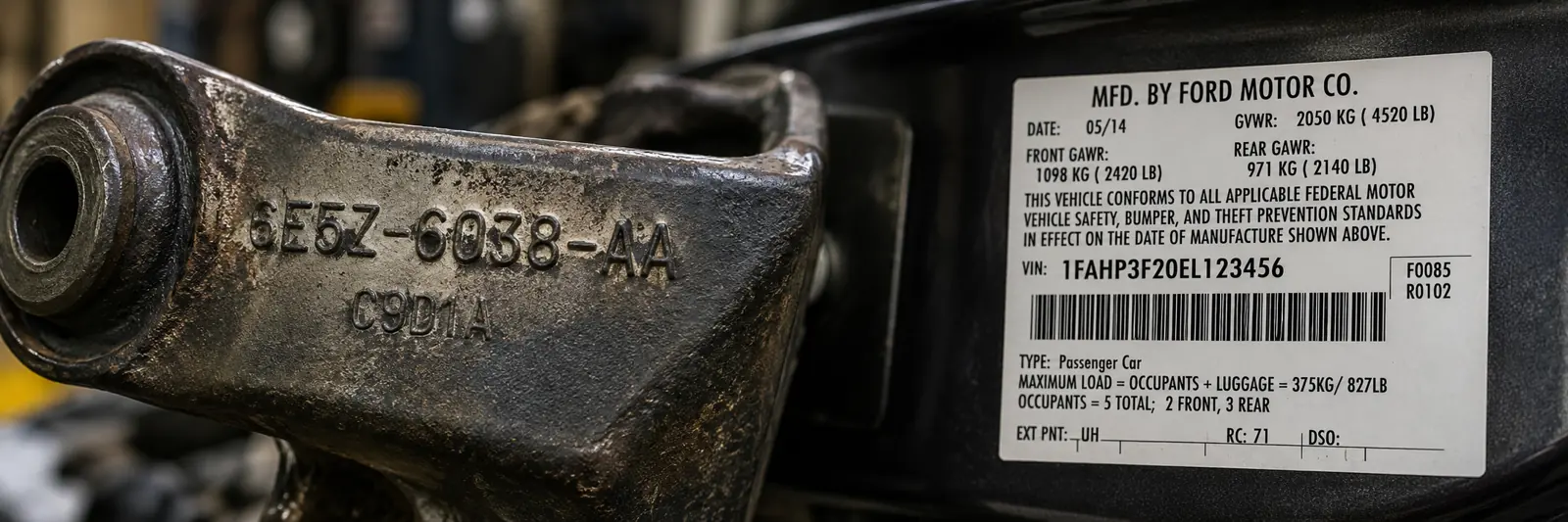
Find Your OE Part Number First — Then Shop Anywhere
The move that makes fitment bulletproof: get your OE part number first, then cross-reference and buy from anyone.
The Short Answer
Find your OE (original equipment) part number first — read it off the old part, the door-jamb sticker, or decode your VIN — then cross-reference it and shop wherever you want. Once you have the number, fitment stops being a guess.
| Where to get the OE number | How reliable | Notes |
|---|---|---|
| The old part itself | Best | Stamped or on a label; exactly what came off your car |
| Door-jamb / underhood label | Good | Common for filters, belts, fluids specs |
| Dealer parts desk (via VIN) | Best | They pull the factory number for your exact build |
| 8th VIN digit + factory catalog | Good | Nails the engine, narrows the number |
| Online OEM parts diagrams | Good | Free to browse; match the exploded diagram |
This is the one habit experienced buyers keep repeating: figure out the OE part number first, *then* shop around. Cheapest seller with the matching number wins.
Why the part number beats the fitment checker
A fitment checker answers "will something like this fit a car like yours?" A part number answers "is this the exact piece that came off *my* car?" Those are different questions, and the second one is the one that keeps your weekend intact.
Real buyers say it over and over. One put it this way: the fitment checker is a nice starting point but he never trusts it alone — he finds the OE part number every single time. Another: "figure out the OE part # first, then shop around." It's not extra work once it's a habit. It's the thing that lets you buy from anyone without sweating it.
How to find your OE part number
1. Read the old part (the gold standard)
Nothing beats the piece that actually came off your car. Pull it, wipe it down, and look for numbers stamped into the metal or printed on a label. That string — sometimes with a brand logo, sometimes just digits — is your anchor. Snap a photo before it gets greasy.
2. Check the stickers
Door-jamb labels, underhood placards, and the sticker on things like air filters or belts often list a spec or a number. Great for maintenance parts you're replacing before they fail.
3. Use your VIN
Your 17-character VIN is the key to the factory catalog. The 8th digit is your engine, and a dealer parts desk (or an online OEM parts diagram site) can turn the full VIN into the exact factory part number for your build. The free NHTSA VIN decoder gets you the year, engine, and plant to start.
4. Match the OEM diagram
Manufacturer parts sites show exploded diagrams — click the piece you need and it gives you the factory number. Even if you don't buy there, you now own the number that makes shopping safe.
Then cross-reference — one number, many brands
Here's the payoff. Once you have the OE number, you can cross-reference it to quality aftermarket equivalents. Most reputable brands publish a cross-reference (their number ↔ the OE number). So a single OE part number can map to a Monroe, a MOOG, a Timken — whatever's right for that part — and now you're comparing real equivalents on price, warranty, and quality instead of hoping a green checkmark is telling the truth.
That's also how you comparison-shop the smart way: search the part number, not the vague description. As one buyer put it, comparison-shop with the part number and whoever's cheapest wins.
A word on brand — the number gets you the right part, brand gets you the right quality
The OE number tells you *what* fits. It doesn't tell you *how good* the replacement is. For anything that moves or holds weight — struts, wheel bearings, control arms — buyers consistently say brand matters. For a cabin air filter, whatever's cheapest is fine. We break down who actually makes your car's parts if you want to shop brand with confidence.
How we make the part-number habit easy
The point of finding your OE number is so you never have to trust a vague listing again. That's how AutoBuffy is built — search your exact vehicle or the part number and you get the real matches and cross-references that apply to your car, not a one-size-fits-all listing. Same habit the pros use, minus the legwork.
Sources
- NHTSA VIN Decoder — decode your VIN to year, engine, and plant
- RepairPal — part and repair reference
- Consumer Reports: Car Maintenance — independent guidance on parts and upkeep
Find the right part for your vehicle
Guaranteed fit, ships free
FAQ / People Also Ask
OE stands for original equipment — the part number for the piece your car came with from the factory. It's the most precise way to identify exactly what fits.


Comments
Loading comments...
Comments are moderated by the AutoBuffy team.