

Front Strut Assembly: A Buying Guide
Everything you need to know before buying a front strut assembly — what to look for, how much to budget, and how to pick the right one for your vehicle.
The Short Answer
A front strut assembly is the single most impactful suspension part you can replace to restore ride quality, steering feel, and tire life — and buying the right one comes down to three things: fit, quality tier, and whether you want a complete unit or a bare strut.
| Factor | What to Know |
|---|---|
| Part type | Complete assembly vs. bare strut (spring included or not) |
| Typical part cost | $80–$350 per side |
| Typical labor cost | $150–$400 per side |
| Alignment after install | Required — budget $75–$150 |
| Replacement interval | 50,000–100,000 miles |
| DIY-friendly? | Yes (complete assembly) / Caution needed (bare strut) |
| Replace in pairs? | Always — both fronts at the same time |
What Exactly Is a Front Strut Assembly?
A strut isn't just a shock absorber — it's a structural suspension component. It carries the weight of the front of the vehicle, controls spring compression and rebound, and serves as the pivot point for steering. That's a lot of jobs for one part.
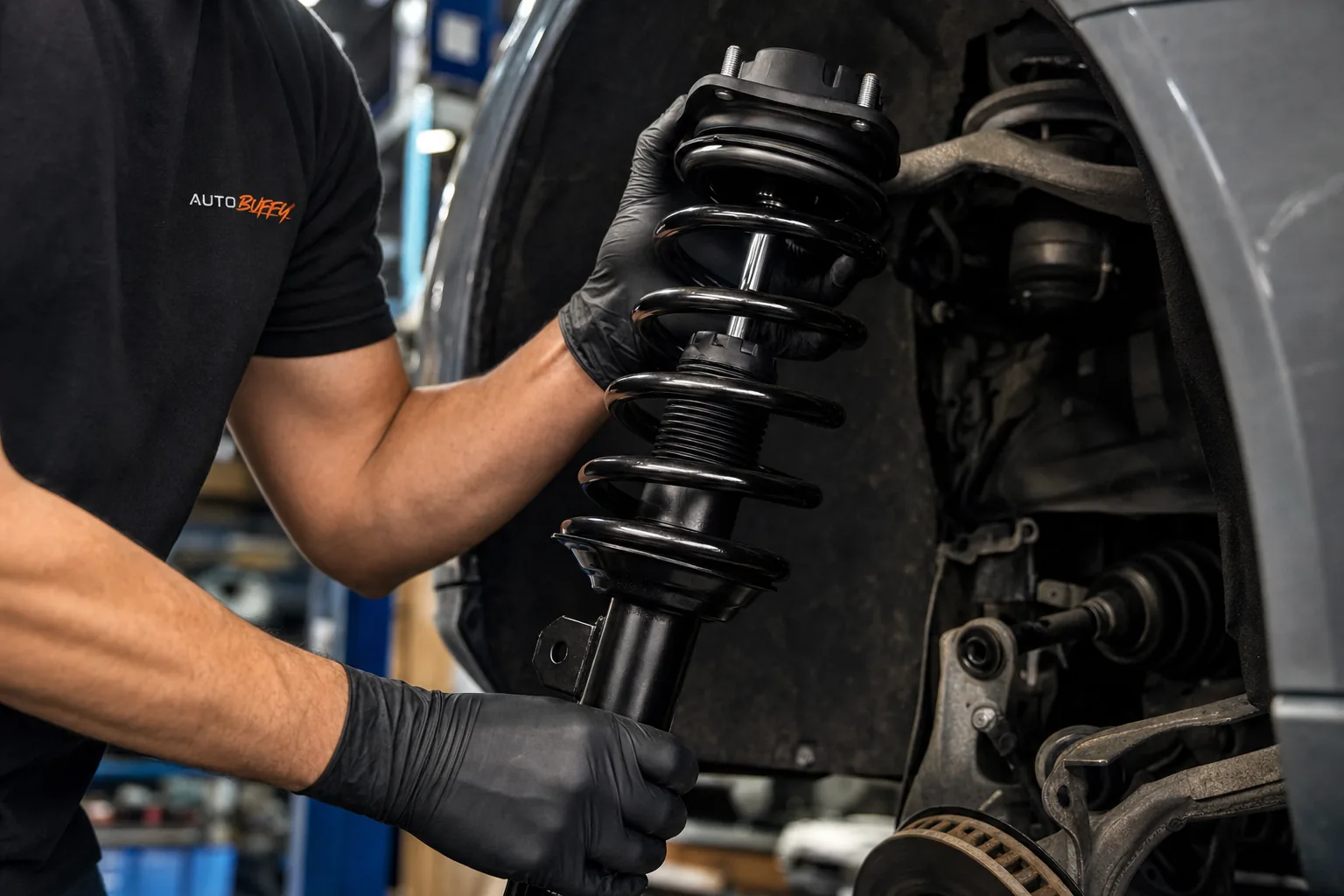
A complete front strut assembly (sometimes called a "quick-strut" or "loaded strut assembly") bundles all the individual pieces into one bolt-on unit:
- The strut cartridge (shock absorber)
- Coil spring
- Upper spring seat
- Upper strut mount and bearing plate
- Dust boot and bump stop
Buying it as a complete unit means no spring compression, no sourcing five separate parts, and dramatically less labor time. That's why most shops and serious DIYers prefer complete assemblies when the budget allows.
A bare strut is just the cartridge. It's cheaper upfront, but you'll need to transfer the spring and hardware from the old unit — which requires a spring compressor and the know-how to use it safely.
How Do You Know Your Front Struts Need Replacing?
Your car gives you signals. You just need to know what to listen for.
Signs a front strut assembly is worn out:
- Excessive bouncing — the nose keeps bobbing after a dip or bump instead of settling quickly
- Nose-dive under braking — the front end dips dramatically when you brake hard
- Cupped or scalloped tire wear — one of the clearest mechanical red flags
- Clunking or knocking sounds over rough pavement or speed bumps
- Vague steering — the car feels like it wanders or takes longer to respond
- Visible leaking — oily residue on the outside of the strut body means the seal is gone
If you're seeing two or more of these together, don't wait. Worn struts increase stopping distances — according to data referenced by NHTSA, degraded suspension components can affect vehicle control in emergency maneuvers. That's not a small thing.
Complete Assembly vs. Bare Strut: Which Should You Buy?
This is the first real decision, and it matters.
Choose a complete strut assembly if:
- You're doing a DIY install and don't own a spring compressor
- You want to minimize shop labor costs (complete installs take 1–2 hours less per side)
- Your existing spring, mount, or bearing is also worn (common at higher mileages)
- You want a single warranty covering all components
Choose a bare strut if:
- Your springs and mounts are genuinely in good shape and recently inspected
- You're a shop or experienced DIYer with the right tools
- You're working with a tighter parts budget and the labor savings offset the risk
Honestly, for most people replacing front struts on a vehicle with over 60,000 miles, the complete assembly is the smarter buy. The spring seat and bearing wear right alongside the strut cartridge, and replacing them separately later means paying labor twice.
Quality Tiers Explained
Not all strut assemblies are created equal, and the right tier depends on what you're driving and how.
Economy / Entry-Level
These hit a low price point and meet minimum fitment specs. They're adequate for short-term repairs or vehicles near end-of-life. Warranties tend to be shorter. Ride quality is functional but not refined.
OE-Replacement (Most Popular)
Engineered to match original factory specs in valving, spring rate, and ride height. Brands like Monroe and KYB compete heavily in this space. For daily drivers — commuters, family vehicles, crossovers — this tier hits the best balance of cost, quality, and longevity.
Performance / Sport
Firmer valving, tighter body control, and sometimes adjustable damping. Bilstein is a well-known name here. These make sense for sport sedans, enthusiast builds, or drivers who genuinely push their vehicles. The tradeoff is a noticeably harsher ride on broken pavement — which most daily commuters won't enjoy.
My honest take: for 80% of vehicles on the road, an OE-replacement tier unit from a reputable brand is the right call. Performance struts on a front-wheel-drive family crossover don't make it handle better — they just make it uncomfortable.
What Does It Cost to Replace Front Strut Assemblies?
Let's be direct about the real-world numbers:
| Cost Item | Typical Range |
|---|---|
| Complete strut assembly (each) | $80–$350 |
| Labor (per side) | $150–$400 |
| Wheel alignment (required) | $75–$150 |
| Total for both front struts | $650–$1,500+ |
Luxury vehicles, trucks with electronic suspension, or vehicles with hard-to-access strut towers can push past these ranges. Check RepairPal's estimator for a baseline on your specific vehicle.
The alignment is not optional — strut replacement changes your front-end geometry. Skip it and you'll be buying tires early.
Key Specs to Check Before You Buy
Before clicking "add to cart" on any front strut assembly, confirm these:
- Vehicle fitment — Year, make, model, and trim. Some trims have different spring rates or ride heights (sport vs. base, AWD vs. FWD).
- Left vs. right — Strut assemblies are side-specific. Don't assume a single "universal" part works.
- Spring included or not — Read the product description carefully. "Loaded" and "complete" don't always mean the same thing between brands.
- Warranty length — A quality OE-replacement unit should carry at least a 12-month/12,000-mile warranty. Many reputable brands offer lifetime warranties on complete assemblies.
- Ride height — If you're lowered or lifted, confirm the spring rate and collapsed/extended length match your setup.
DIY or Shop: Realistic Assessment
A complete front strut assembly swap is one of the more accessible suspension jobs for a capable DIYer. You don't need a spring compressor (the spring stays in the assembly), and the process is largely: remove wheel, disconnect brake line bracket and ABS sensor clip, unbolt the lower strut from the knuckle, remove upper mount bolts, swap the unit in, torque everything to spec.
You'll need: a floor jack, jack stands, basic socket set, torque wrench, and ideally an impact wrench for stubborn hardware. Budget 2–4 hours per side the first time.
What you can't DIY is the alignment — always take it to a shop afterward.
If you're buying a bare strut and need to transfer the spring, stop and rent or borrow a proper spring compressor, or have the shop do it. Improvised spring compression methods cause serious injuries every year.
Sources
- NHTSA — Vehicle Safety & Suspension
- RepairPal — Strut Replacement Cost Estimator
- Monroe Struts
- KYB Struts & Shocks
- Bilstein Suspension
Find the right part for your vehicle
Guaranteed fit, ships free
FAQ / People Also Ask
A front strut assembly combines the strut (shock absorber), coil spring, spring seat, bearing plate, and dust boot into one pre-assembled unit. It handles both ride comfort and steering geometry at the same time.

Comments
Loading comments...
Comments are moderated by the AutoBuffy team.