

Front vs Rear Sway Bar Links: Which Do You Need?
Not sure if you need a front or rear sway bar link? We break down the differences, symptoms, costs, and exactly which one your vehicle needs.
The Short Answer
If your vehicle has a rear sway bar, you need rear sway bar links to connect it to the suspension — but many vehicles don't have one at all, making front sway bar links the more universal repair.
| Feature | Front Sway Bar Link | Rear Sway Bar Link |
|---|---|---|
| Found on all modern vehicles? | ✅ Yes | ❌ Not always |
| Connects to | Strut or steering knuckle | Control arm or frame |
| Handles steering loads? | Yes | No |
| Failure noise location | Front footwell / wheel area | Trunk / cargo area |
| Wears faster? | Yes (more stress) | Generally slower |
| Affects handling how? | Steering speed, initial turn-in | Rear traction, oversteer balance |
| Typical replacement cost | ~$150–$250 per axle | ~$150–$250 per axle |
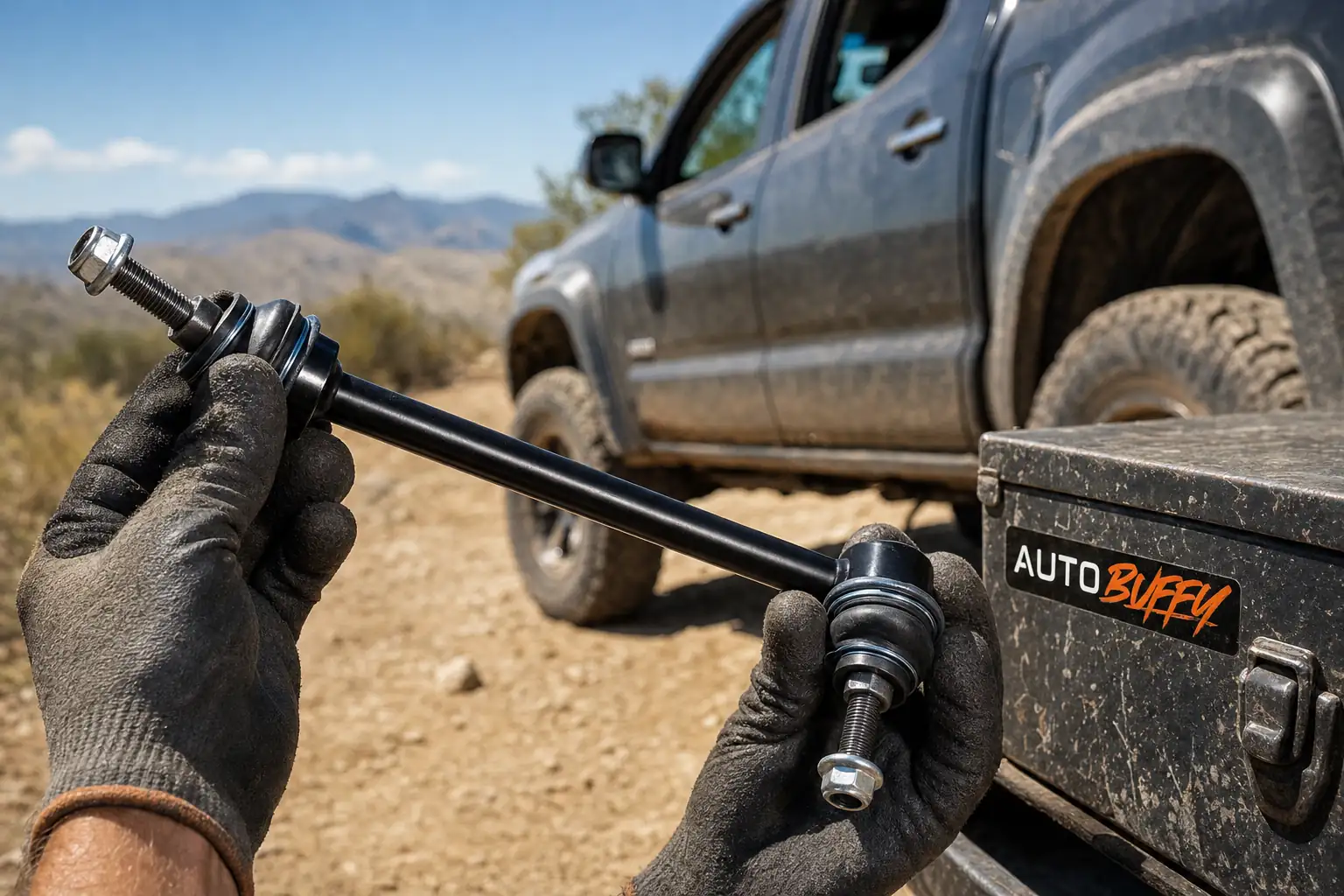
What Is a Sway Bar Link, Actually? Let's clear up the naming confusion first. Sway bar links are also correctly called **stabilizer links** or **anti-roll bar end links** — all three terms refer to the exact same part. You'll see all three used in repair manuals, parts catalogs, and shop invoices, so don't let that throw you off. The link itself is a short rod, usually with a ball joint or bushing on each end, that connects the sway bar to the suspension on each wheel. When the vehicle corners and the body wants to lean, the sway bar twists and uses those links to push back against the lean. Without a working link, that force transfer breaks down and the sway bar can't do its job. Each axle has two links — one per side — so a vehicle with both front and rear sway bars can have up to **four sway bar links total**. ---
Not Every Vehicle Has Rear Sway Bar Links
This is the single most important thing to know before you start ordering parts. Every modern vehicle has a front sway bar. That's a given. But rear sway bars are optional, and plenty of manufacturers — especially on economy and base-trim vehicles — skip them entirely. When there's no rear sway bar, there are no rear sway bar links. The front bar handles all the roll resistance by itself. Rear sway bars resist body roll without the complication of steering loads, which is part of why they're simpler to engineer. But the cost savings of omitting them is real, and budget vehicles often leave the rear end unbraced. If you're not sure whether your vehicle has a rear sway bar, crawl under the rear axle and look for a curved bar running laterally across the vehicle. If it's not there, you're shopping for front links only. ---
Front vs Rear: How They're Mounted Differently
This matters when you're diagnosing or ordering parts, because the two ends of the car use different attachment points. Front sway bar links connect the sway bar to the front strut or steering knuckle. Because the front suspension steers, the geometry is more complex and the link has to accommodate constant changes in angle as the wheels turn. That's why they tend to wear faster. Rear sway bar links connect the sway bar to the control arms or frame in the rear. There's no steering input back there, so the forces are more predictable — mostly body roll and bump absorption. Simpler geometry, slightly less stress, generally longer service life. Don't mix up which end you're buying for. A rear sway bar link is not interchangeable with a front one, even if they look similar. Always confirm front or rear, plus the side (driver or passenger), before ordering. ---
How Each One Fails — and What You'll Hear
The symptoms are different enough that you can usually narrow it down before you even get under the vehicle. ### Failed Front Sway Bar Link Symptoms
- Clunking or rattling noise near the front wheels, typically worse over bumps or during lane changes
- The sound often seems to come from just inside the front footwell
- Reduced roll stiffness means the front end feels floaty or leans more than usual in corners
- In severe cases, you may notice uneven tire wear or vague steering feel
Failed Rear Sway Bar Link Symptoms
- Noise that sounds like something's loose in the trunk or cargo area — this trips people up constantly
- Clunking over railroad tracks, speed bumps, or rough pavement
- The rear end feels less planted in corners, or the car seems to wag slightly on sweeping curves
- No effect on steering feel, since the rear links have nothing to do with steering geometry
Front sway bar links wear faster because they're dealing with steering loads on top of weight transfer during braking and cornering. The rear links handle weight transfer and body roll only, which is a lighter workload. That said, rear links on vehicles with active or performance rear suspensions can wear at a similar pace to fronts. ---
How Sway Bar Link Stiffness Affects Handling Balance
This section matters most if you're doing any kind of performance work or trying to dial in handling — but it's worth understanding even for a stock repair. Front sway bar link stiffness (and the bar itself) affects steering speed and initial turn-in response. A stiffer front setup makes the car feel more agile and responsive at the turn-in point. Rear sway bar link stiffness dictates how easily the rear breaks traction and how the car transitions during a slide. More rear roll stiffness tends to promote oversteer; less tends toward understeer. This is why suspension tuners often adjust the rear bar and links independently from the front — it's the primary lever for controlling handling balance. For a daily driver, this is mostly academic. For anyone tracking a car or doing autocross, rear sway bar link condition and spec selection is worth paying close attention to. A worn rear link changes the handling balance in ways that can feel like a bigger alignment or tire problem than it actually is. ---
What Does Sway Bar Link Replacement Actually Cost? The average sway bar link replacement runs **around $200** for a typical repair, though the real-world range varies depending on the vehicle, whether you're doing front or rear, and whether adjacent components like control arm bushings are being replaced at the same time. Labor is often the bigger variable. Front links are usually straightforward — a mechanic can replace them in under an hour on most vehicles. Rear links can occasionally require more disassembly depending on the suspension design, but it's rarely a complex job. My honest take: if one link is bad, do both on the same axle. Parts aren't the expensive part of this job — labor is. Doing both sides in one visit saves you from coming back six months later to do the other one, and it keeps the suspension balanced. MOOG offers front sway bar link and control arm suspension kits that bundle multiple components together, which is a smart move if your front end has general wear across multiple parts. Replacing links alongside worn control arms in one shot cuts total labor cost compared to doing them separately. ---
Front or Rear — How to Know What You Actually Need
Here's a quick decision guide:
- Hear a clunk near the front wheels? Start with the front sway bar links. 2. Hear a rattle that sounds like the trunk? Check the rear sway bar links. 3. Not sure if your vehicle even has a rear sway bar? Look under the rear axle — if there's no lateral bar, you only need fronts. 4. Doing a full front-end refresh? Consider a kit that includes control arms and links together for better value on labor. 5. Not sure which end or side? Use the part finder below — it'll confirm fit for your exact year, make, and model.
Why buy from AutoBuffy
- Fitment check: add your vehicle and we confirm the part fits before you buy. If it doesn't fit because of our listing, you get a free return and a full refund, including original shipping.
- 24-month limited warranty on new parts bought on autobuffy.com.
- Real reviews: rated 4.9 by 19,069 verified customers.
- 30-day returns on unused parts in the original packaging.
- Free shipping on orders $50+. Orders placed before 12:00 PM ET (Mon-Fri) ship the same business day.
- Questions about an order? Call 888-477-2530 or email help@autobuffy.com.
Find the right part for your vehicle
Guaranteed fit, ships free
FAQ / People Also Ask
A sway bar link (also called a stabilizer link or anti-roll bar end link) is a short connecting rod that attaches the sway bar to the suspension on each side of the vehicle. It transfers force between the bar and the suspension to resist body roll during cornering.

Comments
Loading comments...
Comments are moderated by the AutoBuffy team.