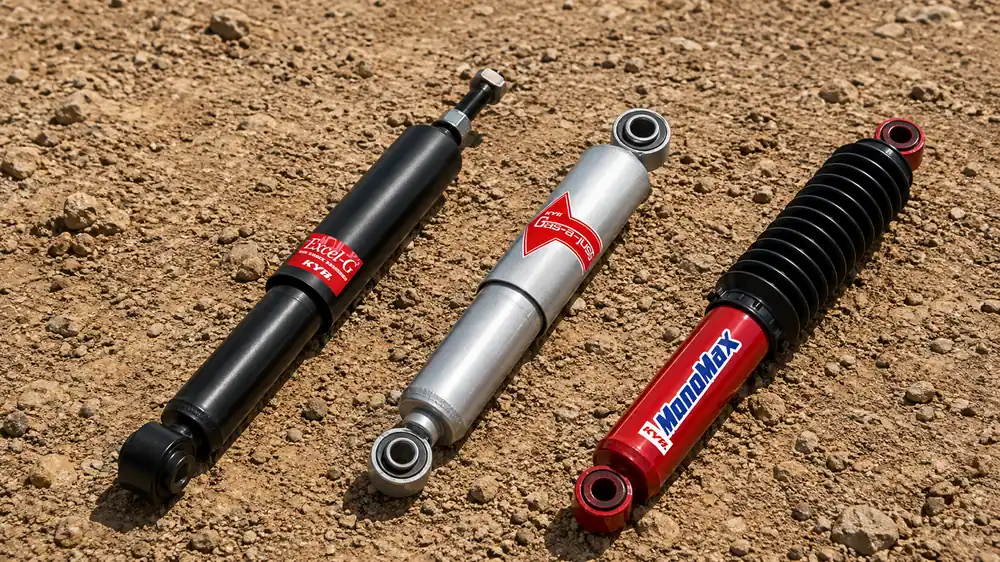
KYB Shocks Explained: Excel-G vs Gas-a-Just vs MonoMax
KYB makes three distinct shock lines. Here's what separates Excel-G, Gas-a-Just, and MonoMax—and which one your vehicle actually needs.
The Short Answer
KYB's three shock lines serve three different jobs: Excel-G restores OEM ride quality, Gas-a-Just delivers high-pressure monotube performance, and MonoMax is built for trucks hauling serious weight.
| Line | Design | Gas Pressure | Best For | Typical Cost (each) |
|---|---|---|---|---|
| Excel-G | Twin-tube | Low-pressure nitrogen | Daily driving, OEM replacement | $25–$60 |
| Gas-a-Just | Monotube | High-pressure gas | Performance, spirited driving | $40–$90 |
| MonoMax | Large-bore monotube | High-pressure gas | Trucks, towing, heavy loads | $60–$120 |
What Makes KYB Different in the First Place?
KYB isn't just an aftermarket brand trying to grab shelf space. They're a legitimate OEM supplier—Toyota, Honda, Nissan, and others have used KYB shocks straight off the factory line. That history matters when you're evaluating aftermarket replacements, because it means their engineering isn't theoretical. They know what a factory-spec shock needs to do because they've been making them for decades.
The confusion comes when shoppers see three different product lines at the parts counter and aren't sure which one applies to their situation. They're not interchangeable. Picking the wrong one doesn't just waste money—it can leave you with a ride that's either too soft or punishingly stiff for your actual use case.
KYB Excel-G: The Everyday Workhorse
Excel-G is KYB's core replacement line, and it's the right answer for the majority of passenger cars and light SUVs driven on normal roads. The design is twin-tube with low-pressure nitrogen gas assist. That combination keeps unsprung weight down, maintains consistent damping, and—crucially—doesn't stiffen the ride beyond what the vehicle was designed for.
KYB claims Excel-G is engineered to restore a vehicle's original handling and control. That's an honest characterization. These aren't an upgrade; they're a return to baseline. If your old shocks were worn out and you want the car to drive the way it did at 20,000 miles, Excel-G does that well.
The twin-tube design is also more forgiving about mounting position. You can only install them right-side up, which is fine for nearly all standard applications.
Where Excel-G falls short: If you regularly push your car hard on backroads or track days, the twin-tube design can heat-soak under sustained aggressive driving and lose some damping consistency. That's where Gas-a-Just enters the picture.
KYB Gas-a-Just: Monotube Performance
Gas-a-Just switches to a monotube design running significantly higher gas pressure than Excel-G. That single-cylinder layout handles heat much better—the oil and gas are separated by a floating piston rather than sharing space in a reserve tube. Under hard cornering or repeated compression cycles, this matters.
The practical result is a firmer, more responsive feel. Body roll decreases. Steering response sharpens. For someone who bought a sport sedan and actually wants to use it as intended, Gas-a-Just makes sense.
There's a real trade-off though: ride quality on rough or broken pavement gets harsher. I've seen this misrepresent itself as a noise or vibration problem when really the driver just picked the wrong shock for a commute that runs over potholed city streets. If you spend 80% of your time in stop-and-go traffic, Gas-a-Just will probably annoy you by the end of the first week.
One technical advantage worth noting: monotube shocks can be mounted inverted (body down, shaft up). Some vehicle applications require this, and Gas-a-Just handles it where Excel-G can't.
KYB MonoMax: Built for When Weight Is the Problem
MonoMax is a different animal. It's not about performance in the sports car sense—it's about load-handling capacity for trucks, full-size SUVs, and vans that regularly carry heavy cargo or tow trailers.
The design uses an oversized monotube bore. Bigger bore means more oil volume, which means the shock runs cooler and resists fade when it's working hard under load. A standard twin-tube shock on a half-ton pickup that's loaded to near its limit will fade noticeably on a long descent. MonoMax is engineered not to do that.
For empty truck driving, MonoMax can feel stiff. That's expected—it's calibrated for loaded conditions. Many truck owners accept this trade-off because the alternative (a soft shock that wallows when loaded) is both uncomfortable and genuinely unsafe.
How to Choose Between the Three
Here's the honest framework:
- You drive a regular car or crossover and want it to ride like it did when new → Excel-G
- You drive a sport-tuned vehicle and want sharper response, and you can tolerate a firmer ride → Gas-a-Just
- You drive a truck, van, or body-on-frame SUV and you tow or haul → MonoMax
About 70% of people reading this should be looking at Excel-G. The other two are genuinely specialist products that only make sense in specific contexts.
When KYB Doesn't Cover Your Application
KYB has strong coverage for mainstream Japanese and domestic vehicles. Where it gets thinner is European luxury platforms, older Land Rovers, commercial trucks, and some GM specialty applications.
Use the part finder below to check exact fitment and current pricing for your vehicle—the inventory updates in real time, so it'll always reflect what's actually available.
Installation: What to Know Before You Start
- Always replace shocks in axle pairs. One worn, one new creates uneven damping across an axle.
- Torque specs matter. Under-torqued shock mounts will clunk; over-torqued can distort bushings.
- Most DIY-friendly shock replacements take 1–2 hours per axle with basic hand tools. Strut assemblies (different from shocks) require a spring compressor and more experience.
- After replacement, drive conservatively for the first 50 miles. New shocks need a brief break-in to fully seat.
Mechanic's tip: While the wheel is off, inspect the shock mounting hardware—boots, bump stops, and upper mounts. Replacing a worn upper mount at the same time as the shock costs $15–$40 in parts and saves you pulling everything apart again in six months.
Find the right part for your vehicle
Guaranteed fit, ships free
FAQ / People Also Ask
Excel-G is a twin-tube design running low-pressure nitrogen gas, built to restore factory ride quality. Gas-a-Just is a monotube running high-pressure gas, designed for firmer, more responsive handling and heavier use. Gas-a-Just can also be mounted inverted, which Excel-G cannot.


Comments
Loading comments...
Comments are moderated by the AutoBuffy team.