

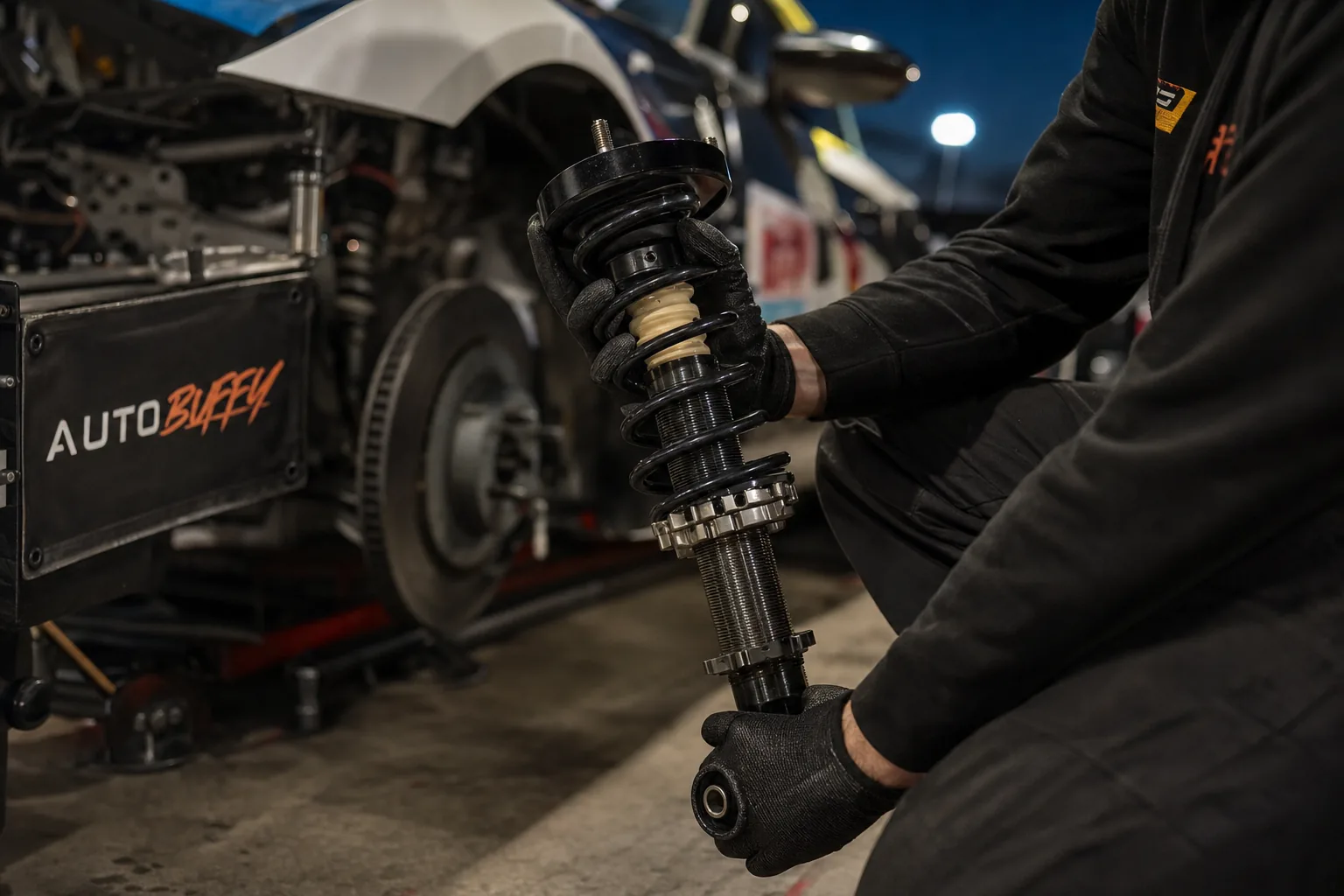
Leaking Shock Absorber: Is It Bad?
A leaking shock absorber isn't something to ignore. Learn what causes it, what the symptoms mean, and when you need to replace it.
The Short Answer
A leaking shock absorber is a genuine safety problem — not just a maintenance nuisance — because once the shaft seal fails and hydraulic fluid escapes, the shock loses its ability to control body movement, which directly increases stopping distances and reduces vehicle stability.
| Factor | Light Oil Film | Active Fluid Streaking |
|---|---|---|
| What it looks like | Thin sheen on shock body | Visible streaks, wet dust boot, drips |
| Cause | Normal seal seepage | Shaft seal failure |
| Damping ability lost? | Minimal | Yes — progressively |
| Drive on it? | Monitor closely | Replace as soon as possible |
| Typical replacement urgency | Soon | Immediate |
What Actually Causes a Shock Absorber to Leak
The shock absorber is a closed hydraulic system. Fluid moves through calibrated valves to control how fast the suspension compresses and rebounds. The shaft seal is the component that keeps all that fluid inside, and it's the first thing that goes. Over time, that seal hardens. Heat cycles are the main culprit — every time the shock heats up and cools down, the rubber compounds in the seal degrade slightly. Add road grit that works its way past the dust boot, exposure to road salt or chemicals, and the simple accumulation of miles, and you've got a seal that eventually can't do its job anymore. Physical damage from road debris — a rock strike, a hard pothole — can also score the shaft itself, which tears the seal from the inside. Corrosion on the shock body is another factor, especially in rust-belt states. Once corrosion compromises the structural integrity of the canister, fluid finds a way out. ### OEM Seals Aren't Permanent
This is worth saying plainly: factory shock absorbers aren't designed to last the life of the vehicle. Most manufacturers engineer them for roughly 50,000–100,000 miles under normal conditions, though real-world variation is wide. Rough roads, heavy loads, and temperature extremes shorten that lifespan. Smooth highway miles extend it. ---
How to Tell If Your Shock Is Actually Leaking
A light film of oil on the shock body is fairly normal — it's not a sign of failure. What matters is *active* leakage. Here's how to check it yourself:
- Park on a flat surface and let the vehicle cool down. 2. Get underneath or look through the wheel well (a flashlight helps). 3. Run a clean rag along the length of the shock body. 4. If you wipe off dirt and grime cleanly, it's probably just road contamination. 5. If you get an oily, slick smear — especially one that starts near the top of the shaft and runs downward — that's a leaking seal. Visible streaks of hydraulic fluid, a wet or saturated dust boot, or fluid dripping onto other suspension components are all signs that replacement can't wait. ---
The Symptoms You'll Feel Inside the Car
A leaking shock doesn't just look bad — you'll feel it. The symptoms build gradually, which is part of why people sometimes ignore them longer than they should. - Excessive bounciness — the vehicle keeps bobbing after hitting a bump instead of settling quickly
- Body roll in corners — the car leans noticeably when turning, even at moderate speeds
- Nose-dive under braking — the front dips sharply when you press the brake pedal
- Rear squat when accelerating — especially noticeable on trucks and rear-wheel-drive vehicles
- Longer stopping distances — this is the one that genuinely concerns me; studies have shown worn shocks can add meaningful feet to emergency braking distances, which matters a lot at 60 mph
- Uneven tyre wear — scalloping or cupping patterns on the tread face, caused by the tyre bouncing rather than maintaining consistent contact with the road
If you're noticing two or more of these symptoms together, the shock absorber — or strut — is worth inspecting immediately. ---
Can You Repair a Leaking Shock, or Does It Need to Be Replaced? Short answer: replace it. Shock absorbers are serviceable in theory — rebuilding kits exist — but the labor time, the need for a shock dyno to verify calibration, and the availability of quality replacement units means rebuilding almost never makes financial sense for a standard passenger vehicle. Even for specialty or high-end applications, replacement is typically more reliable than trying to reseal a worn unit. ### Always Replace in Pairs
When one shock on an axle fails, the other side has logged the same miles and heat cycles. Replacing only the leaking unit leaves a mismatched pair: the new shock working against a worn one. That imbalance shows up as pulling, uneven braking response, and inconsistent handling. Replace both shocks on the same axle at the same time. ---
Which Shock Absorber Brand Should You Choose? This depends on your vehicle and what you're asking the shocks to do. Here's an honest breakdown:
KYB is the world's largest supplier of OE and aftermarket shocks and struts, supplying both drivers and car manufacturers globally. For a driver who wants to restore factory ride and handling characteristics, KYB is a consistently strong choice — the OE-quality fit means you're not introducing new variables into the suspension geometry. Monroe (operated under DRiV Incorporated, part of Tenneco's portfolio) has decades of fitment coverage and is widely stocked, which makes sourcing straightforward. Their product range covers everything from basic replacements to comfort-tuned and sport-tuned options. Bilstein is the choice for drivers who want performance-oriented damping, heavy-duty towing capacity, or lifted truck applications. Their monotube gas pressure design handles heat more effectively than twin-tube units under hard use — that's a real engineering difference, not just marketing. Motorcraft is the direct OE replacement for Ford, Lincoln, and Mercury vehicles. If your priority is keeping a Ford platform exactly as the factory intended, there's a straightforward argument for using the brand Ford uses. Dorman covers specialty applications including rear air shock conversions — useful if an air suspension system has been a chronic problem and you want to simplify it. > My honest take: for most daily-driver replacement jobs, KYB or Monroe will do the job reliably and won't break the budget. If you're running a truck hard, towing regularly, or want better-than-stock handling, step up to Bilstein. Match the product to the use case, not just the price. ---
What Happens If You Keep Driving on a Leaking Shock? The consequences compound. As fluid escapes, damping force decreases. The suspension starts cycling with less control on every bump. Tyre wear accelerates because the tyre loses consistent road contact. The other suspension components — ball joints, tie rods, wheel bearings — experience more stress because the shock isn't absorbing energy the way it should. And the braking issue is real. A shock absorber that can't keep the tyre planted during emergency braking adds feet to your stopping distance. That's not a theoretical risk — it's physics. Most states also treat a visibly leaking shock as a safety defect at inspection time. It can fail a vehicle inspection, which turns a maintenance issue into a registration problem. ---
How Much Does Shock Absorber Replacement Cost? Costs vary significantly by vehicle, brand, and application. For conventional passenger car replacements, parts typically run in the range of $50–$200 per unit. Performance and specialty units — including 60mm monotube designs and corner modules for trucks or high-end platforms — run considerably higher. Labor adds roughly $75–$150 per axle at most independent shops, though rates vary by region and vehicle complexity. For your specific vehicle's fit and current pricing, use the finder below — it pulls live inventory rather than estimates.
Why buy from AutoBuffy
- Fitment check: add your vehicle and we confirm the part fits before you buy. If it doesn't fit because of our listing, you get a free return and a full refund, including original shipping.
- 24-month limited warranty on new parts bought on autobuffy.com.
- Real reviews: rated 4.9 by 19,069 verified customers.
- 30-day returns on unused parts in the original packaging.
- Free shipping on orders $50+. Orders placed before 12:00 PM ET (Mon-Fri) ship the same business day.
- Questions about an order? Call 888-477-2530 or email help@autobuffy.com.
Find the right shock absorber for your vehicle
Guaranteed fit, ships free
FAQ / People Also Ask
Yes, it can be. A leaking shock absorber loses its ability to control body movement, which increases stopping distances, causes nose-dive under braking, and reduces stability in emergency maneuvers. The longer you drive on a failed shock, the more risk you carry — especially at highway speeds or in wet conditions.
Keep Reading
Isuzu NPR Shocks & Medium-Duty Truck Shock Absorbers: GMC C4500/C5500 and Box Truck Guide
7
Nissan Maxima Struts (2000–2023): What They Cost, When to Replace, and Which Brand to Buy
7
Comments
Loading comments...
Comments are moderated by the AutoBuffy team.