

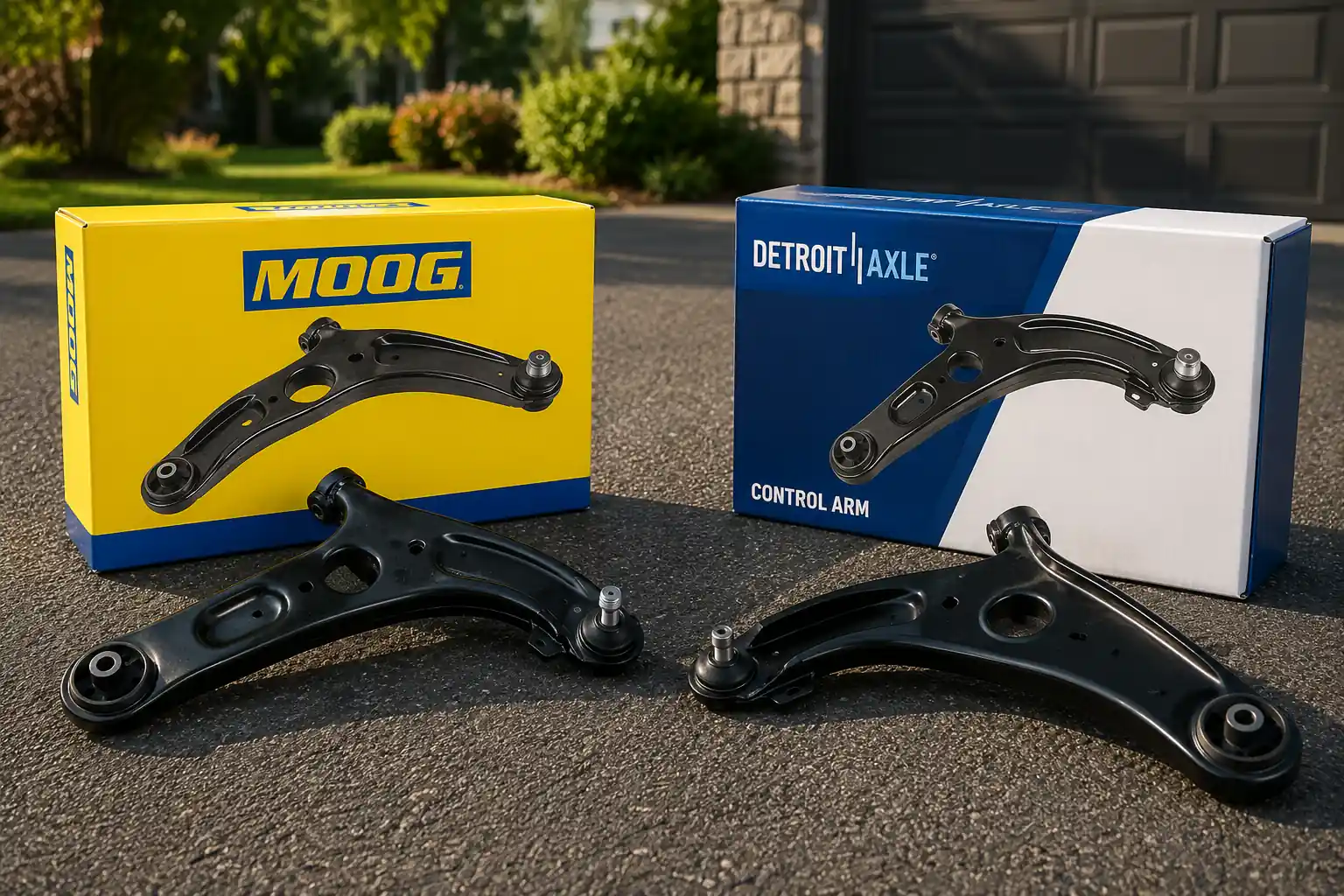
MOOG vs Detroit Axle: Which Suspension Brand Should You Actually Buy?
MOOG and Detroit Axle both sell control arms, but they're built for different buyers. Here's an honest breakdown of quality, warranty, and value.
The Short Answer
MOOG is the stronger choice for control arms when you want OE-matching quality and long-term reliability — Detroit Axle competes on price, but the gap in build quality is real enough that most mechanics recommend MOOG for any vehicle you plan to keep.
| Factor | MOOG | Detroit Axle |
|---|---|---|
| Quality Tier | Premium / OE-grade | Budget / Economy |
| Typical Control Arm Price Range | $60–$180 per arm | $30–$100 per arm |
| Warranty | Limited lifetime (many applications) | Limited lifetime (varies) |
| Greaseable Fittings | Yes, on many applications | Rarely |
| Ball Joint / Bushing Included | Often, app-dependent | Often, app-dependent |
| Best For | Daily drivers, kept vehicles | Older cars, tight budgets |
| Pro Mechanic Preference | Widely preferred | Less common in shops |
Why This Comparison Actually Matters
Control arms are one of those parts you don't want to cheap out on — and then immediately wish you hadn't. They connect your wheel hub to the vehicle's frame, and when they fail, you're dealing with pulling, clunking, uneven tire wear, and in serious cases, a loss of vehicle control. Getting the part choice right the first time also saves you from paying for a second wheel alignment, which at $80–$150 at most shops isn't trivial.
MOOG and Detroit Axle are two of the most-searched suspension brands online, partly because they sit at opposite ends of the price spectrum. One targets the professional installer and the driver who wants to fix it once. The other targets the DIYer watching their wallet. Neither answer is always wrong — but they're not interchangeable choices either.
What Makes MOOG Worth the Premium?
MOOG has built its reputation on what the brand calls "problem-solver" engineering — design improvements over OE that address known failure points. On control arms specifically, a few things stand out.
Greaseable Ball Joints and Gusher Bearings
Many MOOG control arm assemblies include ball joints with greaseable fittings, meaning you can push fresh grease into the joint during regular maintenance. That single feature dramatically extends service life. A sealed ball joint, once the lubricant breaks down, is essentially on a countdown to failure. A greaseable one can last the life of the vehicle if you stay on top of it.
MOOG also uses what they call gusher bearings — internal channels that distribute grease evenly throughout the joint under load. It's not marketing copy; it's a real mechanical advantage that independent mechanics have noted in teardowns.
Reinforced Housings and Tight Tolerances
Premium control arm housings use higher-grade steel and tighter manufacturing tolerances, which directly affects how the part feels at the wheel and how long it holds its geometry. Loose tolerances mean play — and play in a control arm shows up as vague steering feel and accelerated bushing wear.
Fitment Consistency
Professional shops stock MOOG because the parts fit right the first time. When you're paying a technician by the hour, a part that needs modification or comes with marginal fitment is a real problem. MOOG's consistent OE-match fitment is a big reason it's the go-to at independent shops.
Where Detroit Axle Makes Sense
Detroit Axle isn't a scam brand — it's a volume aftermarket supplier that competes on price, and that's a legitimate niche. Their control arm assemblies often include ball joints and bushings pre-installed, which can simplify a DIY install.
The Budget Repair Case
Say you're driving a 2009 sedan with 180,000 miles on it. You're not keeping it long. You need a front lower control arm to pass inspection and get another year out of the car. Spending $35 instead of $95 makes complete sense in that scenario. Detroit Axle exists for exactly that customer.
DIY-Friendly Kits
Detroit Axle frequently sells control arm pairs or full suspension kits that bundle both sides together at a lower combined price. For a DIYer doing a full front end refresh on a budget vehicle, that's genuinely convenient.
The Honest Risk
The tradeoff is quality consistency. Detroit Axle sources from multiple suppliers, and real-world feedback shows the experience varies considerably by application. Some buyers report years of problem-free service. Others report premature failure within 20,000 miles. RepairPal's community data and forum discussions across platforms consistently show more variance in Detroit Axle's results than MOOG's.
Head-to-Head: The Numbers That Tell the Story
Here's the part that makes my opinion clear: a professional wheel alignment costs roughly $100 on average, according to RepairPal. You need one every time you replace a control arm. If a Detroit Axle part fails in 30,000 miles and you replace it — plus pay for another alignment — you've likely spent more than if you'd bought MOOG the first time. Factor in the labor if you're not doing it yourself, and the math gets even worse.
The price delta on a single control arm between the two brands is usually $20–$60. That's the actual cost of "saving money" with the budget option. If you're a DIYer who can do the swap in an afternoon, the math may still favor Detroit Axle on a throwaway vehicle. But for a kept daily driver, MOOG earns back its premium quickly.
What About Warranty?
Both brands advertise limited lifetime warranties on many suspension parts. Here's where it gets nuanced.
A warranty is only as good as the process to claim it. MOOG, sold through established distribution channels including major retailers, has a straightforward warranty path — you return the part through the store and get a replacement. Detroit Axle, which sells heavily through Amazon and its own website, has a more variable claims experience based on real customer reviews. Some buyers report smooth replacements; others describe significant friction in the process.
Warranty coverage is not a tie between these two brands in practice, even if the printed terms look similar.
Which Should You Buy?
Here's the honest verdict:
- Buy MOOG if you plan to keep your vehicle, you're doing a single-axle repair, or you're paying for professional installation. The quality is consistent, the fitment is reliable, and the warranty process is cleaner.
- Buy Detroit Axle if you're doing a budget repair on a high-mileage vehicle you don't plan to keep long, or you're a capable DIYer who accepts the risk-reward trade-off.
There's no wrong answer if you're choosing based on your actual situation. The mistake is buying Detroit Axle on a vehicle you'll own for another 10 years because it was $40 cheaper at checkout.
Sources
- RepairPal – Wheel Alignment Cost Estimator
- RepairPal – Community Repair Data
- NHTSA – Vehicle Safety & Suspension Information
- KBB – Car Maintenance Guidance
Find the right part for your vehicle
Guaranteed fit, ships free
FAQ / People Also Ask
For most drivers, MOOG offers better long-term durability and a stronger warranty on suspension parts like control arms. Detroit Axle is a competitive budget option, but MOOG's OE-grade engineering and reputation among professional mechanics gives it the edge when longevity matters.


Comments
Loading comments...
Comments are moderated by the AutoBuffy team.