

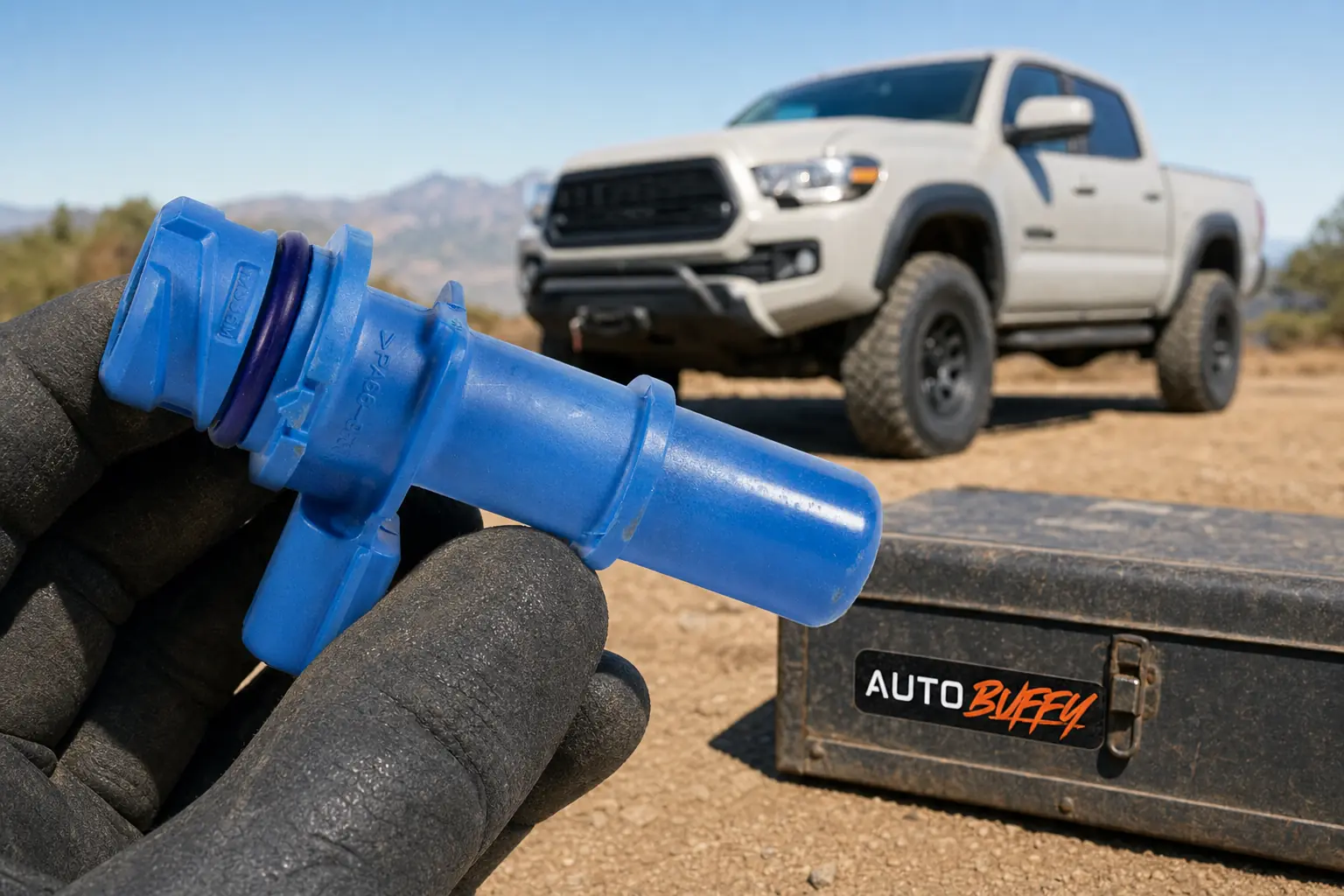
PCV Valve Symptoms and Replacement Cost: The $15 Fix for Rough Idle
Learn the top PCV valve symptoms, what replacement costs, and why this $15 part can save your engine from serious damage.
The Short Answer
A failing PCV valve most commonly causes a rough idle, increased oil consumption, and oil leaks — and replacing it typically costs $5–$25 for the part alone, making it one of the cheapest engine fixes you can do.
| Symptom | Likely Cause | Urgency |
|---|---|---|
| Rough or lopey idle | Stuck-open valve, vacuum leak | Moderate |
| Excessive oil consumption | Oil pulled into intake | Moderate–High |
| Oil leaks (valve cover, seals) | Elevated crankcase pressure | High |
| Whistling/hissing noise | Cracked PCV hose or stuck valve | Moderate |
| Check engine light (P0171, P0174) | Unmetered air from open valve | Moderate |
| Engine sludge buildup | Long-term clogged valve | High |
| White/bluish exhaust smoke | Oil burning in combustion chamber | High |
What Does a PCV Valve Actually Do?
The Positive Crankcase Ventilation valve is a one-way check valve that recirculates blow-by gases from the crankcase back into the intake manifold, where the engine burns them cleanly instead of venting raw hydrocarbons into the atmosphere. It became federally mandated on all U.S. cars starting in the 1960s.
Simple job. But when it fails — either stuck open or clogged shut — it throws a wrench into your engine's pressure balance, fuel mixture, and oil system all at once. That's a lot of trouble for a part that often costs less than a fast-food lunch.
PCV Valve Symptoms You Shouldn't Ignore
Rough Idle That Won't Go Away
This is the one that sends most people to the internet searching "PCV valve symptoms." When the valve sticks open, it acts like a giant vacuum leak, pulling more air than the MAF sensor measured. The ECU is flying blind. You'll feel it as a shaky, inconsistent idle — sometimes it smooths out at higher RPMs, which is a telltale clue pointing straight at the PCV system.
Oil Leaks Showing Up Out of Nowhere
The crankcase needs to breathe. If the PCV valve is clogged, pressure builds up inside and looks for the weakest exit point — usually the valve cover gasket, rear main seal, or dipstick tube. If you're suddenly seeing oil spots in the driveway after years of clean pavement, check the PCV valve before you panic about a major gasket job.
You're Adding Oil Every Few Weeks
A stuck-open valve creates such strong suction that it literally pulls oil mist up out of the crankcase and into the intake. That oil burns in the cylinders. You won't always see blue smoke, especially on newer engines with tighter tolerances, but your dipstick will tell the story. In my experience diagnosing this on a 2014 Ford F-150, the owner had added nearly two quarts over 4,000 miles with no visible external leaks — the PCV hose was collapsed and the valve was stuck open.
A Hissing or Whistling Sound from the Engine Bay
This is usually the PCV hose, not the valve itself. These hoses are under constant vacuum and heat cycling. They crack internally before they crack externally, which makes them easy to miss. Pull the hose and inspect the inside — if it's collapsing or has a crack you can see when you flex it, replace it alongside the valve.
Check Engine Light with Lean Mixture Codes
P0171 (Bank 1 lean) and P0174 (Bank 2 lean) show up a lot when the PCV system is pulling excess, unmetered air into the intake. Many mechanics go straight to the MAF sensor or oxygen sensors. Always check the PCV system first — it's a $15 test before a $200 MAF sensor diagnosis.
How to Test Your PCV Valve in 2 Minutes
- Let the engine cool, then locate the PCV valve — usually a small plastic or metal valve pressed into a grommet on the valve cover, connected to a hose.
- Remove it and shake it next to your ear. You should hear a clear metallic rattle from the internal plunger. No rattle = clogged or stuck. Replace it.
- Reinstall temporarily and start the engine. Place your thumb firmly over the valve's inlet port for a few seconds. You should feel strong, steady vacuum. If you feel nothing, or if you feel intermittent puffing pressure, the valve isn't functioning correctly.
- While you're there, squeeze and flex the PCV hose. If it collapses, feels brittle, or shows any cracking, replace it too.
The whole inspection takes about two minutes. The actual replacement takes maybe ten.
PCV Valve Replacement Cost: What You'll Actually Pay
| Repair Scenario | Typical Cost Range |
|---|---|
| PCV valve (part only) | $5–$25 |
| PCV hose (if needed) | $10–$40 |
| DIY total (valve + hose) | $15–$65 |
| Shop labor (most vehicles) | $45–$120 |
| Shop total (parts + labor) | $60–$150 |
| Luxury/European vehicles | $80–$250+ |
The wide shop range exists because some engines — particularly many European turbocharged designs — integrate the PCV function into the valve cover or intake manifold as a sealed unit. On a BMW N54 or Audi 2.0T, for example, the crankcase ventilation system is a multi-piece assembly that runs $150–$300 just in parts. On a small-block V8 or most naturally aspirated four-cylinders, it's a $12 valve and a $6 hose.
Honestly, the labor markup on a straightforward PCV replacement is hard to justify when you can do it yourself in a parking lot with no special tools. That said, if you're paying a shop for an oil change anyway, asking them to swap the PCV valve while the car's already on the lift is reasonable — you're mostly paying for their convenience, not their expertise on this one.
Choosing the Right Replacement PCV Valve
Not all PCV valves are interchangeable, and this is where cheap can cost you. The internal calibration — spring tension and plunger sizing — is specific to your engine's crankcase pressure range. An incorrect valve that flows too much vacuum will mimic a stuck-open valve. One that flows too little mimics a clog.
Always match by year, make, model, and engine displacement. Specialist brands that focus specifically on emissions and engine management components tend to get the calibration right, because they're not just stamping out generic valves — they engineer to OE flow specs. That's the practical case for using a quality brand rather than the cheapest bin part at the auto parts store.
For the right valve for your specific engine, use the part finder below — it cross-references your vehicle to confirmed-fit applications so you don't guess.
Can You Drive with a Bad PCV Valve?
Short answer: yes, but you're gambling. A stuck-open valve leans your fuel mixture and causes a rough idle — annoying but not immediately catastrophic. A clogged valve is the more dangerous failure mode. It builds crankcase pressure steadily over miles, forcing oil past seals, contaminating your intake with oil vapor, and accelerating sludge formation that can starve your bearings of clean oil.
If you've been driving with a clogged PCV for a long time, it's worth doing an engine flush or at minimum changing your oil right after the repair. You want fresh oil circulating through passages that may have accumulated deposits.
Should You Replace the PCV Hose Too?
Yes, in most cases. The hose is made of rubber or reinforced plastic, and it lives in a brutal environment — constant heat, oil exposure, and vacuum stress. By the time the valve fails, the hose is probably 80% of the way there anyway. Replacing both at once costs another $10–$40 and saves you from pulling everything apart again in six months when the hose finally cracks.
This is one of those two-for-one situations where skipping the hose is just false economy.
Find the right part for your vehicle
Guaranteed fit, ships free
FAQ / People Also Ask
The most common symptoms include rough idle, increased oil consumption, oil leaks around gaskets and seals, a hissing or whistling noise from the engine, and sometimes a check engine light for lean or rich fuel mixture codes.

Comments
Loading comments...
Comments are moderated by the AutoBuffy team.