

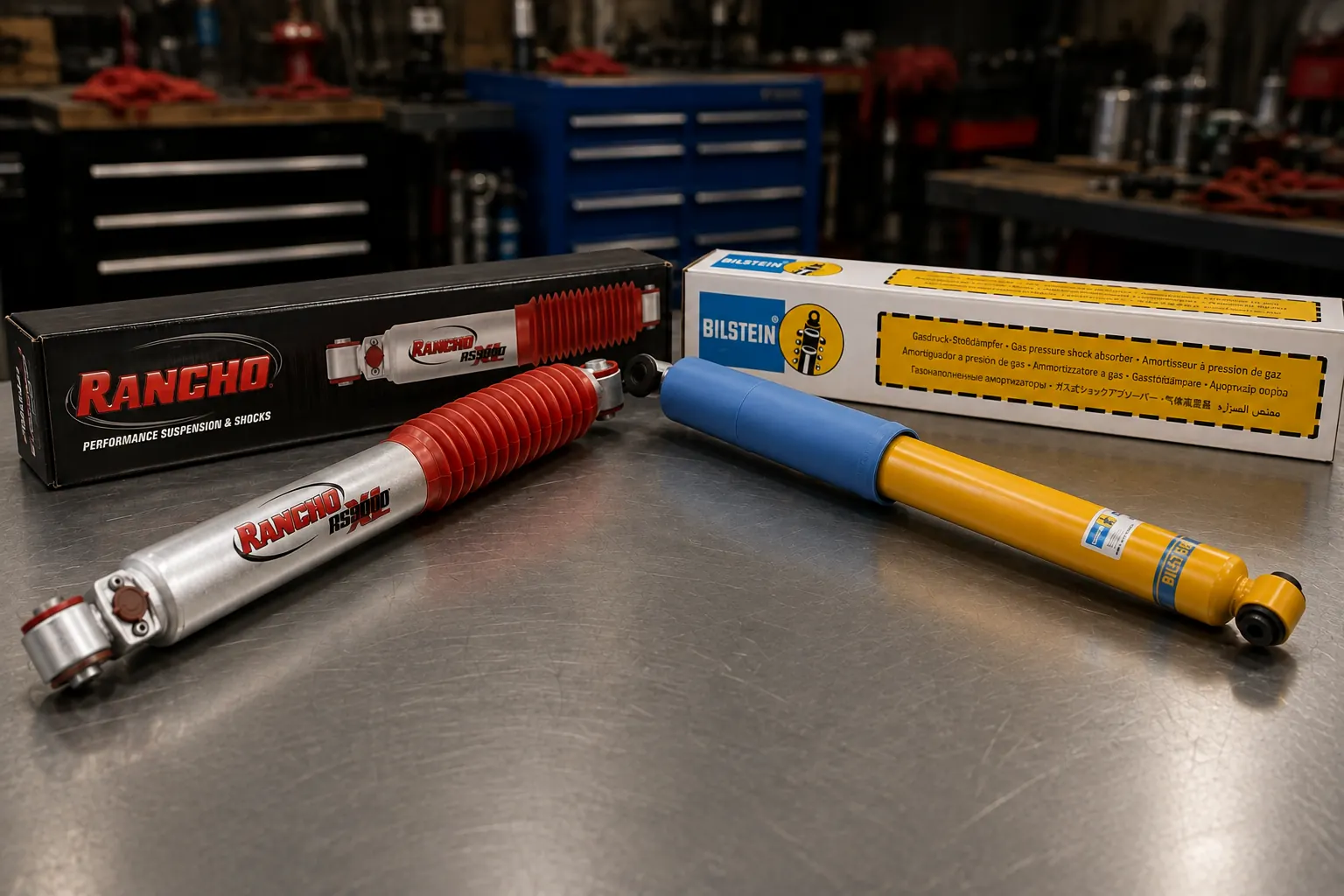
Rancho vs Bilstein Shocks: Which Should You Buy?
Rancho and Bilstein both make excellent shocks, but they're built for different drivers. Here's the honest breakdown to help you choose the right one.
The Short Answer
Bilstein is the stronger pick for long-term performance and on-road refinement, while Rancho is the better choice for budget-conscious off-road builds and adjustable damping flexibility.
| Rancho | Bilstein | |
|---|---|---|
| Design | Twin-tube (most models) | Monotube (all models) |
| Best for | Off-road, lifted trucks, value builds | All-around, towing, performance, longevity |
| Adjustability | Yes (RS9000XL — 9 positions) | No (set-and-forget) |
| Typical price range (per shock) | $40–$120 | $80–$200 |
| Expected lifespan | 50,000–80,000 miles | 100,000+ miles |
| Top series | RS5000X, RS9000XL | 5100, 6112, 4600 |
| Ride quality | Comfortable, soft-leaning | Firm, controlled, consistent |
What's the Actual Difference Between These Two Brands?
Both Rancho and Bilstein have serious off-road credibility and long track records in the truck and SUV market. But they approach shock absorber design from different angles, and that matters when you're trying to figure out where to spend your money.
Rancho built its reputation almost entirely in the truck and Jeep world. Their shocks are designed around lifted 4x4 platforms — Wranglers, Tacomas, F-150s, Silverados — and they've always priced themselves to be accessible. You're not going to spend a fortune on a full set, and the RS9000XL's adjustable damping dial is a genuinely useful feature if you want to soften the ride for the highway and firm it up for the trail.
Bilstein takes a more engineering-first approach. Every shock they make uses a monotube gas-charged design, which means the gas and oil are separated by a floating piston. That separation prevents aeration (oil foaming under heat), which is what causes shock fade on long descents or repeated hard hits. It also means Bilstein shocks run cooler and recover faster — important whether you're running mountain switchbacks or a rocky trail.
The honest verdict? If you're building a weekend-warrior Jeep on a budget, Rancho gets the job done and gives you some tuning flexibility. If you drive your truck daily, tow regularly, or push hard on technical trails, the Bilstein is worth the extra cost.
Monotube vs Twin-Tube: Why This Design Difference Matters
Most Rancho shocks — including the popular RS5000X — use a twin-tube design. The shock has an inner and outer cylinder, with oil filling the space between them. It's a proven, cost-effective design that works well under moderate use.
The problem with twin-tube is heat. When you're compressing the shock repeatedly — think washboard roads, sustained off-camber driving, or spirited canyon driving — the oil and gas can mix and aerate. Aerated oil doesn't damp as well. You feel it as inconsistency: the shock starts soft and gets softer over a run, then firms back up once it cools.
Bilstein's monotube eliminates that. The floating piston keeps the nitrogen gas and hydraulic oil completely separated at all times. According to RepairPal's suspension overview, consistent damping is one of the biggest factors in both tire wear and braking performance — two things you don't want degraded on a trail or in an emergency stop on the highway.
This isn't a knock on Rancho — twin-tube shocks work fine for the majority of drivers. But if you're asking which design holds up better under sustained stress, monotube wins.
Rancho's Best Series: RS5000X and RS9000XL
Rancho offers a few distinct shock lines, and they're not all created equal.
RS5000X
This is their workhorse. It's a twin-tube design aimed at stock-height and mildly lifted trucks. The RS5000X is a solid upgrade over factory shocks for drivers who want better control without spending a lot. Good for light off-road, daily driving, and towing light loads.
RS9000XL
This is where Rancho gets interesting. The RS9000XL is an adjustable monotube shock with nine damping settings you can dial in by hand — no tools needed. Setting 1 is plush for highway cruising, setting 9 is stiff for technical terrain. For drivers who genuinely alternate between pavement and trail, that's a real advantage. It also puts Rancho's damping quality much closer to Bilstein's price range at the high end.
Bilstein's Best Series: 4600, 5100, and 6112
4600 Series
Designed for stock-height trucks and SUVs. The 4600 is a direct OE-replacement monotube shock — same height, better performance. If you're not lifted and just want the best-possible ride and longevity over a factory shock, this is the move.
5100 Series
The most popular Bilstein for truck owners. The 5100 is built for lifted applications and, on front applications, features an adjustable lower mount that lets you dial in ride height between roughly 0–2.5" of lift without swapping springs. It's become a staple for mild-lift Tacomas, Tundras, and F-150s. KBB's truck buying resources consistently list upgraded shocks as one of the top value-adds on used truck listings.
6112 Series
A coilover kit combining a 5100-style shock body with a matching spring. If you want a complete front suspension upgrade, this is a cleaner solution than mixing components from different brands. Premium price, premium results.
Which Is Better for Towing?
Towing puts sustained, directional load on your shocks. You want a shock that doesn't compress too easily under the tongue weight and doesn't oscillate on highway undulations while hauling.
Bilstein holds an edge here. The monotube design handles sustained load better because it doesn't suffer heat fade, and the firmer damping tune helps keep the rear from squatting excessively. NHTSA's trailer towing safety resources emphasize that vehicle stability control begins with proper suspension function — worn or under-spec'd shocks are a genuine safety issue when towing.
Rancho's RS9000XL at setting 7–9 is a respectable towing shock, but in a direct comparison, the Bilstein 5100 or 4600 is the more confident choice.
Price vs. Value: The Honest Math
Rancho typically runs $40–$120 per shock at retail. A full set of four RS5000X shocks might run you $200–$350 depending on your application.
Bilstein shocks run $80–$200 per shock. A full set of 5100-series shocks for a midsize truck can easily run $350–$650.
Here's where the math gets interesting: if Bilstein shocks last twice as long — and many owners report exactly that — the per-mile cost evens out or even favors Bilstein over time. If you're keeping your truck for 150,000 miles, one set of Bilsteins might outlast two sets of Ranchos.
My honest take: for a dedicated off-road rig you'll beat on hard and rebuild every few years anyway, Rancho makes total sense. For a daily-driven truck you plan to keep long-term, invest in the Bilsteins. You'll feel the difference every single day.
What About Warranty?
Both brands offer limited lifetime warranties on their shocks against defects in materials and workmanship. The fine print differs — off-road or racing use typically voids coverage on both sides. Read the warranty card that comes with your specific part, because "limited lifetime" means different things to different manufacturers.
Sources
- RepairPal — Suspension & Shock Absorbers
- Kelley Blue Book — Truck Resources
- NHTSA — Trailer Hitch & Towing Safety
Find the right part for your vehicle
Guaranteed fit, ships free
FAQ / People Also Ask
For on-road handling and long-term durability, most experienced off-roaders and automotive enthusiasts lean toward Bilstein. For lifted trucks, budget-conscious builds, or adjustable damping, Rancho is a solid choice. Neither is universally 'better' — it depends on how and where you drive.

Comments
Loading comments...
Comments are moderated by the AutoBuffy team.