

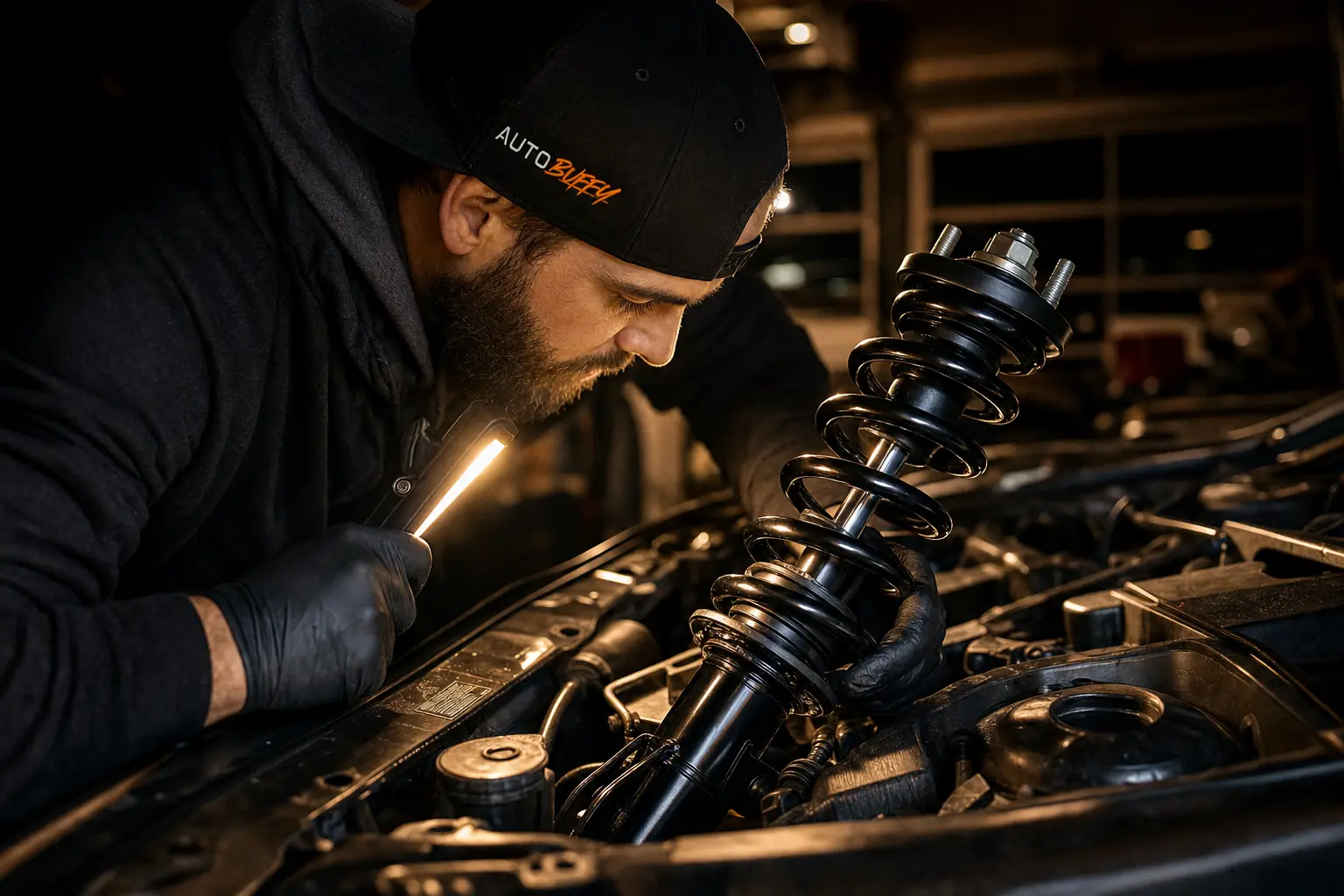
Rear Shock Replacement Cost: What You'll Pay for Parts and Labor
Rear shock replacement runs $250–$580 for both sides on most vehicles. Here's exactly what drives that number — and how to avoid overpaying.
The Short Answer
Rear shock replacement costs $250–$580 for both sides on most passenger vehicles when you factor in parts and labor together.
That range covers the majority of everyday cars, trucks, and SUVs with conventional rear shock setups. Vehicles with electronic, adaptive, or air suspension are a different story — plan on significantly more. Here's a clean breakdown of what drives the number. | Cost Component | Typical Range |
| Budget shocks (per shock) | $30–$100 |
|---|---|
| Premium shocks (per shock) | $100–$300 |
| Labor – independent shop | $50–$100/hour |
| Labor – dealership | $100–$140/hour |
| Job duration | 1–3 hours |
| Total, both rear shocks (most vehicles) | $250–$580 |
| Electronic/air suspension parts (pair) | $600–$1,500+ |
What's Actually Included in That Price? When a shop quotes you rear shock replacement, the number should cover two shocks (always replace in pairs — more on that below), labor, and usually a basic inspection of the surrounding hardware. What it often *doesn't* include: any worn-out bump stops, mounting hardware, or a post-service alignment check if other components were touched. Ask upfront. "Does that quote include new mounting hardware?" is a completely reasonable question and a good shop won't flinch at it. ---
Parts Cost: Budget vs. Premium
Budget Shocks ($30–$100 per shock)
You'll find these at the low end of the aftermarket. They work fine for basic commuting on smooth roads and are a practical choice for older vehicles where the repair cost approaches the car's value. Ride quality is adequate, not exceptional. ### Premium Shocks ($100–$300 per shock)
This is where brands like KYB, Monroe, and Bilstein live. KYB is an independent Japanese corporation headquartered in Tokyo — one of the largest shock absorber producers in the world by volume — and their Gas-a-Just and Excel-G lines are workhorses in this segment. Monroe, owned by DRiV Incorporated (which also holds Rancho, MOOG, and other brands), offers a wide range from daily-driver units up to performance-tuned options. Bilstein sits at the upper end, particularly on heavy-duty and performance applications, with full corner module assemblies available for vehicles that need them. My honest take: for any vehicle you plan to keep past 100,000 miles, the premium tier is worth it. The price difference between a budget and mid-grade shock is often $40–$80 per shock. That's a small number compared to doing the labor over again in 30,000 miles. ---
Labor Cost: Shop vs. Dealership
Independent Shops ($50–$100/hour)
This is where most of the value is. A good independent mechanic can do a rear shock swap in 1–3 hours, and on a common vehicle it's closer to 90 minutes per side combined. At $75/hour, that's roughly $112–$225 in labor for a straightforward job. ### Dealerships ($100–$140/hour)
Dealers charge a premium, full stop. The technicians are factory-trained on your specific brand, which matters more for complex electronics than for a bolt-on shock swap. For conventional rear shocks on most vehicles, you're paying extra for the badge on the wall, not necessarily better results. > "I can get the same KYB shock installed at my local shop for about 60% of what the dealer quoted me." — a sentiment heard in virtually every online forum covering this topic, and it's consistently backed by the numbers. ---
When Costs Jump: Electronic and Air Suspension
If your vehicle runs Magnetic Ride Control, Continuous Damping Control, adaptive damping, or air suspension, budget expectations need to reset. Parts alone for these systems run $600–$1,500 per pair, and that's before labor. The job also requires diagnostic time and system recalibration, so expect longer shop hours too. Vehicles in this category include many luxury sedans, performance models, and modern trucks with available adaptive ride packages. Check your trim level before assuming you have conventional shocks. ---
Why You Should Always Replace Shocks in Pairs
Both rear shocks accumulate identical mileage under the same conditions. If one is worn, the other is at the same point in its lifespan — you just haven't noticed it failing yet. Replacing only one leaves mismatched damping side-to-side, which creates an imbalanced feel through corners and under braking. You'll also be back in the shop paying labor again when the second one gives out. Do both at once; the incremental parts cost is minor compared to paying for the labor twice. ---
RepairPal's Numbers and Why They Look Higher
You may have seen RepairPal's September 2026 estimate for suspension shock or strut replacement running $1,144–$1,348 total (labor $332–$487, parts $812–$862). That's a real data point, but it's reflecting strut-inclusive jobs — not bare rear shock replacements. Struts are structural assemblies that integrate the spring, and replacing them is a longer, more involved procedure. If your rear suspension uses standalone shocks (which many trucks, SUVs, and rear-wheel-drive vehicles do), you're looking at the lower range of our table above, not RepairPal's strut estimate. ---
Can You DIY Rear Shock Replacement? On many vehicles, yes — and it's one of the more approachable suspension jobs. Most rear shock swaps require basic hand tools, a floor jack, and jack stands. You skip the labor cost entirely and pay only for parts. The catch: some applications need a spring compressor, special sockets, or have tight packaging that makes the job genuinely tedious. Look up your specific vehicle before committing. If the job requires a coilover spring compressor or the shocks are integrated into a complex rear subframe, an independent shop is probably worth the money. ---
How to Get an Accurate Quote
- Call two or three independent shops and give them your year, make, model, and trim. Ask for a quote on parts *and* labor together, including mounting hardware. 2. Ask what brand of shock they plan to use. A shop that can't answer that is a shop that might install whatever's cheapest in the moment. 3. Compare to online parts pricing. If you know what a quality shock costs, you can tell whether a shop is padding the parts markup heavily. 4. Use the part finder below to check exact fitment and current pricing on quality shocks for your vehicle — then you walk into any shop knowing what you should be paying for the part. ---
Signs Your Rear Shocks Need Replacing
- Bouncing continues for more than one or two cycles after hitting a bump
- Rear end squats noticeably during braking
- A floating or wallowing sensation at highway speeds
- Uneven tire wear, particularly cupping or scalloping
- Clunking or knocking sounds over rough pavement
- Visible oil leaking from the shock body
If you're seeing two or more of these at the same time, get an inspection scheduled. Worn shocks don't fix themselves, and they accelerate wear on tires and other suspension components the longer they're ignored. ---
Find the right shock absorber for your vehicle
Guaranteed fit, ships free
FAQ / People Also Ask
Most drivers pay $250–$580 to replace both rear shocks, including parts and labor. That range shifts based on your vehicle type, the brand of shock you choose, and whether you go to a dealership or an independent shop.

Comments
Loading comments...
Comments are moderated by the AutoBuffy team.