

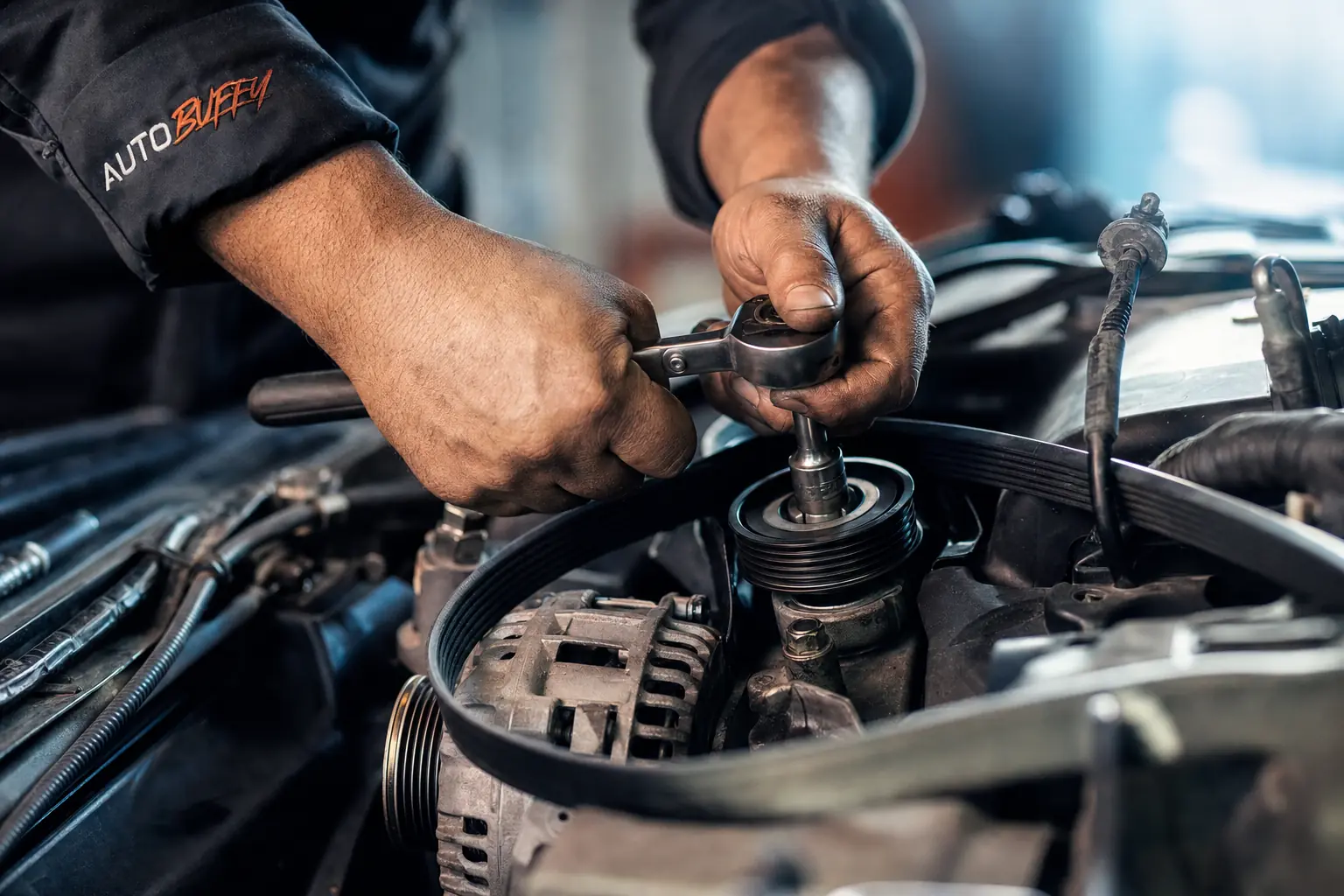
Serpentine Belt Replacement Cost: What You'll Pay and When to Do It
A serpentine belt is cheap to buy but drives your alternator, power steering, and often the water pump. Here's what replacement actually costs, the signs it's failing, and how long you can keep driving.
That chirp or squeal on a cold morning start-up? Nine times out of ten it's your serpentine belt telling you it's tired. The good news: the belt itself is one of the cheapest parts on your engine. The catch: it quietly runs your alternator, power steering, A/C, and on a lot of engines the water pump too — so when it goes, it can leave you stranded on the shoulder with a dead battery and an overheating engine.
Here's the straight answer: at a shop, a serpentine belt replacement usually runs $100 to $220 all-in. Do it yourself and you're looking at $20 to $70 for the belt and about twenty minutes once you've done it once. The belt is cheap; labor is the whole swing.
What a serpentine belt actually does (why one $30 part can strand you)
Older cars used a separate V-belt for each accessory. Modern engines run one long, flat, ribbed belt that snakes across every pulley at the front of the motor — that's the "serpentine" part. That single belt spins your alternator (charges the battery), the power steering pump, the A/C compressor, and on many engines the water pump that keeps the whole thing from overheating.
So when a serpentine belt snaps, it doesn't just get noisy. You lose charging, your steering goes heavy, and if the belt drives your water pump, the temperature needle climbs fast. That's why a part that costs less than a tank of gas is worth staying ahead of.
How much does a serpentine belt cost to replace?
| Scenario | Typical cost |
|---|---|
| Belt only, DIY | $20 – $70 |
| Belt + labor at a shop | $100 – $220 |
| Belt + tensioner or idler pulley | $200 – $450 |
| Tight transverse engines / belt routed behind other parts | $250 – $500+ |
Why the spread? Two things. First, the belt itself varies by length and rib count. Second — and this is the big one — access. On a rear-wheel-drive V8 with the belt right up front, it's a fifteen-minute job. On a sideways-mounted four-cylinder crammed against the fender, a tech may have to move a motor mount or wheel-well liner to reach it, and labor climbs.
One more line item worth knowing: the automatic belt tensioner and idler pulleys wear out on roughly the same timeline as the belt. If yours is rattling or the belt has been squealing for a while, replacing them together is smart — you're already in there, and a worn tensioner will chew through a brand-new belt.
5 signs your serpentine belt is on the way out
- Squealing or chirping, loudest on a cold start or right after you drive through a puddle.
- Visible damage: flip a flashlight on it and look for cracks across the ribs, a glazed shiny surface, fraying edges, or missing chunks.
- Battery or charging light flickering on — a slipping belt isn't spinning the alternator hard enough.
- Heavy, stiff steering at low speed, because the power steering pump is starving for belt grip.
- A/C that quit cooling, or a temperature gauge creeping up if the belt drives your water pump.
Can you drive with a bad serpentine belt?
A little — not far. If it's only squealing and the belt still looks intact, you can get to a shop, but don't put it off. If you can see cracks, fraying, or chunks missing, treat it as urgent. A belt that lets go on the highway takes out your charging system instantly and, on many engines, your cooling too — turning a $30 part into an overheated engine and a tow bill.
How long does a serpentine belt last?
Most belts are rated for 60,000 to 100,000 miles — check your owner's manual for the exact interval. The tricky part with modern EPDM rubber belts is that they wear smooth instead of cracking, so they can look fine and still be slipping. If yours is past 60,000 miles or the tensioner is noisy, it's cheap insurance to replace it before it fails on its own schedule instead of yours.
DIY vs. shop
If the belt is up front and reachable, this is one of the most satisfying jobs a beginner can tackle. You need a serpentine belt tool or a long ratchet to swing the spring-loaded tensioner off, and — most important — you need the routing diagram (usually a sticker under the hood or on the fan shroud). Snap a photo of the old belt's path before you pull it. Let the tensioner down slowly; don't let it snap.
Send it to a shop if the belt routes behind the engine or other components, if you don't own the tool, or if the tensioner and pulleys need replacing at the same time.
Find the right part for your vehicle
Guaranteed fit, ships free
The bottom line
A serpentine belt is a cheap part attached to an expensive risk. Replace it on schedule, swap the tensioner if it's noisy, and don't let a worn belt take your alternator or water pump down with it. Whether you DIY it for the price of the belt or pay a shop a couple hundred, it's one of the best-value repairs on the car.
FAQ / People Also Ask
At a shop, expect roughly $100 to $220 including parts and labor. The belt itself is only $20 to $70, so most of the cost is labor, which varies with how hard the belt is to reach. Replacing the tensioner or idler pulleys at the same time can push the total to $200–$450.
Comments
Loading comments...
Comments are moderated by the AutoBuffy team.