

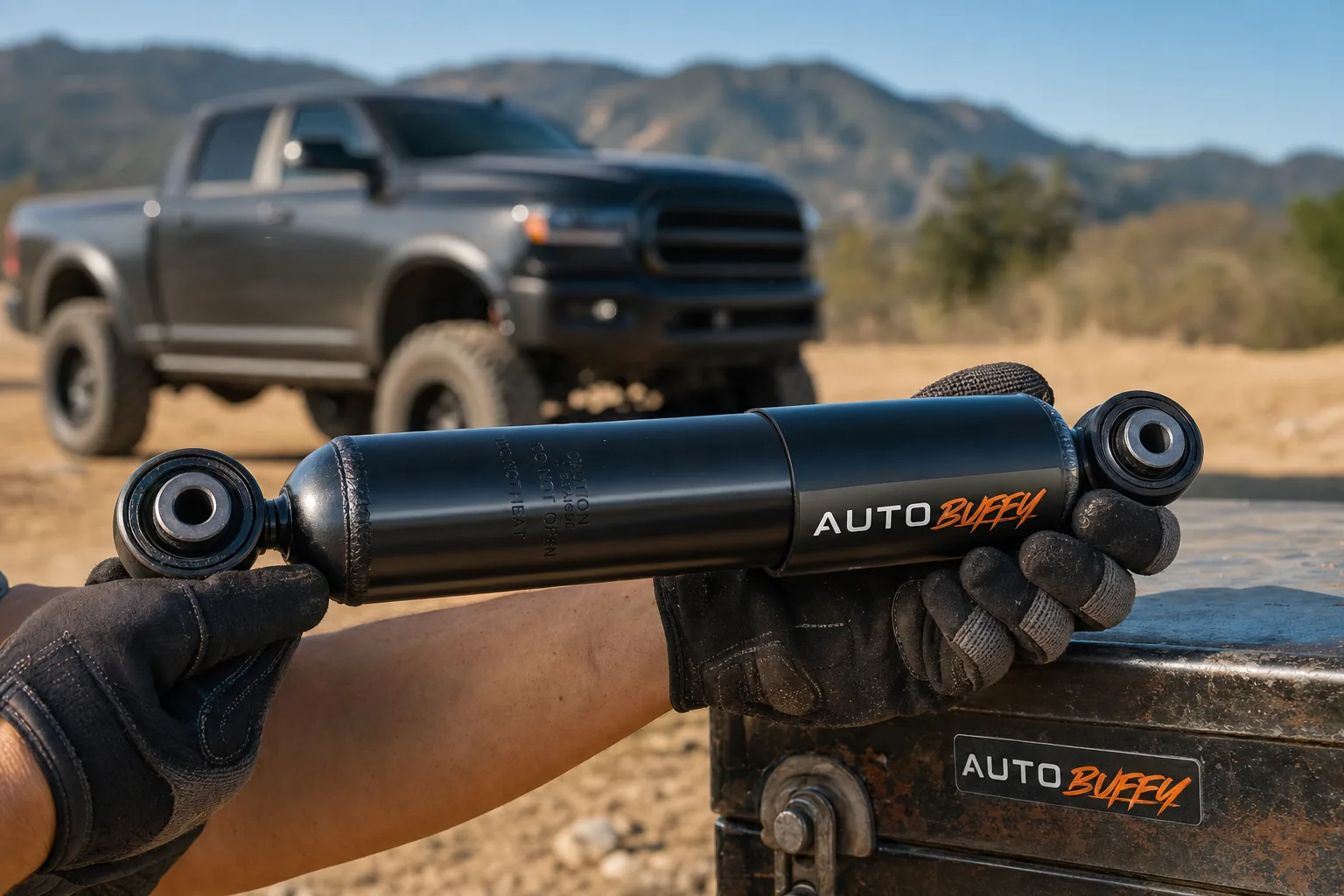
Shocks for Lifted Trucks: How to Measure Extended Length Before You Buy
Buying shocks for a lifted truck without measuring first is a gamble. Here's exactly how to measure extended and compressed length so you get the right fit.
The Short Answer
Before you buy shocks for a lifted truck, you must measure the center-to-center distance between your upper and lower mount points at full droop (extended) and full compression — shocks are not universal, and getting these numbers wrong means your suspension won't work correctly.
| Measurement | How to Get It | Why It Matters |
|---|---|---|
| Extended length | Lower axle to full droop; measure mount center-to-center | Shock must reach this length without running out of travel |
| Compressed length | Compress to bump stop; measure mount center-to-center | Shock must collapse to at least this short |
| Stroke | Extended minus compressed | Must match or exceed your lift's added suspension travel |
| Typical lifted-truck stroke | 10–16 inches depending on platform | Stock shocks average 8–12 inches — often not enough |
| Typical cost range | $150–$400 (basic) / $600–$1,500+ (performance/module) | Varies by shock type, platform, and brand |
Why Lifted Trucks Destroy the Wrong Shocks Fast
A shock absorber has two jobs: dampen suspension movement on compression, and control rebound on extension. It can only do both within its designed travel range. When you lift a truck, the distance between the upper and lower mount points increases — sometimes dramatically. Factory shocks are calibrated for stock ride height, so they're working outside their range the moment you bolt on a lift kit. The failure modes are predictable. A shock that's too short bottoms out before the bump stop engages, so the shock itself takes full impact loads it was never built for. Seals blow, shafts bend, and the truck rides like a buckboard. A shock that's too long gets pulled past its extended limit under droop, stressing the internal limit strap (if it has one) or simply tearing the shock off its mount under hard articulation. Neither failure is subtle. Both are expensive. Measuring first is free. ---
How to Measure Extended Length (Droop)
This is the measurement most people skip, and it's the one that bites them hardest. What you need: A tape measure, a floor jack or lift, and ideally a helper. 1. Safely lift the truck and support the frame so the axle or control arm hangs freely. 2. Slowly lower the axle — or let it hang — until it reaches maximum downward travel. You'll know you're at max droop when the movement stops, limited by the sway bar links, coil spring length, or the shock's own internal limit strap if it has one. 3. Measure from the center of the upper shock mount bolt hole to the center of the lower shock mount bolt hole. 4. Write that number down. That is your required extended length. > The shock you buy must be able to reach this length at full extension. If it's shorter, you'll be pulling it past its limit under normal droop travel. One honest opinion: most mechanics I've talked to say they see at least a 30% failure rate on improperly sized lift-kit shocks within 18 months. Measuring takes 15 minutes. Buying a replacement shock doesn't. ---
How to Measure Compressed Length
This one's a little easier because bump stops give you a hard reference point. 1. With the truck safely supported, compress the suspension fully upward until the bump stop contacts its pad. Don't force it — just get the suspension to its natural limit. 2. Again, measure center-to-center between the upper and lower shock mount bolt holes. 3. That number is your required compressed (collapsed) length. The shock you choose must collapse to at least this measurement — ideally a little shorter, so the bump stop is actually doing its job rather than the shock topping out first. ### Calculating Stroke
Once you have both numbers:
Stroke = Extended Length − Compressed Length
This tells you how much travel the shock can absorb. Compare it to the stroke of your current shocks. Your lift kit added suspension travel — your new shocks need enough stroke to cover it. ---
Mount Style and Diameter: Two More Things to Confirm
Shock length is the big one, but it's not the only fitment variable. Mount style: Shocks attach via eye/loop mounts (a circular ring) or stud mounts (a threaded post). Measurements are always taken from the center of the loop or the base of the stud — not the tip. Mixing mount styles requires an adapter and isn't ideal. Shock body diameter: Performance monotube shocks for lifted trucks often come in larger diameters — 46mm, 60mm, and bigger. Larger diameter means more oil volume, which matters for sustained off-road use and heat management. Confirm your application can physically fit the diameter you're considering, especially up front where space is tight. ---
Which Shocks Are Actually Built for Lifted Trucks? A few brands stand out for lifted-truck applications, and each has a different strength. ### Bilstein
Bilstein — part of thyssenkrupp, headquartered in Ennepetal, Germany — is one of the most consistently recommended brands for lifted applications. Their monotube gas-pressure design maintains consistent damping even when the shock is working hard over rough terrain, which matters more on a lifted truck running bigger tires and added weight. Their 60mm shock bodies are specifically built for high-travel, high-stress applications. If your truck runs an independent front suspension, their corner module assemblies come pre-assembled with the spring and upper mount, which takes a lot of the guesswork out of installation. ### FOX
FOX Factory — a publicly traded American company (Nasdaq: FOXF) with roots going back to 1977 in California, now headquartered in Duluth, Georgia — has become a go-to name in lifted-truck and off-road circles. Their internal bypass and reservoir shock designs are engineered around high travel and repeated hard use. It's worth knowing that Fox Factory also owns BDS Suspension and Zone Offroad, so there's tight integration between their shock specs and those suspension kit designs. ### Motorcraft and Dorman
For trucks that need OE-quality replacements — particularly Ford platforms — Motorcraft shocks are built to factory spec and are a solid, honest choice when your lift is mild and your mount dimensions are close to stock. Dorman covers specific rear air shock applications, which show up on some truck trims that use air suspension from the factory. ---
A Simple Pre-Purchase Checklist
Before you click buy on any shock for your lifted truck, run through this:
- Measured extended length? (center-to-center at full droop)
- Measured compressed length? (center-to-center at full bump)
- Calculated required stroke? (extended minus compressed)
- Confirmed mount style? (eye-to-eye, eye-to-stud, stud-to-stud)
- Checked shock body diameter fits your application?
- Matched shock valving to your tire size and use case? (a truck with 37s and 1,000 lbs of added weight needs different valving than a stock-weight daily driver)
Skip any one of these and you're guessing. Guessing on lifted-truck shocks is how you end up doing this job twice. ---
Don't Forget: Revalving and Weight Matter
A shock that's the right length but valved too soft for your setup will feel like a wet noodle. Lifted trucks running larger tires, heavy bumpers, or a loaded bed put significantly more demand on shock damping than a stock truck. Some brands offer application-specific valving — always check whether the shock you're buying is tuned for stock weight or for a built truck. If you're running a heavy winch bumper up front, for example, a shock valved for that added unsprung weight will control body roll and dive far better than a standard replacement, even if the lengths are identical. ---
Why buy from AutoBuffy
- Fitment check: add your vehicle and we confirm the part fits before you buy. If it doesn't fit because of our listing, you get a free return and a full refund, including original shipping.
- 24-month limited warranty on new parts bought on autobuffy.com.
- Real reviews: rated 4.9 by 19,069 verified customers.
- 30-day returns on unused parts in the original packaging.
- Free shipping on orders $50+. Orders placed before 12:00 PM ET (Mon-Fri) ship the same business day.
- Questions about an order? Call 888-477-2530 or email help@autobuffy.com.
Find the right shock absorber for your lifted truck
Guaranteed fit, ships free
FAQ / People Also Ask
Yes. Shocks are not universal — a lift kit raises the body or frame relative to the axle, increasing the distance between your upper and lower mount points. Factory-length shocks will bottom out or top out before the suspension reaches full travel, which ruins ride quality and can damage the shock internals.

Comments
Loading comments...
Comments are moderated by the AutoBuffy team.