

Shocks vs Struts: What's the Difference and Which Does Your Car Have?
Shocks and struts aren't interchangeable. Learn the real difference, how to tell which your car has, and when to replace them.
The Short Answer
A shock absorber is a standalone damping component, while a strut is a structural assembly that combines a shock absorber with a suspension mount and they serve related but distinct roles, with your car likely having one, the other, or both depending on which corner you are looking at.
| Feature | Shock Absorber | Strut |
|---|---|---|
| Carries vehicle weight? | No | Yes |
| Structural suspension component? | No | Yes |
| Spring integrated? | No (separate) | Often yes |
| Typical location | Rear of trucks and SUVs | Front of most cars |
| Replacement requires alignment? | Usually no | Almost always yes |
| DIY difficulty | Moderate | Higher |
| Typical part cost per unit | $100 to $300 | $150 to $450 |
If a shop has ever told you your struts are shot and you wondered why they cost more to fix than a friend's bad shocks, this article clears that up.
What Does a Shock Absorber Actually Do?
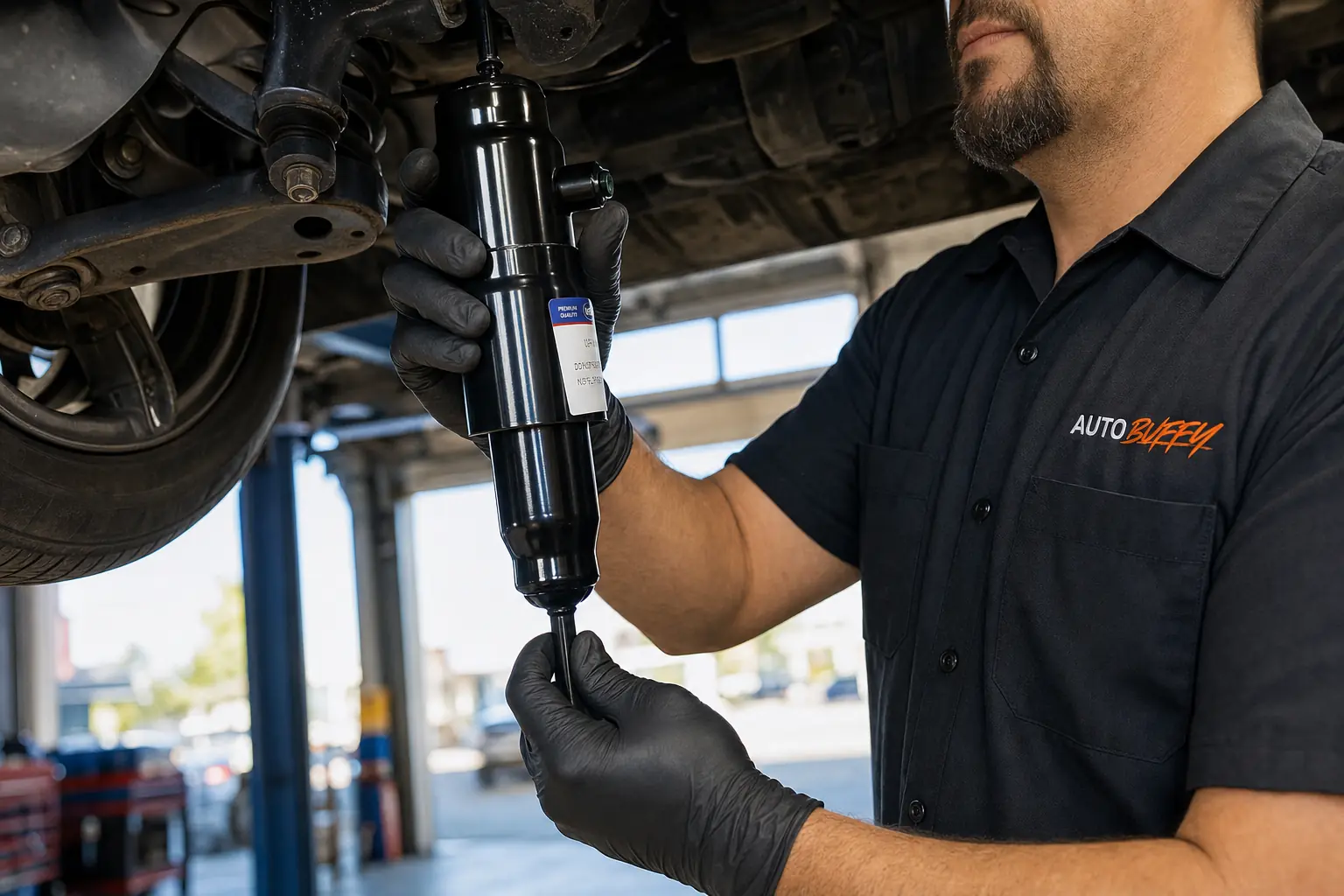
A shock absorber is a hydraulic damper. Its only job is to control how fast your suspension compresses and rebounds after hitting a bump. It doesn't hold the car up. It doesn't locate the wheel. It just slows the bounce.
Inside the cylinder, hydraulic fluid is forced through small valves as the piston moves. That resistance converts suspension energy into heat, which dissipates through the shock body. Simple and effective.
Shocks are typically found at the rear of trucks, pickup trucks, and body-on-frame SUVs, where the coil spring or leaf spring sits separately on the axle housing or control arm. The shock bolts between the axle and the frame doing nothing structural, just damping.
Types of Shock Absorbers
- Twin-tube: The traditional design. Two cylinders, one inside the other. Reliable, cost-effective, and found on the vast majority of passenger vehicles.
- Monotube (gas-charged): A single cylinder with pressurized nitrogen gas separating the oil from a floating piston. Better heat management under hard use and faster response.
- Reservoir shocks: Serious off-road and performance units with an external fluid reservoir. Overkill for daily drivers but essential for extreme duty.
For most drivers on most roads, twin-tube or standard gas-charged shocks are exactly what you need.
What Is a Strut and How Is It Different?
A strut does everything a shock does and more. It is a structural suspension component that forms part of the vehicle's steering and weight-bearing geometry. Remove a strut and the wheel has no defined location relative to the chassis.
Most front strut assemblies include the shock absorber cartridge, a spring perch often with the coil spring already mounted, a strut bearing and mount at the top, and a steering knuckle attachment point at the bottom.
Because the strut controls camber and caster angles, disturbing it usually means a wheel alignment is required afterward. That is a big part of why strut jobs cost more.
The MacPherson strut is by far the most common design in front suspensions today. It is compact, lightweight, and cheap to manufacture at scale, which is why you find it on everything from economy hatchbacks to full-size crossovers.
Which Does Your Car Have?
Here is the quickest way to check without getting under the car.
- Look at the top of your front wheel well. If you see a large circular mount with bolts going into the strut tower, that is a strut top mount. Your front suspension uses struts.
- Look at the rear. If there is a separate shock cylinder with the spring sitting on the control arm or axle nearby, those are shocks.
- Check your owner's manual. The suspension section will name the front and rear setup.
Common Configurations by Vehicle Type
| Vehicle Type | Typical Front | Typical Rear |
|---|---|---|
| Compact or midsize car | Struts | Struts or shocks |
| Full-size sedan | Struts | Shocks or multi-link |
| Pickup truck | Struts or shocks | Shocks (leaf or coil) |
| Body-on-frame SUV | Shocks or struts | Shocks |
| Unibody crossover | Struts | Struts or shocks |
| Luxury SUV (e.g. Range Rover) | Air suspension with shock dampers | Air suspension with shock dampers |
How Do You Know When They Are Worn Out?
Most drivers don't notice gradually degrading shocks or struts because the change is so slow. By the time you really feel it, they've often been bad for thousands of miles.
Watch for these signs.
- Excessive bounce: Push down on a corner of the car. If it bounces more than once before settling, the damper isn't doing its job.
- Nose dive under braking: The front dips noticeably when you brake hard.
- Body roll in turns: The car leans heavily to the outside of every corner.
- Cupping or scalloping on tires: Irregular wear patterns caused by the tire hopping instead of maintaining consistent road contact.
- Clunking or knocking over bumps: Often a worn strut mount or loose shock hardware, not just the damper itself.
- Steering wander: On strut-equipped vehicles, worn strut bearings can make the steering feel vague or pull to one side.
Honest opinion: if your vehicle has 80,000 miles or more and you have never touched the shocks or struts, have a shop put it on a lift and look. Industry data suggests roughly one in five vehicles on the road has at least one worn damper, and many owners have no idea.
What Do Replacement Shocks Cost?
Part costs vary significantly by vehicle. A rear shock for a 1990s Ford Explorer runs well under $200 per unit. A rear shock for a 2003 to 2012 Land Rover Range Rover with its complex suspension architecture is a different story, and specialty units for that platform reflect those engineering demands in their market pricing.
Labor is the other variable. Rear shock replacement on a solid-axle truck can be a 45-minute job. Front strut replacement with alignment on a unibody crossover is a 2 to 3 hour job at most shops. Call around for quotes, and don't skip the alignment afterward. It'll cost you more in tires if you do.
Find the right shock absorber for your vehicle
Guaranteed fit, ships free
FAQ / People Also Ask
No. A shock absorber is a standalone damping component. A strut combines a shock absorber with a structural suspension mount, meaning it also carries vehicle weight. They are not interchangeable.

Comments
Loading comments...
Comments are moderated by the AutoBuffy team.