

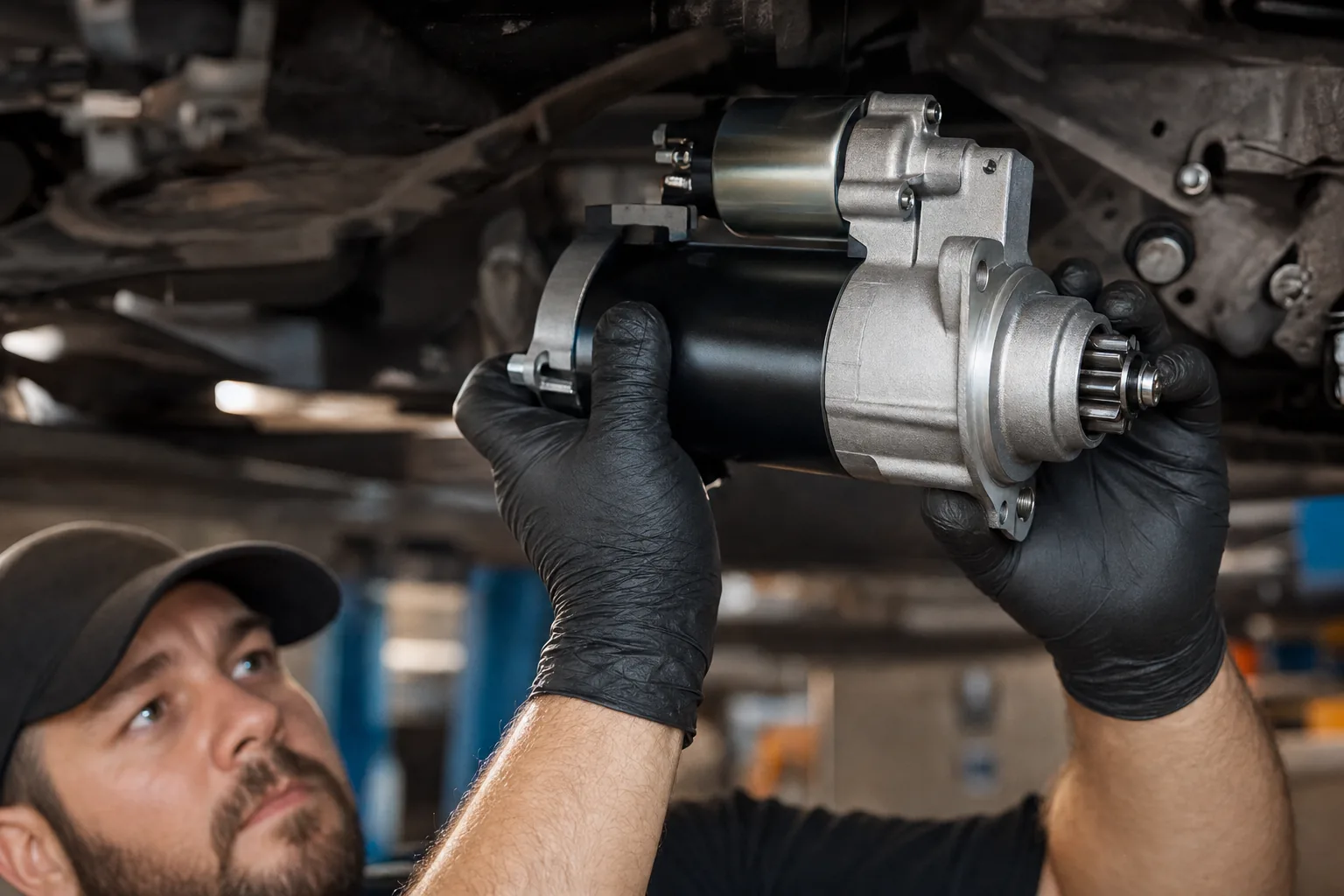
Starter Replacement Cost (2026): What You'll Actually Pay
Starter replacement runs $250–$650 at most shops in 2026. Here's what drives the price up, what you can skip, and how to avoid getting overcharged.
The Short Answer
Starter replacement costs $250–$650 at most independent shops and dealerships in 2026, with parts running $80–$350 and labor making up the rest.
| Cost Factor | Typical Range |
|---|---|
| Remanufactured starter (part only) | $80 – $200 |
| New OE-quality starter (part only) | $150 – $350 |
| Labor (1–2 hrs, accessible location) | $80 – $200 |
| Labor (3–4 hrs, buried/difficult access) | $200 – $400 |
| Total: average car/SUV | $250 – $550 |
| Total: truck, diesel, or luxury vehicle | $400 – $900+ |
Those numbers line up with what RepairPal reports across thousands of real repair orders. Your actual bill depends on three things: your vehicle, where you live, and whether you go to a dealer or an independent shop.
What Actually Goes Into the Price
The Part
The starter itself is usually the bigger chunk of the bill. You'll see two main options at any parts counter or online retailer:
- Remanufactured (reman): A factory-rebuilt unit where the worn components—brushes, solenoid, bearings—have been replaced and the whole assembly tested to OE specs. These typically run $80–$200 and come with a warranty ranging from 1 year to lifetime depending on the brand.
- New: All-new components, no core exchange required. Expect $150–$350 for most applications, more on European or diesel platforms.
For the average daily driver, a quality reman starter is hard to argue against. I've seen them last just as long as new units in comparable conditions, and the cost savings are real.
The Labor
Here's where the price can swing dramatically, and it has nothing to do with the part itself. On a lot of four-cylinder economy cars, the starter sits right up front—two bolts, one wiring connector, 45 minutes total. On a V6 or V8 where the starter is tucked under the intake manifold or wedged between the engine and firewall, a technician might spend three to four hours in there. Labor rates at independent shops run roughly $80–$120/hour in most U.S. markets; dealerships typically charge $130–$180/hour.
That's why the same $150 starter can result in a $300 bill on one car and a $650 bill on another.
Symptoms: How Do You Know It's the Starter?
Before you authorize a repair, make sure the starter is actually the problem. A dead battery or a failed alternator can produce very similar symptoms, and replacing a good starter doesn't fix either of those.
Starter symptoms to watch for:
- Single loud click or silence when you turn the key — the solenoid is engaging but the motor isn't spinning.
- Rapid clicking — usually a battery issue, but can indicate a starter drawing too much current.
- Grinding noise during cranking — the starter drive or flywheel ring gear teeth may be worn or damaged.
- Intermittent no-start — sometimes it cranks fine, sometimes nothing. Heat-soaked starters do this.
- Starter cranks but engine won't catch — that's a fuel or ignition issue, not the starter.
The fastest way to confirm: have the battery load-tested first (most auto parts stores do this free). If the battery checks out, a shop can bench-test the starter after pulling it. Skipping that diagnostic step and guessing costs money.
Dealer vs. Independent Shop vs. DIY
Dealership
You'll pay the highest labor rate here, and the parts are OE or dealer-branded. For vehicles still under warranty, this is where you go — the repair may be covered at no cost. Outside warranty? The premium is hard to justify for a straightforward electrical job.
Independent Shop
This is where most people get the best value. A reputable independent will typically use quality reman or new-aftermarket starters with comparable warranties, and their labor rates are 20–40% lower than dealers on average. AAA's repair shop locator can help you find vetted shops in your area.
DIY
If the starter is accessible, replacing it yourself is genuinely one of the more manageable electrical jobs on a vehicle. The basic steps are:
- Disconnect the negative battery terminal — non-negotiable.
- Locate the starter (check your factory service manual or a model-specific forum).
- Label and disconnect the wiring (there's usually a main power cable and a small trigger wire to the solenoid).
- Remove the mounting bolts — typically two or three.
- Install the new/reman unit, torque bolts to spec, reconnect wiring, reconnect battery.
- Test.
If you're dealing with a buried starter on a transverse V6 or something that requires intake removal, honestly evaluate whether the labor savings are worth the risk of a stripped bolt in a tough spot. On those jobs, paying a shop is reasonable.
What Can Drive Your Quote Higher
- Diesel engines: Diesel starters are heavier-duty and simply cost more to manufacture. Parts alone can run $200–$400.
- European vehicles: BMW, Mercedes, and Audi starters often require dealer-specific parts or longer labor times. Total bills of $700–$1,000 aren't unusual.
- Flywheel damage: A starter that's been grinding for a while can chew up ring gear teeth. If the shop says you also need a flywheel, get a second opinion — but don't dismiss it outright.
- Location: Labor rates in major metro areas (New York, San Francisco, Chicago) run higher than rural markets. A $450 job in Kansas City might be $650 in Los Angeles.
Should You Go New or Remanufactured?
Honest answer: for most people on most vehicles, a quality remanufactured starter is the right call. The core performance specs are the same, the warranties are solid, and you'll typically save $50–$150 over a new unit. If you're keeping the vehicle long-term and want absolute peace of mind, a new unit makes sense. If you're driving a high-mileage daily driver or an older vehicle you're not planning to keep forever, reman is the practical choice.
Use the part finder below to see which options fit your exact year, make, and model — and what they'll actually cost today.
How to Avoid Overpaying
- Get at least two quotes. Labor rates vary enough that a second call is always worth three minutes of your time.
- Supply your own part. Some shops allow it; some charge a handling fee. Ask upfront. If you can buy a quality part and save $60–$100, that matters.
- Confirm the diagnostic before the repair. A misdiagnosed starter replacement is a waste of everyone's time and money.
- Ask about the warranty. A shop should warranty both the part and their labor. One year minimum is reasonable; three years or "lifetime on the part" is better.
Sources
Find the right part for your vehicle
Guaranteed fit, ships free
FAQ / People Also Ask
Most drivers pay between $250 and $650 total (parts + labor) for a starter replacement in 2026. Luxury vehicles, diesel trucks, and cars with difficult access can push that to $900 or more.

Comments
Loading comments...
Comments are moderated by the AutoBuffy team.