

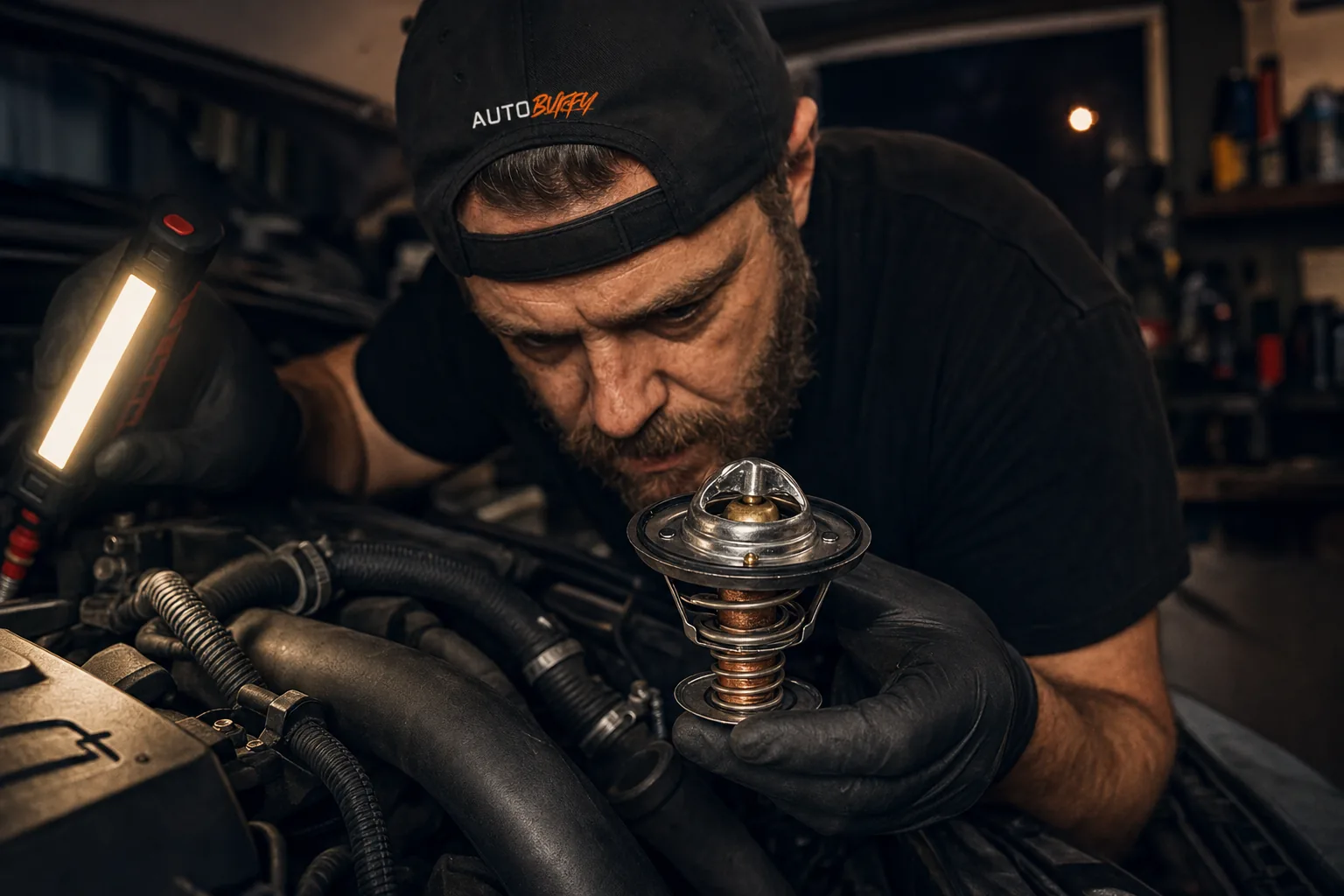
Thermostat Replacement Cost: Why a $20 Part Costs $400 at the Shop
A thermostat costs $15–$50, but total replacement bills hit $150–$450. Here's exactly where that money goes—and how to cut it.
The Short Answer
A thermostat itself costs $15–$50, but once you add shop labor, a new gasket or housing, coolant, and the shop's standard markup on parts, the total thermostat replacement cost lands between $150 and $450 for most vehicles.
| Cost Component | Typical Range | Notes |
|---|---|---|
| Thermostat (part) | $15 – $50 | $80–$150 for integrated assemblies |
| Thermostat housing | $20 – $80 | If plastic housing needs replacement |
| Coolant refill | $20 – $60 | Most shops drain system during this job |
| Labor (0.5–3 hrs) | $75 – $300 | Wide range by engine layout |
| Total at shop | $150 – $450 | More for luxury/European vehicles |
So where exactly does the rest of that money go? Let's walk through it.
Why Labor Costs More Than the Part
Here's the thing that surprises most people: mechanics don't charge $100/hour because they're taking advantage of you. Shops have real overhead—lifts, diagnostic equipment, insurance, training, and the hours they spend on jobs that don't go smoothly. A thermostat on a 2010 Toyota Camry might take 45 minutes. The same job on a 2016 BMW 328i, where the housing is tucked behind the intake manifold with a cluster of coolant lines around it, can eat two hours easily.
Labor rates range from about $80/hour at independent shops to $160+/hour at dealerships. That spread alone explains a big chunk of the price difference you'll see when you call around.
My honest take: for a straightforward thermostat job on a domestic or Japanese vehicle, paying more than $250 total at an independent shop is hard to justify. Get two quotes.
The Parts Markup You Don't See
Shops typically mark up parts 20–50% above their wholesale cost. That $15 thermostat they install might show up on your invoice as $35. This isn't a scam—it's how shops stay profitable on fast jobs where labor time is short. But it's worth knowing, because it's a real reason the bill climbs past what you'd pay buying the part yourself.
If you supply your own part, some shops will install it. Others won't, or they'll charge a higher labor rate to offset the lost margin. Ask before you assume.
Thermostat Housing: The Hidden Add-On Cost
Older vehicles used a simple cast-iron or aluminum housing. Many modern engines use plastic integrated housings that combine the thermostat, housing, and sometimes a temperature sensor into one assembly. These cost more—$60 to $150 is common—but they also eliminate the old-style gasket leak point.
If a tech recommends replacing the housing while they're in there and yours is plastic with visible stress cracks or a pitted sealing surface, that's legitimate advice. A leaking housing two weeks after a thermostat job means paying labor all over again.
What a Stuck Thermostat Actually Does to Your Car
A thermostat has one job: hold coolant in the engine until it reaches operating temperature (usually around 195–210 degrees F), then open and let it circulate through the radiator. When it fails:
- Stuck open: Coolant flows constantly, the engine never fully warms up, your heater blows lukewarm air, and fuel economy drops because the engine keeps running cold-enrichment fueling longer than it should.
- Stuck closed: Coolant can't escape. Engine temperature climbs. If you ignore the gauge, you risk a warped head gasket—a repair that can cost $1,500–$3,500 or more.
The math is obvious. Spending $200 now to fix a thermostat is a much better outcome than a $2,500 head gasket job.
DIY vs. Shop: When It Makes Sense to Do It Yourself
If you're comfortable with basic tools and can follow a procedure, a thermostat swap is one of the better DIY cooling jobs. The core steps are:
- Let the engine cool completely—hot coolant scalds.
- Drain enough coolant to work without a flood.
- Remove the hose and housing bolts (usually just two or three).
- Note the orientation of the old thermostat before pulling it.
- Install the new thermostat with a fresh gasket or O-ring.
- Torque bolts to spec—plastic housings crack if you go heavy-handed.
- Refill coolant, run the engine, bleed any air pockets from the system.
The job is harder when the housing is buried. Check a forum for your specific model before you commit. If there's a coolant pipe maze involved, the shop makes more sense.
Choosing the Right Thermostat: Don't Cut Corners
A $6 thermostat from a bargain bin is a false economy. Thermostats see constant thermal cycling—expand, contract, expand, contract, thousands of times a year. Cheap ones fail faster, and some fail stuck closed.
For fit confirmation and current pricing, use the part finder below.
How to Tell If a Shop Quote Is Fair
When you get a quote, ask these three things:
- What's the labor time? A fair estimate for an accessible housing is 0.5–1 hour. If someone quotes you 3 hours on a Civic, ask why.
- What brand thermostat are you using? A generic house brand with no warranty is a different value than a quality part.
- Does that include a coolant refill and system bleed? It should. If they say no, the job's not done right.
For most non-luxury vehicles, a complete job including coolant should be under $300 at an independent shop. Dealerships will be higher. European vehicles—especially anything with a plastic integrated housing buried in the engine—can legitimately run $350–$500.
The Coolant Refill You Shouldn't Skip
When the cooling system is opened for a thermostat job, air gets in. Air pockets in the cooling system cause hot spots and inaccurate temperature readings. A proper coolant refill and bleed—using the right coolant type for your vehicle (not all coolants are interchangeable)—is part of the job, not an upsell. If a shop quotes you a thermostat replacement without mentioning coolant, ask specifically what they plan to do with the system afterward.
Find the right part for your vehicle
Guaranteed fit, ships free
FAQ / People Also Ask
Most shops charge between $150 and $450 total, depending on vehicle make, thermostat housing design, and local labor rates. European and luxury vehicles routinely land at the higher end.


Comments
Loading comments...
Comments are moderated by the AutoBuffy team.