

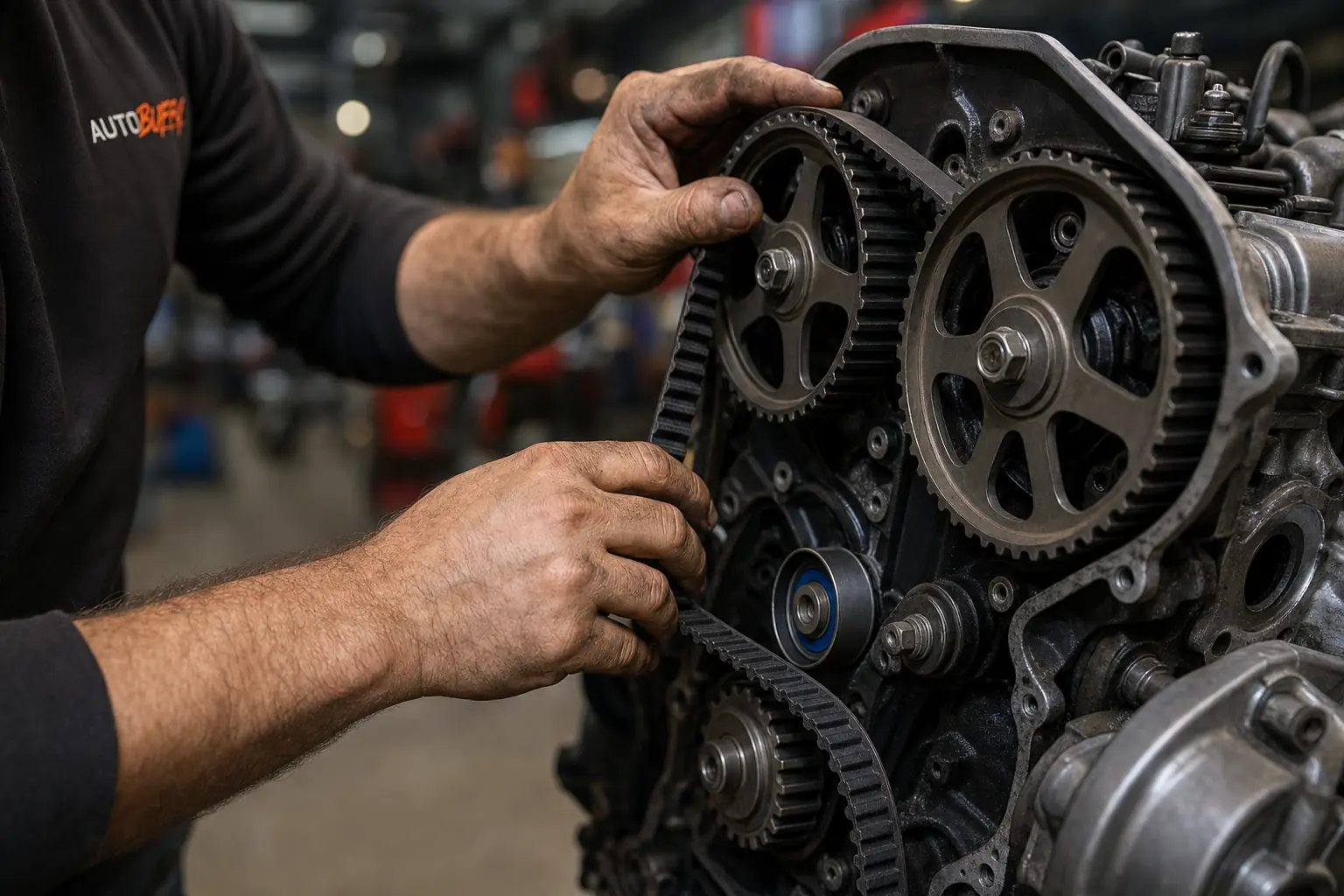
Timing Belt Replacement Cost (2026): What You'll Really Pay
Timing belt replacement typically runs $300–$1,000 at a shop. Here's exactly what drives the price and how to avoid a $3,000+ engine disaster.
The Short Answer
Timing belt replacement costs between $300 and $1,000 at most shops, with the final number driven by your specific engine, whether you bundle in the water pump, and local labor rates.
Don't let sticker shock push you into skipping this service. A snapped timing belt on an interference engine can turn a $500 maintenance job into a $3,000–$4,000 engine rebuild — or worse, a total loss.
| Scenario | Typical Cost Range |
|---|---|
| Belt only (parts + labor, basic engine) | $300 – $500 |
| Belt + tensioner + idler kit | $400 – $700 |
| Belt + full kit + water pump | $500 – $1,000 |
| European / complex engine (Audi, BMW, VW) | $700 – $1,200+ |
| Engine repair after belt failure (interference engine) | $1,500 – $4,000+ |
What Actually Drives the Price Up (or Down)
Labor is the biggest variable. The timing belt sits at the front of the engine, often behind the crankshaft pulley, splash shields, and sometimes the engine mount. On a straightforward inline-4, a skilled tech can knock it out in 3 hours. On a transversely mounted V6 or a tightly packaged European engine, you're looking at 6–8 hours easily.
RepairPal estimates the average timing belt replacement at $409–$919, which lines up with real-world shop invoices across most domestic and Japanese vehicles.
The three main cost factors:
- Engine design — How accessible is the front of the engine? A Honda 4-cylinder is far simpler than a Volkswagen TDI or a Mitsubishi V6.
- Parts bundled in — Belt alone vs. a full kit with tensioner, idler pulleys, water pump, and cam/crank seals.
- Shop type — Dealerships run 20–30% higher on labor than independent shops. A quality independent with OEM-equivalent parts is often the sweet spot.
Should You Replace the Water Pump at the Same Time?
Short answer: yes, almost always.
On most timing-belt-driven engines, the water pump sits right there in the same timing cover, driven by the belt itself. The labor to access it is already billed during a belt job. If the pump fails six months later, you're paying for all that disassembly again from scratch.
Adding a water pump to a timing belt job typically adds $80–$200 in parts and maybe 30–60 minutes of labor — a fraction of what you'd pay to do it separately. My honest opinion: skipping the water pump to save $150 now is one of the costlier mistakes I see people make. The math just doesn't work in your favor.
Timing Belt Replacement Intervals by Vehicle Type
Your owner's manual is the final word, but here are common intervals by category:
| Vehicle Type | Common Replacement Interval |
|---|---|
| Most Japanese 4-cylinders (Honda, Toyota) | 60,000 – 105,000 miles |
| Domestic engines (older Chrysler, Ford) | 60,000 – 90,000 miles |
| European engines (VW, Audi, BMW) | 40,000 – 80,000 miles (varies widely) |
| Subaru DOHC engines | 60,000 – 105,000 miles |
| Diesel engines (VW TDI, etc.) | 40,000 – 80,000 miles |
Also factor in time, not just mileage. Rubber degrades even if you're not driving. Most manufacturers recommend replacing the belt at the mileage interval OR 7–10 years, whichever comes first. A low-mileage car sitting for years can still have a dangerously brittle belt.
Interference vs. Non-Interference: Why It Matters So Much
This is the piece of information that determines whether a broken timing belt is an inconvenience or a catastrophe.
Interference engine: The pistons and valves share the same space — the timing belt is what keeps them from hitting each other. If it snaps, they collide. You'll bend valves, and in severe cases crack pistons or damage the cylinder head. Engine replacement or rebuild is often the result.
Non-interference engine: The pistons and valves have enough clearance that they can't contact each other. If the belt breaks, the engine stalls and you get towed. Annoying and expensive, but not catastrophic.
Most modern engines — especially Japanese and European designs — are interference engines. Don't assume yours isn't. Check your owner's manual or ask your mechanic.
The NHTSA database can help you look up recall and technical service bulletin history for your specific engine if you're researching known timing belt issues on a used vehicle.
Signs Your Timing Belt May Be Failing
Timing belts don't always give you a lot of warning, but watch for:
- Ticking or slapping noise from the front of the engine, especially on cold starts
- Engine misfires or rough idle caused by the belt slipping a tooth on the sprocket
- Visible wear — if you can see the belt through an inspection cover, look for cracking, fraying, or missing teeth
- OBD-II codes related to camshaft or crankshaft position sensor correlation (P0016, P0017, P0018, P0019)
- Oil leaks near the timing cover from degraded cam or crank seals, which can saturate and weaken the belt
If you're anywhere near the manufacturer's recommended interval and you're seeing any of these symptoms, get it inspected immediately. Waiting is gambling.
DIY vs. Professional Replacement
This is one of the jobs where experience matters more than enthusiasm. The belt has to be installed at precise timing marks, tensioned correctly, and the crank pulley torqued to spec — often 100+ ft-lbs. A mistake here doesn't show up right away; it shows up at 70 mph on the highway.
That said, mechanically confident DIYers with a proper repair manual, the right tools (including a crankshaft holding tool for most applications), and patience can do this job. The parts cost for a quality kit typically runs $60–$200 depending on the vehicle.
For most people, though, this is a "pay a pro" job. The consequences of getting it wrong are simply too severe.
What to Ask Your Shop Before You Approve the Work
- Does the quote include the tensioner and idler pulleys, or just the belt?
- Is the water pump part of the kit, or is that add-on pricing?
- What brand of belt are you using — is it OE-equivalent quality?
- Are the cam and crank seals being replaced?
- What's the warranty on parts and labor?
A reputable shop will answer all of these without hesitation. If they're vague about what's included, that's worth pushing on before you sign anything.
Sources
Find the right part for your vehicle
Guaranteed fit, ships free
FAQ / People Also Ask
Most drivers pay between $300 and $1,000 at an independent shop or dealership, depending on the vehicle make, model, and whether the water pump and tensioners are replaced at the same time. European and some Japanese vehicles often land at the higher end of that range.
Comments
Loading comments...
Comments are moderated by the AutoBuffy team.