

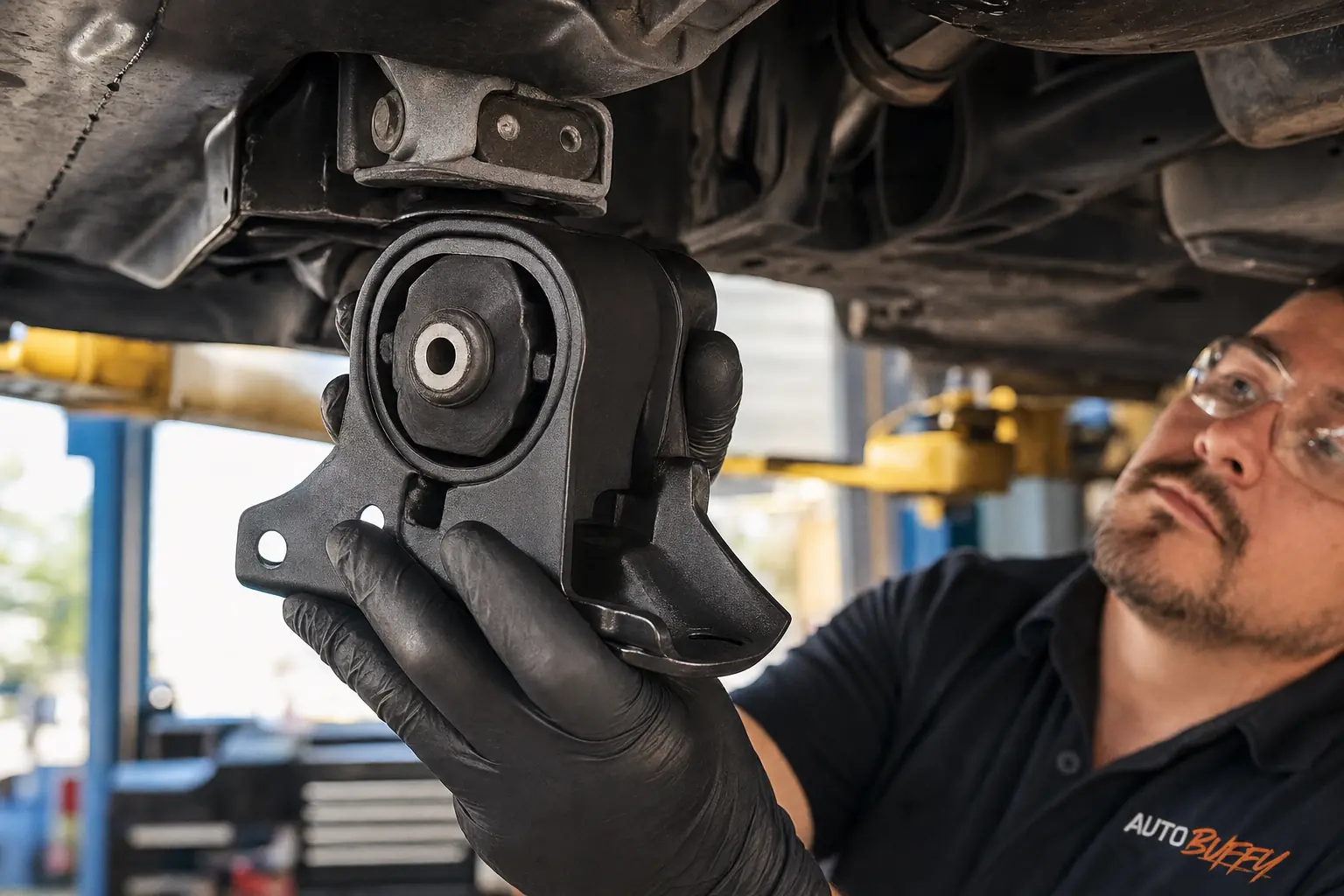
Toyota Avalon Motor Mount Symptoms and Replacement Cost
Toyota Avalon motor mount symptoms, failure patterns by generation, and what a full replacement costs — plus why a complete kit makes more sense than one mount.
The Short Answer
A failing Toyota Avalon motor mount most commonly shows up as cabin vibration at idle, a clunk under throttle, or visible engine rock — and total replacement runs $605–$673 at a shop, though a DIY complete kit can cut that cost substantially.
| Symptom | Severity | Act Within |
|---|---|---|
| Cabin/seat vibration at idle in Drive | Moderate | 1–2 months |
| Clunk on acceleration or throttle lift | Moderate–High | Weeks |
| Visible engine rocking under hood | High | Immediately |
| Steering wheel buzz + choppy idle | High | Immediately |
| Cracked hoses, stressed CV boots, wiring damage | Critical | Same day |
The Avalon ran from the 1995 model year through 2022 — a 28-year production run. That's five distinct generations and a wide spread of engine and trim variants, which means mount wear patterns, mount counts, and repair access all shift depending on which Avalon you're driving.
Toyota Avalon mount layout: what's actually under the hood
Westar manufactures five distinct mount types for the Toyota Avalon. Here's what each does and how it typically fails on this platform:
| Mount Type | Where It Sits on the Avalon | What It Does | How It Usually Fails |
|---|---|---|---|
| Engine Mount | Front and/or rear of the engine block, bolted to the subframe | Primary load-bearing support; carries engine weight and absorbs vertical/lateral forces | Rubber cracks or compresses under heat cycling; fluid leaks internally on hydraulic versions, killing damping |
| Engine Mount Kit | Complete multi-piece set for the full engine mount system | Replaces all primary engine mount positions at once | Sold as a kit specifically because multiple mounts degrade on the same timeline |
| Engine Torque Strut Mount | Right-side upper area of the engine bay, bridging engine bracket to chassis | Resists rotational torque during acceleration and deceleration; often called the "dog-bone" or front upper mount | Fails with a sharp directional clunk under hard throttle rather than idle buzz; bracket-to-bushing separation is common |
| Automatic Transmission Mount | Rear of the powertrain, beneath the transmission housing | Supports the transmission and controls drivetrain movement under gear load | Collapses under sustained load; symptoms appear during gear engagement or highway throttle hold, not just at idle |
| Suspension Strut Mount | Upper strut tower, between the strut and the chassis | Isolates suspension inputs from the cabin; allows controlled strut rotation during steering | Worn bearings cause groaning or clunking over bumps and during parking-speed turns; often confused with strut failure |
Because mount configuration varies by generation and engine, the exact positions your Avalon uses depend on your model year. Confirm via the part finder before ordering.
Which Toyota Avalon years and engines fail most
The Avalon went through five generations. Based on real-world repair volume and the depth of Westar's catalog coverage, here's an honest breakdown:
- First gen (1995–1999): These are now 25–30 years old. Any surviving example with original mounts has failed mounts — there's no "if" at this point, only "how bad." The 3.0L 1MZ-FE V6 was the only engine offered.
- Second gen (2000–2004): Same 1MZ-FE engine, similar age-related failure patterns. If these cars are still being driven, a mount inspection is overdue.
- Third gen (2005–2012): This is where volume picks up significantly. The 3.5L 2GR-FE V6 arrived here and became the dominant Avalon engine for the rest of the car's life. Third-gen cars are now hitting 150,000–200,000+ miles in real-world use, and mount failure at this mileage is common. The torque strut is a frequent first failure on this generation.
- Fourth gen (2013–2018): The 2013 model year has the deepest Westar mount catalog coverage of any Avalon year — more distinct mounts than any other, which reflects the number of variant-specific configurations Toyota used that year. Fourth-gen Avalons are now entering the 80,000–150,000-mile range where rubber mounts begin to degrade noticeably. This generation is the highest current repair volume.
- Fifth gen (2019–2022): The newest Avalons, but the 2019, 2020, 2021, and 2022 model years all carry deep Westar coverage (among the top six by mount count). Early high-mileage examples are starting to show up with mount issues, particularly on cars in hot climates where rubber ages faster.
If you're unsure about your generation's specific failure tendencies, state so to your shop — but if your Avalon is past 80,000 miles and showing any of the symptoms below, mounts belong on the inspection list.
The symptoms you shouldn't ignore — specific to the Avalon
1. Vibration through the front seats and floor in Drive, but not Park
This is the Avalon-specific tell. Because the engine sits transversely and the cabin is well-insulated, you'll often feel degraded mount vibration as a low-frequency buzz in the seat cushion and floorboard rather than through the steering wheel. Put the car in Park and the idle smooths out; put it in Drive and the buzz returns — that's engine torque loading a worn mount.
2. Clunk under hard throttle from a stop
When you pull away firmly from a stoplight, the 3.5L V6 generates enough torque to make a worn engine torque strut mount audible. You'll hear (and sometimes feel) a distinct thud or knock as the engine rotates against the mount's travel limit. This isn't a transmission slip — it's mechanical, it's immediate, and it points directly at the torque strut.
3. Steering wheel vibration that wasn't there before
The Avalon's electric power steering is sensitive to drivetrain inputs. When a front engine mount collapses enough to let the engine shift position, vibration can travel up through the steering column. Owners often chase this symptom through alignment, tires, and wheel balance before a shop catches a failed mount. If the steering wheel buzzes at idle and your tires and alignment check out, look at the mounts.
4. Transmission engagement thud in Drive or Reverse
A failed automatic transmission mount lets the entire powertrain shift slightly under load. When you select Drive or Reverse from Park, the engagement jolt — which should be absorbed by the mount — instead transmits as a noticeable thud through the floor or center console. This symptom is specific to transmission mount failure and is often misdiagnosed as a transmission issue until the mount is inspected.
5. Cracked exhaust flex pipe or stressed CV axle boots
The Avalon's front halfshafts and exhaust flex pipe are positioned close enough to the engine that excess engine movement eventually damages them. If your shop finds a cracked flex pipe with no other obvious cause, or torn CV boots on a car that otherwise looks clean, ask them to check the mounts — the engine has likely been moving more than it should for a while.
Toyota Avalon motor mount replacement cost
According to RepairPal (August 2026), Toyota Avalon engine mount replacement averages $605–$673 at a shop, including parts and labor.
That range covers a single-mount job. The Avalon's engine bay is compact, and supporting the engine safely while mounts are changed requires proper equipment — most shops use a support bar or floor jack under the oil pan with a wooden block. Access to the rear mount is tighter than the front positions, which adds labor time. On older Avalons, corroded fasteners can extend that further.
DIY with a complete kit changes the math considerably. If you're doing all positions in one session, you support the engine once, swap all mounts, lower, and torque to spec. A full day of work versus multiple shop visits — and a single parts purchase versus individual mounts bought in pieces over time.
The honest advice: if one mount is gone, get the kit and do them all.
Why Westar makes sense for the Avalon specifically
Westar covers the Toyota Avalon from 1995 through 2022 with 57 distinct mount SKUs across all five generations. They make only engine and transmission mounts — not brakes, not filters, not every suspension component under the sun. That specialization translates to careful attention to rubber durometer (how firm the mount is), metal bracket specifications, and fitment precision across Avalon's many trim and engine variants.
Their kits range from three-piece to six-piece sets depending on which generation and configuration you have. A general-line parts brand with a thousand product categories doesn't put the same engineering focus into mount-specific materials. For a platform like the Avalon — where mount geometry and rubber firmness directly affect how much V6 vibration reaches the cabin — that specificity matters.
Use the finder below for your exact year, trim, and engine. It pulls current pricing and confirms which kit fits your configuration.
The Avalon is gone — but yours has years left
Toyota ended North American Avalon production after the 2022 model year; the Toyota Crown now fills that space in the lineup. But there are hundreds of thousands of Avalons still on the road, and parts availability is strong across all five generations. A well-maintained Avalon — mounts included — has plenty of life left. Don't let rubber that costs less than a car payment turn into a hose, axle, or exhaust repair that costs ten times more.
Sources
- RepairPal, Toyota Avalon Engine Mount Replacement Cost estimate (accessed August 2026)
- Westar catalog data for Toyota Avalon, 1995–2022 (AutoBuffy inventory)
Find the right motor mount kit for your Avalon
Guaranteed fit, ships free
FAQ / People Also Ask
In the Avalon, the first thing most owners notice is a low-frequency vibration that buzzes through the front seats and the steering wheel at idle — the kind that disappears when you put it in Park. That's followed by a distinct thud or clunk when you tip into the throttle from a stop, caused by the engine rotating against worn rubber. Later-generation Avalons with hydraulic mounts can develop a subtler symptom: a mushy, dampened vibration rather than a sharp buzz, because the fluid inside the mount has leaked and lost its damping ability even though the mount looks structurally intact from the outside.

Comments
Loading comments...
Comments are moderated by the AutoBuffy team.