

U-Joint Replacement Cost and the Symptoms of a Bad Universal Joint
Learn what a u-joint replacement costs, how to spot a failing universal joint, and when to fix it before it takes your driveshaft with it.
The Short Answer
U-joint replacement typically costs $150–$400 per joint at a shop, parts and labor included, though trucks with multiple joints or difficult access can reach $600 or more total.
| Scenario | Typical Cost Range |
|---|---|
| Single u-joint, shop labor | $150 – $300 |
| Two u-joints, same driveshaft | $250 – $450 |
| Full driveshaft with 3+ joints | $400 – $650+ |
| DIY (part only, no labor) | $20 – $80 per joint |
| Driveshaft replacement (worst case) | $500 – $1,200+ |
Those ranges are real-world estimates for most light trucks, SUVs, and rear-wheel-drive cars. Specialty vehicles, heavy-duty trucks, and anything with a two-piece driveshaft will sit toward the top of the range.
What Is a Universal Joint and What Does It Do?
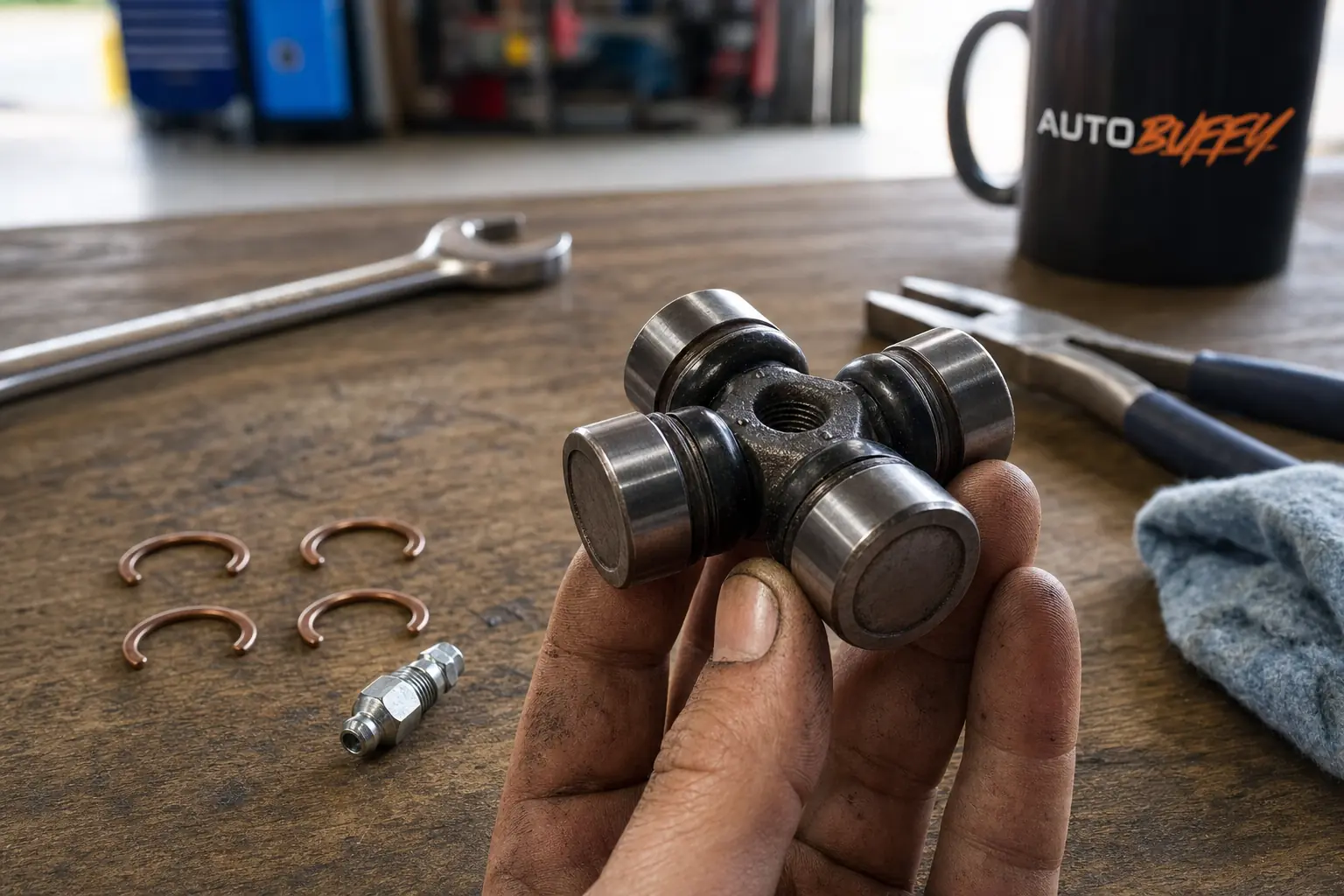
A universal joint — u-joint for short — is a cross-shaped coupling that connects sections of a driveshaft and allows it to flex as the suspension moves. Without it, the rigid driveshaft couldn't transmit torque from the transmission to the differential while the axle moves up and down with the road.
The joint consists of a cross (also called a spider), four bearing caps packed with needle bearings, and snap rings that hold everything in place. It's a simple design that's been around for over a century. Simple doesn't mean indestructible, though. Those needle bearings wear down, the grease dries out, and eventually the joint develops slop — and then you've got a problem.
Symptoms of a Bad Universal Joint
Catching a failing u-joint early is the difference between a $200 repair and a $1,000 one. Here's what to watch for.
Clunking Noise When Shifting Into Drive or Reverse
This is the most common complaint. You put the truck in gear and hear a distinct metallic clunk from underneath. It happens because a worn joint has play in it — when the drivetrain loads up in the opposite direction, the loose joint slaps against its travel limit. Some people describe it as a "thunk," others say it sounds like something hit the underside of the vehicle.
Vibration That Gets Worse at Certain Speeds
A u-joint that's worn unevenly or seized in one position can't rotate smoothly. Instead, it introduces a cyclic speed variation into the driveshaft — and that shows up as vibration, usually between 35 and 55 mph. The frequency changes as you accelerate. It often feels similar to an out-of-balance tire, but tire balancing won't fix it.
Squeaking During Low-Speed Acceleration
If your u-joints have grease fittings and they've gone dry, you'll often hear a rhythmic squeaking that follows driveshaft rotation. It's more noticeable at parking-lot speeds, and it usually goes away at highway speed — which makes people dismiss it. Don't. A dry joint is a joint that's about to fail.
Visible Play in the Driveshaft
Get under the vehicle with the transmission in park and try to rotate the driveshaft back and forth by hand. A healthy u-joint has zero rotational play. If you can feel any movement — even a couple of millimeters — the bearing caps are worn and the joint needs to come out.
Transmission Fluid Leak at the Tailshaft
This one surprises people. A severely worn u-joint can allow the driveshaft to wobble, which hammers the transmission output shaft seal. If you see fluid leaking from where the driveshaft meets the transmission, inspect the u-joint before you assume the seal itself is the cause.
What Causes U-Joints to Fail?
Three things kill universal joints faster than anything else:
- Lack of lubrication. Greaseable joints that never see a grease gun will fail well before 50,000 miles.
- Off-road use. Dirt, water, and mud contaminate the bearing caps and wash out grease. Trucks that see regular trail use should have their u-joints inspected at least once a year.
- Driveshaft angle. A lifted truck with a steep driveshaft angle puts the u-joint through a wider range of motion on every rotation, which accelerates wear. This is why a lift kit installation often includes a driveshaft modification or slip yoke eliminator.
Age alone is also a factor. Even a well-maintained joint on a 20-year-old vehicle may simply be at the end of its service life.
U-Joint Replacement Cost Breakdown
Parts
A replacement universal joint for a common half-ton truck typically runs $20–$80 depending on the size and whether it's a greaseable or sealed design. Heavy-duty joints for 3/4-ton and one-ton trucks cost more. The part itself is rarely the expensive piece of this job.
Labor
Most shops charge 1–2 hours of labor to remove the driveshaft, press out the old joint, press in the new one, and reinstall. At shop rates of $100–$175 per hour, that's $100–$350 in labor. The press work is the real skill component — doing it wrong damages the yoke bore, and a damaged yoke means a new driveshaft.
The Hidden Cost Nobody Mentions
Driveshaft phasing. When the shop reinstalls your driveshaft, the front and rear yokes must go back in the same rotational alignment they came out in. If they don't, the driveshaft will vibrate at highway speeds even with a brand-new u-joint. A reputable shop marks the driveshaft before pulling it. If yours doesn't, ask them to. A post-replacement vibration diagnostic can add another hour of labor to the bill.
DIY vs. Shop: Which Makes Sense?
Replacing a u-joint yourself saves the labor charge — typically $100–$300 — but requires a hydraulic press or at minimum a quality bench vise and the right sockets to avoid damaging the bearing caps. If you have the tools and mechanical confidence, it's a legitimate Saturday job. If you don't have a press, renting one from a parts store for the afternoon is a reasonable option.
My honest take: for most home mechanics with a basic tool set, the press rental route works fine on a single-piece driveshaft. Two-piece driveshafts with a center support bearing add complexity that pushes more people toward the shop, and I think that's a reasonable call. The cost of damaging a yoke or misphasing the shaft on reassembly usually exceeds what you'd have saved.
Choosing the Right Replacement U-Joint
When to Worry About the Driveshaft Itself
If the u-joint failed completely and the vehicle was driven on it, inspect the yoke bores for damage before installing a new joint. Worn or elongated bores won't hold a new joint properly. Also check the driveshaft tube for bends — a dropped driveshaft is often bent and will need balancing or replacement even after the joint is fixed. A straight driveshaft with clean yoke bores? You're in good shape. A bent tube or wallowed-out bore changes the math toward full driveshaft replacement.
Find the right universal joint for your vehicle
Guaranteed fit, ships free
FAQ / People Also Ask
For most trucks and SUVs, expect to pay $150–$400 at a shop for a single u-joint replacement, parts and labor included. Vehicles with difficult-to-access driveshafts or multiple joints can push the total to $600 or more.

Comments
Loading comments...
Comments are moderated by the AutoBuffy team.