
Upper vs Lower Ball Joint: Which One Is Bad?
Clunking front end? Learn how to tell upper vs lower ball joints apart, which fails more often, and exactly how to diagnose the bad one.
The Short Answer
The lower ball joint is the one that fails most often — it's load-bearing, wears faster than the upper, and its failure can cause your suspension to collapse.
| Upper Ball Joint | Lower Ball Joint | |
|---|---|---|
| Location | Top of suspension, upper control arm to knuckle | Bottom of suspension, lower control arm to knuckle |
| Load-bearing? | No (follower joint) | Yes (carries vehicle weight) |
| Found on | Double wishbone suspensions | Double wishbone AND MacPherson strut |
| Failure frequency | Less common | More common |
| Safety risk if failed | High (steering loss) | Very high (suspension collapse) |
| Diagnosis clue | Top-to-bottom tire rock | Side-to-side tire rock |
| Typical replacement cost (parts + labor) | $150–$350/side | $150–$400/side |
What Each Ball Joint Actually Does
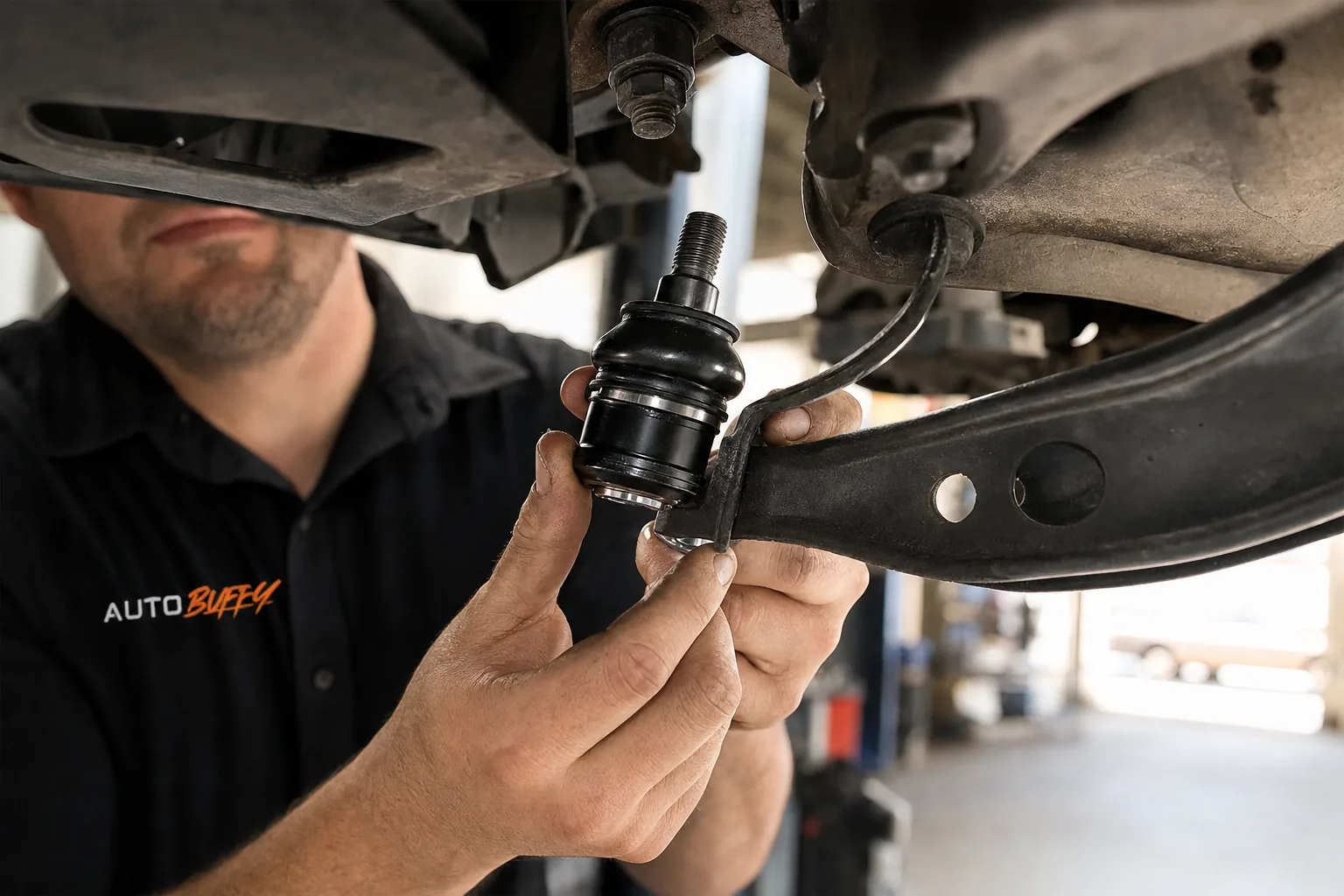
A ball joint is exactly what it sounds like — a ball-and-socket pivot that lets the wheel move up and down with the road while still allowing you to steer left and right. You need that range of motion, but you also need it to stay *tight*. When a joint wears, that socket develops play, and everything downstream — steering feel, tire wear, alignment — starts to go sideways. The upper ball joint sits at the top of the front suspension, connecting the upper control arm to the steering knuckle. In a typical double wishbone setup, it's a non-load-bearing "follower" joint. It guides the knuckle through its arc without carrying the car's weight. The lower ball joint is at the bottom, connecting the lower control arm to the knuckle. This one *does* carry the vehicle's weight. Every pothole, every hard stop, every loaded mile runs through that lower joint. That's why it wears faster. One more thing worth knowing: if your car uses a MacPherson strut suspension — which is the majority of modern front-wheel-drive vehicles — you may not have an upper ball joint at all. The strut itself handles the upper pivot through a bearing mount at the top. Only one lower ball joint per side. So if someone tells you your upper ball joint is shot on a MacPherson strut car, that's worth a second look. ---
How to Tell Which Ball Joint Is Bad
This is where a lot of DIYers get turned around. The symptoms overlap — both joints cause clunking, both affect steering feel — but the physical test separates them cleanly. ### The Lift-and-Rock Test
Park on level ground, chock the rear wheels, and safely lift the front axle with a floor jack and jack stands under the frame. Do not support from the control arms — you want the suspension hanging freely. 1. Grab the tire at 12 and 6 o'clock (top and bottom). Rock it firmly in and out. Excessive play here? That's your upper ball joint. 2. Grab the tire at 9 and 3 o'clock (sides). Rock it left and right. Significant looseness here typically points to the lower ball joint — though a worn tie rod end can produce a similar result, so check both. For a definitive reading, mount a dial indicator on the control arm and measure actual joint deflection against your vehicle's service spec. Most manufacturers specify rejection at 0.050"–0.125" of play, depending on the joint. ### Noise and Feel Clues
- Clunking over bumps or dips — classic ball joint symptom, both upper and lower
- Clunking on low-speed turns in a parking lot — often the lower joint under load shift
- Steering that wanders or feels vague — both joints contribute to this
- Uneven or rapid tire wear — especially inside or outside edge wear, often paired with alignment that won't hold
None of these symptoms pinpoint which joint on their own, but they tell you it's *time to do the rock test*. ---
Why the Lower Ball Joint Is the More Urgent Repair
It's not just about failure frequency. The consequence of a lower ball joint failure is categorically worse. When a lower joint lets go completely, the control arm can drop away from the knuckle. The wheel folds under the car. At highway speed, that's not a fender-bender — it's a rollover scenario. An upper joint failure is serious too (you lose steering geometry and eventually steering control), but the lower joint carries structural load that keeps the whole corner assembled. That's why mechanics treat a worn lower joint as a stop-driving-now situation once it reaches spec limits, and why many states will fail a vehicle at inspection for a lower ball joint with measurable play. If your lower joint is showing wear, don't wait for the clunk to get louder. ---
Should You Replace Upper and Lower Together? Not automatically — but inspect both while you're in there. Labor on a double wishbone suspension to replace one joint often overlaps significantly with replacing both on the same side. If the upper is close to spec limits while you're already replacing the lower, spending the extra part cost to do both at once makes real sense. Replacing both **sides** simultaneously is almost always the right call. If the left lower joint is worn out, the right one has seen the same mileage and conditions. Odds are good it's not far behind. ---
Choosing a Ball Joint Brand
For most vehicles, MOOG is the honest go-to answer. They offer a broad catalog of application-specific joints, and their problem-solver design philosophy means many of their joints add a grease fitting even on originally sealed joints — which genuinely extends service life if you follow through with periodic greasing. Their coverage extends to both individual joints and complete control arm + ball joint kit sets for multi-corner or fleet replacements. Mevotech is another strong option worth knowing. They're a privately held Canadian suspension specialist — acquired by TorQuest Partners — and were recognized with Gold status among Canada's Best Managed Companies for 2026, their fourth consecutive year. That kind of recognition in an industry full of commodity parts says something about their engineering investment. Their Supreme and TTX lines are built for professional installers and are worth considering if your vehicle's application is covered. My honest take: for a high-mileage daily driver where I want the job to last, I'm reaching for MOOG on most domestic applications and Mevotech TTX if the MOOG coverage is thin for that specific fitment. Both are leaps ahead of generic house-brand joints at a box store. ---
Buying the Right Ball Joint for Your Vehicle
Ball joint fitment is highly vehicle-specific. The thread size, stud taper, press fit vs. bolt-in design, and housing diameter all vary by year, make, model, and trim — sometimes even by production date within the same model year. Don't guess on fitment. Use the part finder below to enter your exact vehicle. It'll pull current inventory, confirm fit, and show today's pricing. That's the only reliable way to make sure you're getting the right joint.
Why buy from AutoBuffy
- Fitment check: add your vehicle and we confirm the part fits before you buy. If it doesn't fit because of our listing, you get a free return and a full refund, including original shipping.
- 24-month limited warranty on new parts bought on autobuffy.com.
- Real reviews: rated 4.9 by 19,069 verified customers.
- 30-day returns on unused parts in the original packaging.
- Free shipping on orders $50+. Orders placed before 12:00 PM ET (Mon-Fri) ship the same business day.
- Questions about an order? Call 888-477-2530 or email help@autobuffy.com.
Find the right ball joint for your vehicle
Guaranteed fit, ships free
FAQ / People Also Ask
The upper ball joint connects the upper control arm to the steering knuckle at the top of the suspension. The lower ball joint connects the lower control arm to the knuckle at the bottom. In most double wishbone setups, the lower joint is load-bearing (it carries vehicle weight), while the upper is a non-load-bearing follower joint.


Comments
Loading comments...
Comments are moderated by the AutoBuffy team.