

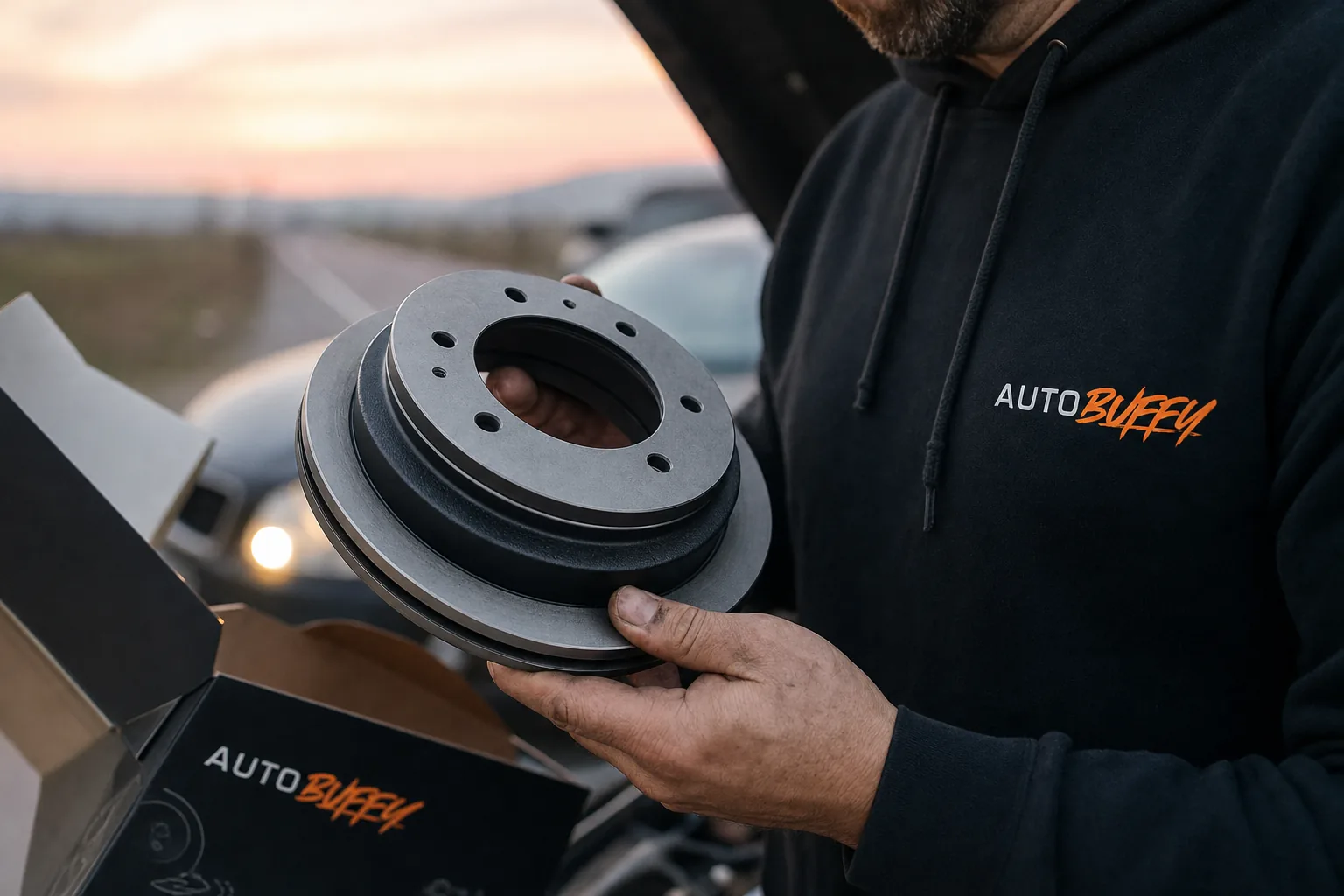
Warped Rotors Symptoms: Steering Wheel Shake When Braking
Steering wheel shaking when you brake? Learn the key warped rotor symptoms, what causes them, and when to replace your rotors.
The Short Answer
If your steering wheel shakes specifically when you press the brake pedal, warped rotors are the most likely cause, and the fix is rotor replacement, usually paired with new brake pads.
| Symptom | What It Feels Like | Likely Cause |
|---|---|---|
| Steering wheel vibration when braking | Rhythmic shake through the wheel at 45-70 mph | Uneven rotor surface (front axle) |
| Brake pedal pulsing | Pulsing underfoot as you slow down | Uneven rotor surface (either axle) |
| Longer stopping distances | Car takes more distance to stop fully | Reduced pad-to-rotor contact |
| Pulling to one side under braking | Vehicle drifts left or right when braking | One rotor more warped than the other |
| Grinding or squealing | Harsh metal noise when braking | Worn pads combined with rotor damage |
Major brake-service guides from Firestone and AutoZone describe this same braking-time vibration as the signature symptom of uneven rotor wear, which is why a rotor measurement should always precede replacement.
Why "Warped Rotors" Is Actually a Misleading Term
Mechanics say "warped rotors" all the time, but what's really happening isn't a rotor bending into a potato chip shape. The more accurate term is disc thickness variation (DTV). Over time, brake pad material deposits unevenly on the rotor surface. Some spots get a thin layer of pad compound baked on; others stay clean. When the pad sweeps across those high and low spots thousands of times per stop, you feel it as a rhythmic pulse that travels right up the steering column.
True geometric warping from heat does happen, but it's less common than DTV. Either way, the fix and the symptoms are the same.
The 5 Classic Warped Rotor Symptoms
1. Steering Wheel Shaking When Braking
This is the most reported symptom, and the one that sends most drivers straight to the shop. The shake usually starts around 50-60 mph and gets worse as you slow down. It's not constant — it only happens when the brakes are applied. That specificity is your biggest diagnostic clue. Tire balance issues shake the wheel at speed without braking. Warped rotors shake the wheel during braking.
2. Brake Pedal Pulsation
You'll feel this one in your foot. Press the brake and the pedal pulses back against you in a rhythmic beat. That beat corresponds to each revolution of the rotor as the thick-thin variation runs under the brake pad. Some drivers notice this before the steering wheel shake appears, especially if the rear rotors are the primary culprit.
3. Increased Stopping Distance
When a rotor's surface isn't uniform, the brake pad can't maintain consistent contact pressure across the full sweep. That means less friction, which means more distance to stop. You might not notice a few extra feet at low speeds, but at 65 mph those feet matter a lot.
4. Vehicle Pulls to One Side Under Braking
If only one front rotor is significantly worse than the other, braking force becomes uneven across the axle. The car will pull toward the side with more effective braking. Don't confuse this with regular steering pull, which happens without braking. Brake-specific pulling almost always points to a rotor or caliper issue.
5. Visible Scoring or Rotor Lip
Pull your wheels and look at the rotor face. A healthy rotor has a smooth, even surface. Warped or worn rotors often show concentric grooves cut into the face by debris or worn pad material. You'll also see a raised lip around the outer edge where the rotor metal hasn't been swept by the pad — that lip tells you how much the rotor has thinned.
What Actually Causes Rotors to Warp or Develop DTV?
Heat is the primary villain. Rotors can reach temperatures above 500 degrees F during hard braking. If you immediately drive through a puddle or park quickly after a long downhill, that uneven cooling creates stress. Over time, this can cause material irregularities.
The other big cause is glazed brake pads. Pads that get too hot can leave patches of hardened compound on the rotor surface — spots of baked-on resin. Those spots cause the pad to skip and grab unevenly. Many drivers mistake this for a rotor problem when the pads are actually the root cause.
Lug nut torque matters more than most people think. Over-torqued or unevenly torqued lug nuts can distort the hat section of the rotor against the hub, creating a slight wobble that mimics DTV. Always torque lug nuts to spec in a star pattern using a calibrated torque wrench, not an impact gun set to max.
Resurface or Replace? The Honest Answer
Resurfacing shaves the rotor surface back to flat using a brake lathe. It can fix minor DTV if the rotor is still above its minimum thickness specification — a number stamped right on the rotor hat or listed in your service manual.
Honestly, for most daily drivers, replacement makes more sense. A thinner resurfaced rotor holds less heat, which speeds up the next round of fade and warping. With replacement rotors available in the $40-$120 range per unit for most vehicles, the cost difference between machining and buying new often isn't compelling enough to go the resurfacing route. Resurfacing earns its keep on performance vehicles with expensive rotors, or when the rotor is nearly new and barely warped.
If you're replacing rotors, always replace pads at the same time. Worn pads won't bed in correctly on a new rotor surface, and you'll be back in the same situation sooner than you should be.
Front vs. Rear Rotor Symptoms: How to Tell the Difference
Front rotors do roughly 70% of your braking work, so front rotor problems are usually more dramatic. The steering wheel shake is a front-axle symptom because the front wheels are connected to the steering column. Rear rotor issues show up primarily as pedal pulsation without much steering wheel involvement. If you feel the shake in the seat and pedal but not the wheel, start with the rear.
How to Check Your Rotors Without a Dial Indicator
You don't need a machine shop to do a basic assessment:
- Visual check — Look for deep grooves, heavy rust (light surface rust is normal after rain), or an obvious rotor lip.
- Thickness check — Use a micrometer or vernier caliper at several points around the rotor face. Variation of more than 0.001-0.002 inches is enough to cause pedal pulsation on many vehicles.
- The hot-stop test — After a normal drive, perform 10 moderate stops from 30 mph to 5 mph without coming to a full stop. If pulsation gets worse as the rotors heat up, DTV is almost certain.
For a precise diagnosis, a shop can measure DTV with a dial indicator in about 10 minutes. It's worth it before committing to parts.
When to Act: Don't Wait on This One
Brake issues are not the place to adopt a wait-and-see attitude. If you're feeling the steering wheel shake every time you slow for a light, get it looked at within the week, not the month. Degraded rotor condition reduces your ability to stop in an emergency — and that's a risk that's genuinely not worth taking.
Use the finder below to match the right rotors to your exact vehicle and see today's pricing.
Find the right part for your vehicle
Guaranteed fit, ships free
FAQ / People Also Ask
You'll typically feel a rhythmic pulsing or shuddering through the brake pedal and steering wheel when you apply the brakes, especially at highway speeds. The vibration usually intensifies as you press harder.

Comments
Loading comments...
Comments are moderated by the AutoBuffy team.