

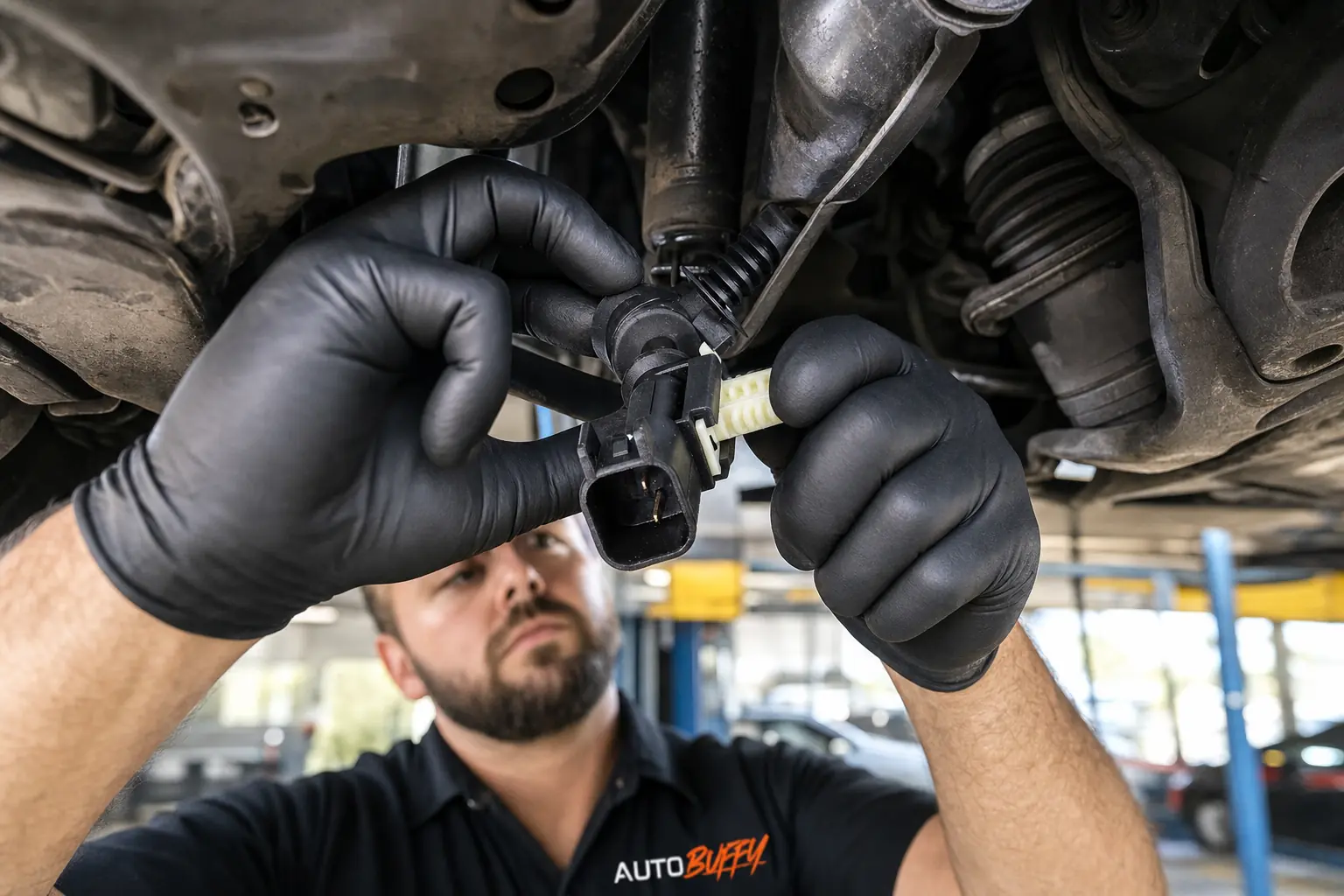
ABS Sensor Replacement Cost: Why Your ABS Light Is On
ABS light on? Learn what an ABS wheel speed sensor costs to replace, what causes failure, and how to fix it without overpaying.
The Short Answer
Replacing a faulty ABS wheel speed sensor costs $150–$400 at a shop, or $30–$100 in parts alone if you do it yourself — and it's the most common reason an ABS warning light stays on.
| Repair Scenario | Typical Cost Range |
|---|---|
| DIY (part only) | $30 – $100 per sensor |
| Shop labor only | $80 – $250 |
| Full shop repair (part + labor) | $150 – $400 |
| Integrated hub/bearing assembly (if needed) | $200 – $600+ |
| Dealer repair | $350 – $650+ |
That's the ballpark. The actual number depends on your vehicle, whether the sensor is stand-alone or integrated into a wheel bearing hub, and how badly rust has seized the mounting hardware.
Why Is My ABS Light On?
Your vehicle's ABS (anti-lock braking system) relies on wheel speed sensors at each corner. These sensors track how fast each wheel is spinning and feed that data to the ABS control module in real time. When you brake hard, the module uses that information to pulse brake pressure — preventing wheel lockup and keeping you in control.
When any one of those sensors stops sending a reliable signal, the module goes into fault mode and illuminates the ABS warning light on your dash. It's a safety-first decision: the system would rather tell you it's offline than operate with bad data.
The most common triggers for that light:
- Failed wheel speed sensor (the sensor element itself has died)
- Damaged wiring or connector (chafing, corrosion, or a broken wire in the harness)
- Worn wheel bearing (the sensor is fine, but it can't read a worn tone ring accurately)
- Tone ring damage (the toothed ring the sensor reads can crack or collect debris)
- ABS control module fault (less common, but it happens)
About 70–80% of ABS light complaints trace back to a sensor or its wiring. Start there before assuming anything more expensive.
How to Confirm It's the Sensor
Don't guess. A basic OBD2 scanner — even a $30 Bluetooth unit paired with your phone — can pull ABS fault codes and point you to the exact wheel causing the problem.
Common ABS sensor codes:
- C0035 – Left front wheel speed sensor
- C0040 – Right front wheel speed sensor
- C0045 – Left rear wheel speed sensor
- C0050 – Right rear wheel speed sensor
These codes vary slightly by manufacturer, but they follow this general pattern across most domestic and import vehicles.
Once you know which corner is the culprit, do a visual inspection before ordering parts. Get the wheel off and look at the sensor body, the connector, and the wiring running back toward the chassis. A cracked connector or frayed wire is a $10 fix, not a $80 sensor replacement.
Also spin the hub by hand and feel for roughness or play. Excessive bearing play means the sensor can't maintain consistent clearance with the tone ring — and a new sensor alone won't fix it.
What Affects the Replacement Cost Most
Sensor Type: Stand-Alone vs. Integrated Hub
This is the biggest cost variable. Older and simpler vehicles use a stand-alone sensor bolted near the wheel with a separate tone ring on the axle or rotor. That sensor might cost $30–$60 and takes maybe 30 minutes to swap.
Newer vehicles often integrate the ABS sensor directly into the wheel bearing hub assembly. If the bearing is worn or the sensor is built into a sealed unit, you're replacing the whole hub. Expect parts costs of $100–$350 and more labor time, especially on front wheels.
Rust and Corrosion
In states that salt their roads, the sensor's mounting bolt can seize so completely that technicians break the bolt extracting it. That turns a quick job into drill-and-tap territory. If you're DIYing in the rust belt, soak those bolts with penetrating oil the night before.
Labor Rates in Your Area
Shop labor rates range from about $90/hour in smaller markets to $180+/hour at dealerships in major cities. Most ABS sensor swaps bill 1–2 hours of labor. At a dealer, that alone can run $200–$300.
DIY vs. Shop: Which Makes Sense?
For most people with basic mechanical confidence, this is a legitimate DIY job. You'll need:
- An OBD2 scanner (to read and clear codes)
- A floor jack and jack stands
- Basic socket set and torque wrench
- Penetrating oil if you're dealing with rust
- Your vehicle's torque spec for the sensor and wheel components
The honest reality: the job itself is straightforward. It's the rust that bites people. I've seen a 30-minute sensor swap turn into a two-hour ordeal because one 8mm bolt wouldn't let go. If you're not set up to deal with broken fasteners, a shop is worth it for the rust-belt peace of mind.
If the fault code points to the wiring harness rather than the sensor itself, that's where DIY gets trickier. Tracing a broken wire inside a sheathed harness takes patience and a wiring diagram. Shops deal with it routinely.
Can You Ignore the ABS Light?
Your regular brakes will still work. That part is true. But here's what also happens when the ABS module sees a fault: on many modern vehicles, traction control and electronic stability control draw wheel speed data from the same sensors. A dead ABS sensor can take those systems offline too.
Driving without traction control in wet or icy conditions is a real safety downgrade. And if you're in a state that requires passing an OBD emissions inspection, an active ABS fault code will fail the readiness check. It's not a fix you want to defer indefinitely.
Quick Diagnosis Checklist
- [ ] Pull fault codes with an OBD2 scanner — identify which wheel
- [ ] Inspect sensor body and connector for visible damage
- [ ] Check wiring harness for chafing or breaks
- [ ] Spin the hub and check for bearing roughness or play
- [ ] Clean the sensor tip and tone ring, recheck if fault was intermittent
- [ ] Replace sensor if confirmed faulty; replace hub assembly if bearing is bad
- [ ] Clear codes after repair and confirm light stays off through a test drive
Find the right part for your vehicle
Guaranteed fit, ships free
FAQ / People Also Ask
Total replacement cost typically runs $150–$400 at a shop, depending on your vehicle and how many sensors need replacing. The part itself usually costs $30–$100; labor adds $80–$250 depending on location and difficulty of access.

Comments
Loading comments...
Comments are moderated by the AutoBuffy team.