

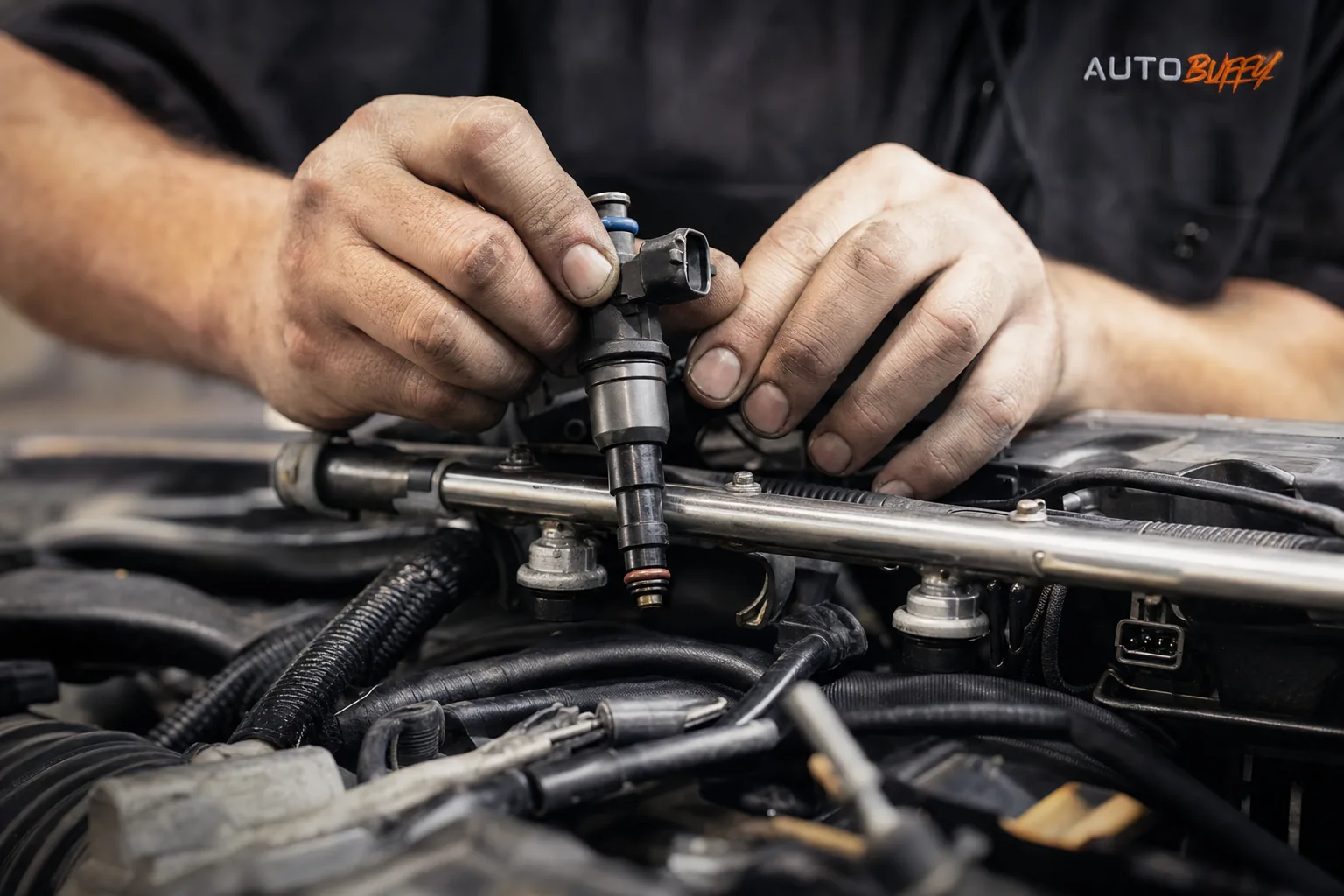
Bad Fuel Injector Symptoms: How to Tell If You Need a Replacement
Rough idle, misfires, poor MPG — a bad fuel injector causes all of these. Learn the key symptoms, what it costs to fix, and when to replace vs. clean.
The Short Answer
A bad fuel injector typically causes one or more of these symptoms: engine misfires, rough idle, a noticeable drop in fuel economy, a raw fuel smell, and a check engine light with misfire or fuel trim codes.
| Symptom | Likely Cause | Urgency |
|---|---|---|
| Engine misfire / cylinder miss | Clogged or dead injector | High |
| Rough, unstable idle | Lean mixture from clogged injector | High |
| Poor fuel economy (10–25% drop) | Leaking or stuck-open injector | Medium |
| Raw fuel smell from exhaust or bay | External injector leak | High — fire risk |
| Check engine light (P0200–P0212, P0300+) | Injector circuit fault or misfire | High |
| Hard starting (especially cold) | Flooded or starved cylinder | Medium–High |
| Engine surge or hesitation under load | Intermittent injector failure | Medium |
| Black smoke from exhaust | Rich-running from leaking injector | Medium |
What a Fuel Injector Actually Does (And Why Failure Hurts So Much)
Your fuel injectors are precision solenoid valves that spray a fine, metered mist of fuel directly into the intake port or cylinder dozens of times per second. The EPA's emissions standards require precise air-fuel ratios — typically 14.7:1 at stoichiometry — and your injectors are the last link in that chain.
When one injector fails, it throws that cylinder's mixture completely off. The ECU tries to compensate through fuel trim adjustments, but it can only correct so much before things go visibly wrong. That's why a single bad injector can make a 4-cylinder feel like it's running on three — because it effectively is.
The 8 Symptoms of a Bad Fuel Injector, Explained
1. Engine Misfires
This is the most reliable indicator. A clogged injector starves its cylinder of fuel; a stuck-open injector floods it. Either way, combustion fails. You'll feel it as a stumble, shudder, or rhythmic miss — often worse under acceleration. Your OBD2 scanner will show P0300 (random misfire) or a cylinder-specific code like P0302 (cylinder 2). RepairPal notes that misfire codes are one of the top reasons fuel injectors get flagged for diagnosis.
2. Rough or Unstable Idle
At idle, the engine runs on small, precise fuel pulses. A partially clogged injector disrupts that rhythm. You'll notice the tach needle hunting or bouncing, a vibration through the steering wheel or shifter, or an idle that dips and recovers. It tends to smooth out at higher RPMs — a key clue that separates an injector issue from, say, a vacuum leak.
3. Drop in Fuel Economy
A leaking (stuck-open) injector dumps more fuel than the engine needs, spiking consumption. A clogged injector forces the ECU to compensate by holding other injectors open longer. Either scenario hurts your MPG, often 10–25% below your normal baseline. If your fill-ups are getting more frequent without a change in driving habits, the fuel system is worth investigating.
4. Raw Fuel Smell
This one demands immediate attention. An injector with a cracked body or failed O-ring can leak fuel externally onto the intake manifold — not just inside the cylinder. You'll smell raw gasoline in the engine bay or faintly in the cabin. This is a fire hazard, not just a performance issue. Pull over, let the engine cool, and don't start it again until the leak is found.
5. Check Engine Light with Specific Codes
A failing injector almost always triggers codes eventually. The injector-specific circuit codes run P0201 through P0212 (one per cylinder). You'll also see misfire codes (P0300–P0308) and potentially lean codes like P0171 (Bank 1 too lean) if a clogged injector is starving a whole bank. An OBD2 scanner can pull these codes in minutes — you don't need to pay a shop just for diagnostics.
6. Hard Starting
Two different failure modes cause hard starting. A leaking injector continues to seep fuel into the cylinder after shut-off, so the cylinder is fuel-soaked when you go to crank it — leading to a flooded condition and extended cranking. Conversely, a severely clogged injector may not deliver enough fuel to fire that cylinder at all, especially on cold mornings when fuel atomization is already poor.
7. Engine Surge or Hesitation Under Load
Intermittent injector failures show up most clearly under load — merging onto a highway, climbing a hill, towing. You'll feel a momentary hesitation, stumble, or unexpected surge as the injector skips a pulse or fires inconsistently. This kind of symptom comes and goes, which makes it easy to dismiss until it gets worse.
8. Black Smoke or Rich Exhaust Smell
A stuck-open or leaking injector floods the combustion chamber with excess fuel. Unburned hydrocarbons exit through the exhaust as black smoke and a noticeably rich, gasoline-like smell. It's the opposite of a lean misfire but equally bad for your catalytic converter, which can be ruined by prolonged exposure to unburned fuel.
Cleaning vs. Replacing: When Each Makes Sense
This is where people overthink it. Here's the honest breakdown:
Try cleaning first if:
- The injector is clogged but not leaking
- The engine has under 80,000 miles
- Symptoms are mild (slightly rough idle, modest MPG drop)
- OBD2 codes show lean conditions but no circuit fault
Professional ultrasonic injector cleaning typically runs $50–$150 for a set when done off-car. An in-car fuel system flush with pressurized solvent costs a similar amount at most shops. Bottle additives are a worthwhile preventive measure but rarely cure a symptomatic injector on their own.
Replace the injector if:
- There's an external fuel leak from the injector body or O-ring
- The OBD2 code is a circuit fault (P0201–P0212), indicating electrical failure of the solenoid
- Cleaning was attempted and symptoms returned within a few thousand miles
- The engine has 100,000+ miles and other injectors are original
"Replacing one injector and leaving five original 110,000-mile ones is a short-term fix. Budget for the full set when mileage is high — you'll save on repeat labor."
What Fuel Injector Replacement Actually Costs
Parts cost roughly $30–$150 per injector depending on your engine's fuel system type. Standard port fuel injection injectors tend to be on the lower end; gasoline direct injection (GDI) injectors run higher due to tighter tolerances and higher operating pressures. Labor ranges from $50–$300 depending on how buried the injectors are in your particular engine.
A full set on a 4-cylinder at an independent shop typically lands in the $200–$600 range, all-in. V6 and V8 engines cost more simply due to part count. GDI engines on certain European and domestic vehicles can push higher. Always get a quote that includes new O-rings and seals — those should be replaced any time an injector is pulled.
How to Confirm Which Injector Is Bad
Before spending money on parts, narrow it down:
- Pull OBD2 codes — cylinder-specific misfire and injector circuit codes point directly to the problem injector.
- Use a mechanic's stethoscope — a healthy injector clicks rapidly and consistently. A dead one is silent; a stuck-open one may click erratically.
- Noid light test — a noid light plugs into the injector harness and confirms whether the ECU is sending a proper electrical pulse. No flash = wiring or ECU issue, not the injector itself.
- Check fuel trims — long-term fuel trim (LTFT) over +10% on a bank suggests a clogged injector leaning that bank out. Negative LTFT suggests a rich condition from a leaking injector.
Sources
- RepairPal — Fuel Injector Replacement Cost
- EPA — Regulations for Emissions from Vehicles and Engines
- NHTSA — Vehicle Safety & Recalls Search
Find the right part for your vehicle
Guaranteed fit, ships free
FAQ / People Also Ask
The most common signs are engine misfires, a rough or unstable idle, poor fuel economy, a strong fuel smell from the exhaust or engine bay, and a check engine light with misfire or fuel trim codes (P0300–P0308, P0201–P0212).



Comments
Loading comments...
Comments are moderated by the AutoBuffy team.