

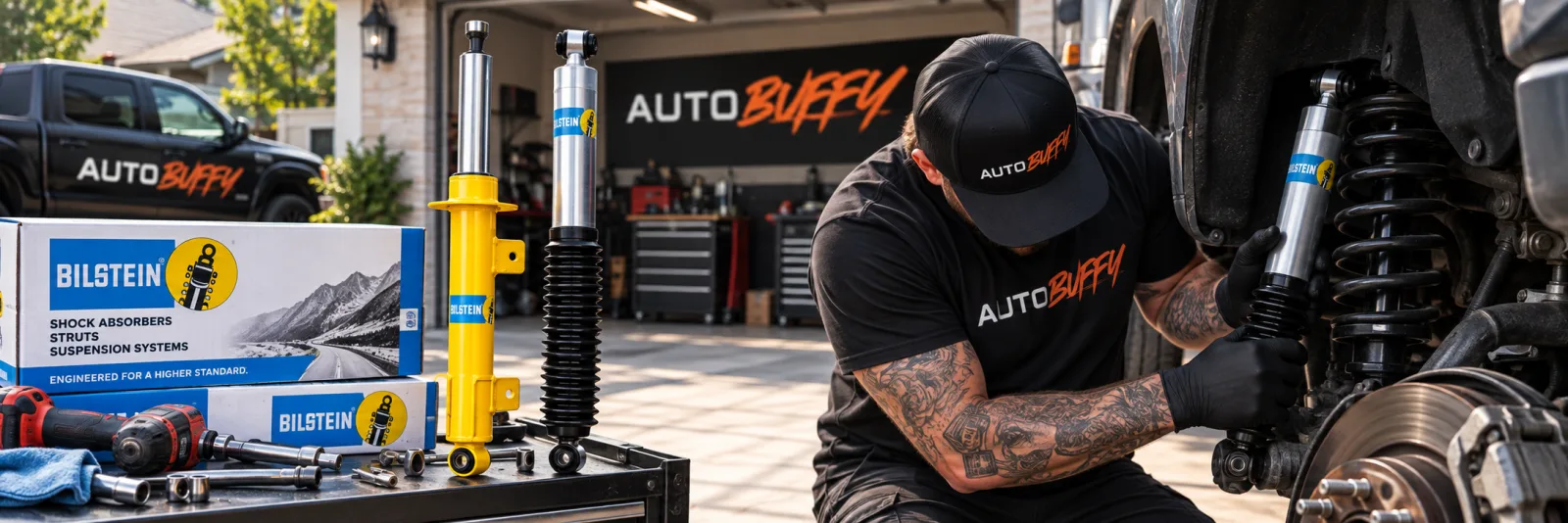
Bilstein 4600 vs 5100: Which Shock for Your Truck?
Bilstein 4600 vs 5100: see how these two truck shocks differ in design, lift compatibility, ride quality, and price—so you buy the right one.
The Short Answer
The Bilstein 4600 is the right shock for stock-height trucks, while the 5100 is built specifically for leveled or mildly lifted applications—choosing between them comes down to your current (or planned) ride height.
| Feature | Bilstein 4600 | Bilstein 5100 |
|---|---|---|
| Best for | Stock height | Leveled / 0–2.5" lift |
| Construction | Monotube gas | Monotube gas |
| Ride height adjustment | None | Yes (adjustable collar) |
| Lift range | 0" only | 0–2.5" (front) |
| Typical price range | $80–$160 each | $110–$180 each |
| Towing/hauling focus | Strong | Strong |
| Off-road tuning | Moderate | More aggressive |
Both shocks use the same core monotube technology. The difference is in the application, not the quality tier.
What Makes Bilstein's Monotube Design Different from Twin-Tube Shocks
Most factory shocks—and a lot of budget replacements—use a twin-tube design. There's an inner cylinder where the piston travels and an outer cylinder that acts as a reservoir. It's simple and cheap to manufacture. The problem is that when the fluid gets hot from repeated compressions (think: washboard roads, towing down a grade), it can cavitate and aerate, reducing damping performance right when you need it most.
Bilstein's monotube design puts the piston and a pressurized gas charge in a single cylinder, separated by a floating dividing piston. The gas stays separated from the oil, so there's no aeration. Heat dissipates faster through the single, larger tube. Damping stays consistent.
In practical terms, on a long tow or a rough trail, the monotube truck is still absorbing bumps correctly when a cheap twin-tube might be fading. That's not marketing—it's physics.
Bilstein 4600 Series: The Case for Stock-Height Trucks
The 4600 is Bilstein's OEM-replacement shock. "Replacement" doesn't mean boring—this is a meaningful upgrade over the standard shocks that come from the factory on most trucks.
It's engineered to match original ride height and geometry exactly. The valving is tuned for unloaded to moderately loaded driving, so daily driving feels controlled without being punishing. For towing, the 4600 handles load increases well because the monotube construction resists fade.
If your truck is bone stock—no lift, no leveling kit—and you want better damping without changing anything else, the 4600 is genuinely the cleaner answer. You're not paying for an adjustable collar you'll never use.
Who should buy the 4600:
- Trucks at factory ride height with no plans to lift
- Daily drivers that occasionally tow or haul
- Owners who want a straightforward OEM-quality upgrade
Bilstein 5100 Series: Built for the Level or Lift
The 5100 changes the conversation. The front shocks come with a threaded body and locking collar that lets you set the shock at several ride height positions—typically 0", 1.75", or 2.5" of lift, depending on the truck. That's a functional leveling solution built into the shock itself.
This matters because leveling a truck—raising the front to match the rear—changes the suspension geometry. A stock-valved 4600 isn't calibrated for that altered geometry. The 5100's valving is tuned to handle that geometry shift, which is why leveled trucks with 5100s typically ride noticeably better than leveled trucks left on factory shocks.
The 5100 also has slightly more aggressive off-road damping. It handles bigger inputs better than the 4600, which is a tangible benefit on trails or rough gravel roads.
One thing to note: once you set the collar, reconfiguring it requires removing the shock. So decide on your lift amount before you install.
Who should buy the 5100:
- Trucks with a leveling kit installed or planned
- Anyone running 0–2.5" of front lift
- Off-road-focused owners who need better large-bump compliance
- Drivers who want to eliminate the harsh ride that comes with a cheap leveling kit
Ride Quality: What to Actually Expect
Here's an honest take: neither of these shocks is going to make your half-ton ride like a luxury sedan. Truck suspensions have compromises baked in—they need to handle empty, loaded, and everything between.
The 4600 on a stock truck delivers a noticeable improvement over worn factory shocks. Body roll is reduced, highway feel tightens up, and you get better composure on broken pavement. It's not dramatic, but it's real.
The 5100 on a leveled truck is a different story. A cheap leveling spacer kit on factory shocks can make a truck genuinely unpleasant to drive—stiff, trampy, and sensitive to road imperfections. Swapping in 5100s corrects most of that. In my view, roughly 70% of the complaints people have about leveling kits are actually complaints about the wrong shock pairing.
Price Comparison and Value
Typically, expect to pay in the $80–$160 range per shock for the 4600 and $110–$180 per shock for the 5100, with full sets (four shocks) running from roughly $320–$650 depending on the truck and where you buy. Those are market ranges—use the part finder below for current pricing on your specific vehicle.
Is the price premium over budget shocks justified? For a truck that works for a living—regular towing, highway miles, rough terrain—yes. The longer service interval and better fade resistance make a real cost-per-mile case. For a light-use truck driven gently on smooth roads, the argument gets thinner.
Quick Decision Guide
- Stock ride height, no lift planned → Bilstein 4600
- Leveled or 0–2.5" lifted truck → Bilstein 5100
- Off-road use with a leveled setup → Bilstein 5100
- Towing-focused, stock height → Bilstein 4600
"The biggest mistake I see is someone buying 4600s after already installing a leveling kit. The geometry doesn't match the valving. You end up with a harsh ride and blame the shocks when the real problem is mismatched hardware."
Final Verdict
The 4600 and 5100 aren't competitors—they're the same quality level built for different configurations. Buy the 4600 if your truck is stock. Buy the 5100 if you're leveled or planning to be. Neither is universally better; the "right" one is the one matched to your actual setup.
Find the right shock absorber for your vehicle
Guaranteed fit, ships free
FAQ / People Also Ask
The 4600 is built for stock-height trucks and OEM replacement duty. The 5100 is designed with an adjustable collar that allows up to 2.5 inches of front lift, making it the choice for leveled or mildly lifted trucks.


Comments
Loading comments...
Comments are moderated by the AutoBuffy team.