
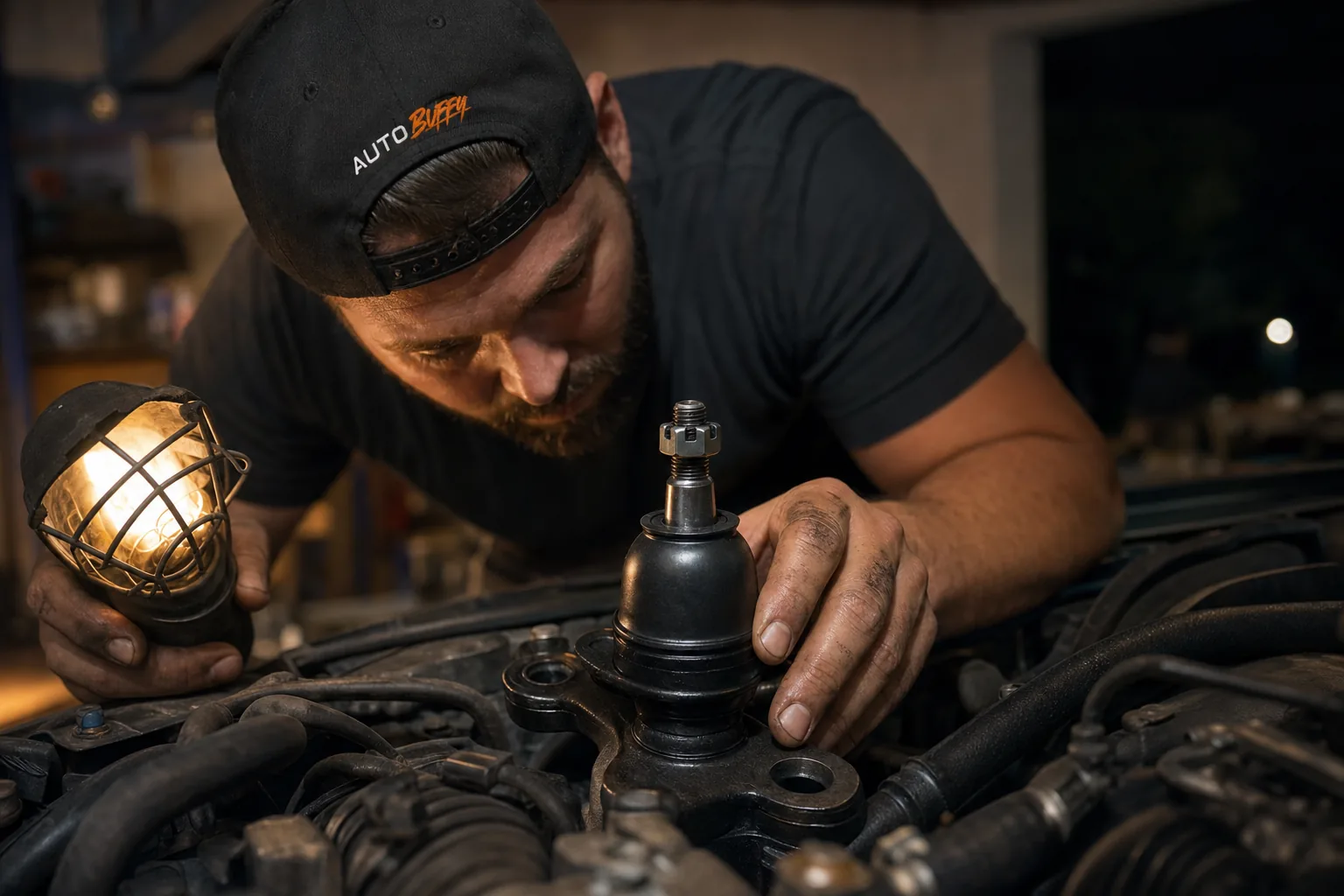
Ford F-250 / F-350 Super Duty & Excursion Ball Joints (1999–2016 4x4): What You Need to Know
Ball joints on 4x4 Super Duty trucks wear fast under load. Here's what to check, when to replace, and which parts actually fit your year.
The Short Answer
F-350 and F-250 Super Duty ball joints on 4x4 trucks typically need replacement every 60,000–120,000 miles depending on load and use, and the correct parts depend heavily on whether your truck is a 1999–2004 or 2005–2016 model — they are not interchangeable.
| Factor | Details |
|---|---|
| Fitment Years (4WD) | 1999–2016 F-250 SD, 1999–2016 F-350 SD, 2000–2005 Excursion |
| Key Fitment Split | 1999–2004 and 2005–2016 are distinct generations |
| Positions | Front upper (K8388) and front lower (K8607T) per side |
| OEM Supplier | Dana Spicer (part nos. 700238-1X / 700238-2X for '99–'04) |
| Typical Parts Cost | $150–$400 for a front axle service (both sides, both positions) |
| Typical Labor Cost | $300–$600 at a shop |
| Full Kit Option | Control arms + ball joints + tie rods + end links available |
| DIY Difficulty | High — requires a ball joint press and torque specs |
Why Super Duty Ball Joints Wear Faster Than You'd Expect
These trucks have a solid front axle — a Dana Spicer unit, fittingly enough. That's great for durability under load, but it puts the ball joints under a different kind of stress than you'd see on an independent front suspension setup. Every bump transfers force directly through the joint rather than getting absorbed across multiple pivot points. Add in the fact that most Super Duty owners actually use their trucks — towing fifth-wheels, hauling heavy payloads, running down rough ranch roads — and you've got a recipe for accelerated wear. A truck that spends its life at gross vehicle weight rating is going to need ball joints well before a lightly used daily driver. The solid axle design also means there's no easy visual shortcut. You have to actually check joint play with the axle unloaded, measuring deflection at the tire. Don't skip this at oil change intervals on high-mileage trucks. ---
Know Your Fitment Generation: 1999–2004 vs. 2005–2016
This is where people get tripped up. Ford revised the front suspension between the first and second Super Duty generations, and the ball joints from one group do not fit the other. Get this wrong and you'll be returning parts. 1999–2004 trucks (including the 2000–2005 Excursion, which shares the platform) use the earlier design. Dana Spicer's OEM replacement joints for this generation carry part numbers 700238-1X (upper) and 700238-2X (lower), which interchange with Ford's own surface finish part numbers BC3Z3050B and 4C3Z3049DB. 2005–2016 trucks are a separate fitment. These also share compatibility with the track bar ball joint application across F-450 and F-550 Super Duty models from 2005 onward — a broader platform than most people realize. If you're not sure which generation applies to your truck, use the part finder at the bottom of this page. It'll sort it out by year, make, and model automatically. ---
Symptoms of Worn Ball Joints on a Super Duty
Don't wait for a catastrophic failure. A ball joint that lets go at highway speed on a 10,000-lb. truck is a genuinely dangerous situation. Watch for:
- Clunking or popping from the front end when turning, going over bumps, or starting from a stop
- Wandering or loose steering — the truck doesn't track straight without constant correction
- Uneven tire wear, especially cupping or scalloping on the front tires
- Visible play when you jack the axle and rock the wheel at the 12 and 6 o'clock positions
- Vibration through the steering wheel at certain speeds
More than about 1/8" of play at the tire when the axle is unloaded is the general rule of thumb for replacement. Some shops use a more conservative threshold on loaded work trucks, which I think is the right call — you're not driving a Civic. ---
OEM vs. Aftermarket: Who Makes the Parts? **Dana Spicer** is the factory supplier. Dana Incorporated (NYSE: DAN), headquartered in Maumee, Ohio, has been supplying driveline and suspension components since 1904. Their current CEO is Byron Foster, effective July 1, 2026. If you want the exact same joint that came on the truck from the factory, Dana Spicer is it. **MOOG** is the other name worth knowing in this application. The steering and suspension brand — known in the trade as "The Problem Solver" — offers replacement ball joints and complete front suspension kits for the Super Duty platform. One important note: MOOG the parts brand is completely separate from Moog Inc. (NYSE: MOG.A/MOG.B), the aerospace and defense company. Different companies, same name — don't let that create any confusion. MOOG's kits available for this application cover a wide range of configurations: individual joint sets, control arm and ball joint combos, and larger full front-end kits that bundle upper and lower joints, control arms, tie rods, and sway bar end links into a single purchase. If your truck has real mileage on it, the full kit approach makes a lot of sense — the labor to pull the front end apart costs the same whether you replace one component or everything while you're in there. ---
Individual Joints vs. Full Suspension Kits: Which Should You Buy? Here's my honest take: **if your truck has more than 80,000 miles and one ball joint has failed, buy a kit.**
The math works out clearly. Labor to access the front suspension on a Super Duty runs $300–$600 at most shops regardless of how many parts you're swapping. If the lower ball joint is shot, the upper is probably close behind, and the tie rod ends are right there too. Replacing everything in one visit costs maybe $200–$400 more in parts but saves you from paying the same labor bill again in 18 months. Individual joint replacement makes sense when:
- The truck has relatively low mileage and one joint failed prematurely (impact damage, for example)
- You've recently replaced the rest of the front-end components and know their condition
- Budget genuinely forces a phased approach
For high-mileage work trucks that live their lives loaded and towing, the comprehensive kit is the smarter buy. Use the finder below to see which kit configurations fit your year and get current pricing. ---
What to Expect During Installation
This is not a beginner job. Replacing Super Duty ball joints requires:
- A ball joint press — you cannot hammer these in/out reliably
- A torch — corrosion in the rust belt makes press-fit joints extremely stubborn
- Proper torque specs — the castle nuts on these joints have specific torque and cotter pin requirements; getting this wrong affects safety directly
- An alignment afterward — any front suspension work on a solid axle truck requires a caster/camber check at minimum
Plan for 3–5 hours at a shop on a truck with average corrosion. Add time if the fasteners are seized or if you're doing a full kit. Get a wheel alignment included in the quote — it's not optional after this job. ---
Keeping Ball Joints Alive Longer
Greasing is the biggest factor. If your joints have grease fittings (Zerk fittings), hit them every oil change — 5,000–7,500 miles. Many aftermarket joints come pre-greased but still have fittings. Sealed joints require no service but can't be re-lubed when they dry out. Beyond greasing:
- Avoid sustained high-speed travel on rough roads when the truck is near GVWR
- Check for play at every tire rotation
- Address any pulling or wandering steering immediately — it accelerates wear across all front-end components
Why buy from AutoBuffy
- Fitment check: add your vehicle and we confirm the part fits before you buy. If it doesn't fit because of our listing, you get a free return and a full refund, including original shipping.
- 24-month limited warranty on new parts bought on autobuffy.com.
- Real reviews: rated 4.9 by 19,069 verified customers.
- 30-day returns on unused parts in the original packaging.
- Free shipping on orders $50+. Orders placed before 12:00 PM ET (Mon-Fri) ship the same business day.
- Questions about an order? Call 888-477-2530 or email help@autobuffy.com.
- Shop or fleet? Call 301-463-4380 for shop pricing.
Find the right ball joints for your Super Duty or Excursion
Guaranteed fit, ships free
FAQ / People Also Ask
The most common signs are a clunking or popping sound from the front suspension when turning or going over bumps, uneven or rapid tire wear, and a loose or wandering steering feel. Jack the front axle and try rocking the wheel at 12 and 6 o'clock — more than about 1/8" of play is a red flag. On Super Duty trucks, always do this check with the axle unloaded.
Comments
Loading comments...
Comments are moderated by the AutoBuffy team.