

How to Make Sure a Part Fits Before You Buy: The 5-Point Check
The 5-point check mechanics use before they hit buy — and the AWD/FWD and trim traps that get people the wrong part.
The Short Answer
A part fits when all five of these match your car: year, make, model, trim, and engine — and for a lot of parts you also need to know AWD vs FWD. Get those five right and confirm the part number, and you'll almost never get burned.
| Check | Where to find it | Why it matters |
|---|---|---|
| Year | Title, registration, door-jamb sticker | Mid-year changes happen more than you'd think |
| Make & Model | You already know it | The easy part |
| Trim / sub-model | Door jamb, window sticker, build sheet | Base vs Sport can be two different parts |
| Engine | Under hood, 8th VIN digit | Different engine = different mount, belt, sensor |
| Drivetrain (AWD/FWD) | VIN, badging, look underneath | The #1 silent mismatch on axles, hubs, brakes |
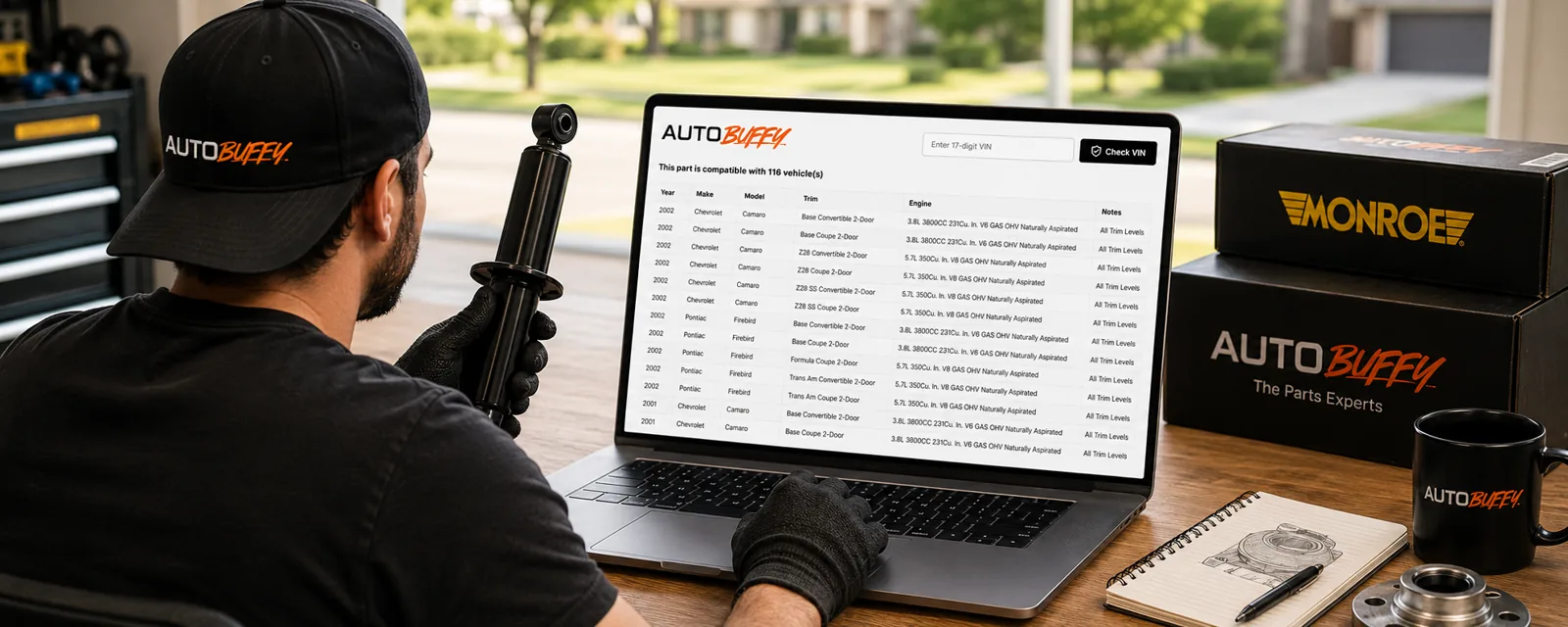
Here's the thing nobody tells you: the little "fits your vehicle" green checkmark is a starting point, not a guarantee. Ask any mechanic. It's built off a database, and databases have holes.
Why doesn't the "fits your vehicle" checker just work?
It usually does. But it's only as good as the fitment data behind it, and that data gets messy in exactly the spots that cost you money — mid-year production changes, trims that share a name but not the same part, and drivetrains that look identical from the driver's seat.
A mechanic on r/MechanicAdvice put it plainly: the fitment checker is a nice starting point but he never trusts it alone. That's not paranoia. That's someone who's eaten a return-shipping bill before. When a site drops a qualifier — say it lumps "with FE3 suspension" and "without" into one listing — the checker turns green for a car that needs the other part.
So you do the five-point check yourself. Takes two minutes. Saves you a week.
The 5-point check, one at a time
1. Year — check it, don't assume it
Grab the exact model year off your registration or the sticker in the driver's door jamb. Cars change mid-cycle. A "2012" built in 08/2011 can take a different part than one built in 03/2012. If a listing says "from 03/2012" or "to 07/2011", that date is talking to you. Read it.
2 and 3. Make and model — the easy ones
You know these. Just don't let a model *family* fool you. A Honda Civic and a Civic Si aren't automatically the same part car. Which brings us to the one people skip.
4. Trim / sub-model — the one people skip
This is where money gets lost. Base, LX, EX, Sport, Touring, Limited — those aren't just badges. A Sport trim can ride on stiffer struts, bigger brakes, or a different rear setup than the base car. Same year, same model, different part.
Find your trim on the window sticker (if you still have it), the door-jamb label, or your build sheet. When in doubt, a dealer parts desk can pull it from your VIN in about thirty seconds.
5. Engine — match it exactly
A 2.4L and a 3.5L in the same body are different worlds for anything engine-adjacent: mounts, belts, water pumps, sensors, coils. Pop the hood — most engines have the displacement stamped or on a label. Or decode the 8th digit of your VIN, which tells you the engine. The free NHTSA VIN decoder spells it all out.
The AWD/FWD trap (this one gets everybody)
If you take one thing from this: AWD and FWD versions of the "same" car are frequently different parts. CV axles, wheel hubs, rear brakes, even some suspension pieces split by drivetrain. The car looks identical in the driveway. The part numbers don't care.
A DIYer told this story: OEM listed two part numbers for a brake booster split by config, and the aftermarket listing blurred them into one. Guess who ordered the one that didn't fit. Check your drivetrain in the VIN or by badging, and if the listing has separate AWD and FWD options, that's a signal — pick the right lane.
When the checker and the part number disagree
Trust the part number. If the green checkmark says "fits" but the OE cross-reference points somewhere else, stop and figure out why before you buy. Pull your old part and read the number stamped on it. Cross-reference it. If they line up, you're golden. If they don't, you just saved yourself a return. (We've got a whole guide on finding your OE part number first — it's the habit that makes all of this bulletproof.)
Being paranoid about fitment is smart — we built for it
The people who cross-reference every part number aren't overthinking it. They've been burned before. That instinct is exactly why AutoBuffy leads with fitment: enter your year, make, model, trim, and engine and you see what actually fits your car — qualifiers and all — not a stripped-down "close enough" list. Do the five-point check, let a fitment tool that doesn't cut corners confirm it, and the guessing stops.
Sources
- NHTSA VIN Decoder — free 17-digit VIN decode, including engine and build info
- RepairPal — repair estimates and part-fit reference
- YourMechanic — mobile-mechanic knowledge base on parts and fitment
Find the right part for your vehicle
Guaranteed fit, ships free
FAQ / People Also Ask
No. It's a strong starting point built off a fitment database, but databases have gaps — especially around mid-year changes, trims, and AWD/FWD splits. Confirm the five-point check and the part number and you're safe.

Comments
Loading comments...
Comments are moderated by the AutoBuffy team.