

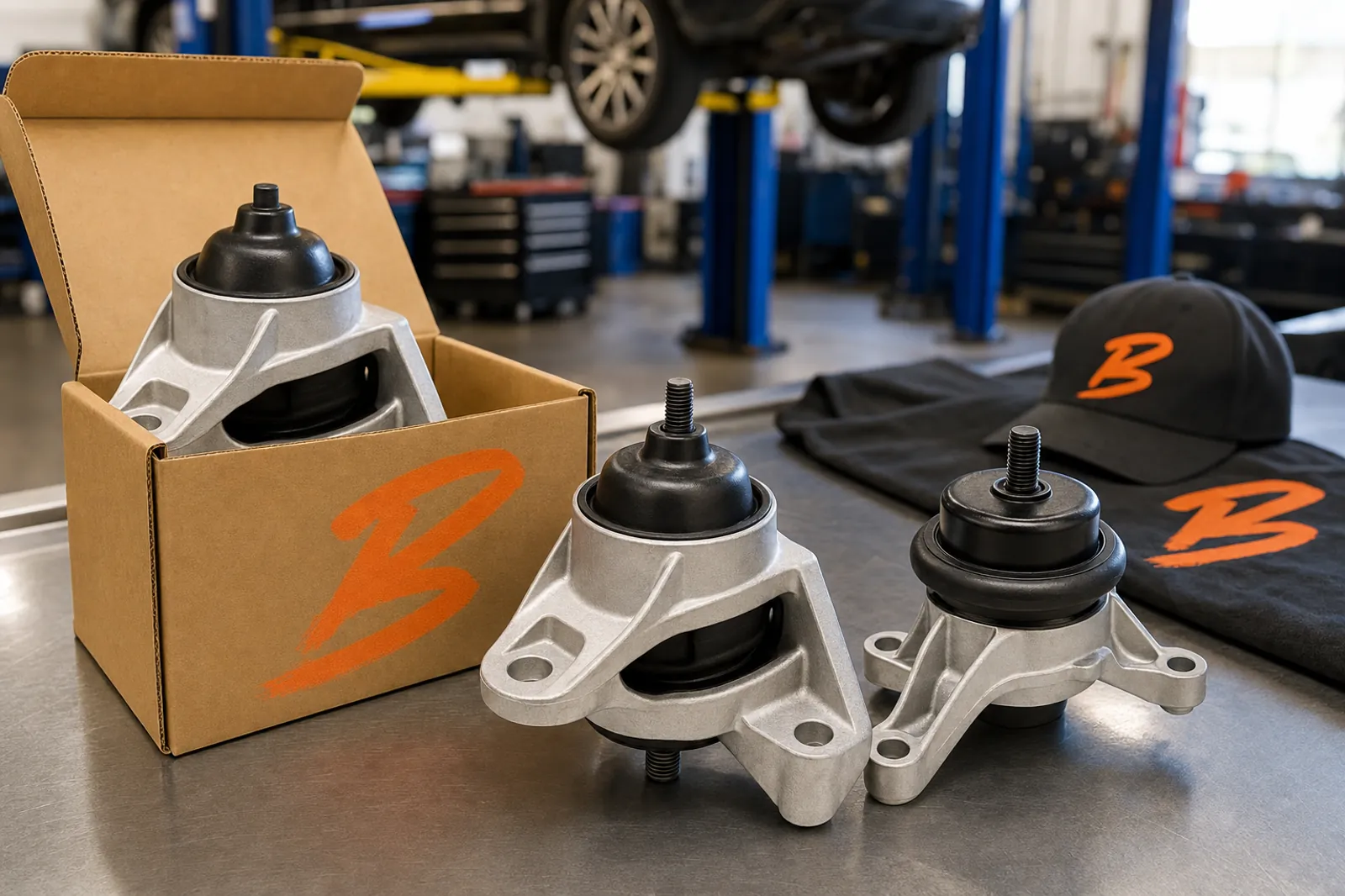
Motor Mount Replacement Cost in 2026: The Real Price Breakdown (Per Mount, DIY vs Shop)
A single motor mount typically costs $250–$600 to replace at a shop and $15–$200 in parts to do yourself. Here's the honest breakdown by mount type, labor rate, and specific vehicle — plus exactly where the money goes and how to avoid getting overcharged.
The Short Answer
Replacing one motor mount typically costs $250 to $600 at a shop, and $15 to $200 in parts if you do it yourself. The wide range comes down to three things. What kind of mount your car uses (plain rubber is cheap, fluid-filled hydraulic and electronic mounts cost more), how buried the mount is (some are a 30-minute job, some take two-plus hours to reach), and who does the work (an independent shop bills roughly $110–$135 an hour in 2026, a dealer bills $140–$180).
| Scenario | Parts | Labor | All-in |
|---|---|---|---|
| One rubber mount, easy access, indie shop | $15–$80 | $110–$220 | $150–$300 |
| One hydraulic mount, average access, indie shop | $50–$200 | $165–$400 | $250–$600 |
| One mount at a dealer | $60–$250 | $210–$540 | $300–$800 |
| Full set (3–4 mounts), mainstream car | $120–$500 | $400–$900 | $600–$1,400 |
| Full set, European / luxury | $400–$1,200 | $900–$1,800 | $1,500–$3,000+ |
Here's the single most important thing to understand before you pay anyone. On most cars, the part is cheap and the labor is the bill. That one fact is what makes this a repair worth doing yourself if you're at all handy, and worth getting a second quote on if you're not.
What Will It Cost for Your Car? Start Here
Enter your year, make, and model — we'll show the exact mounts that fit and what they cost.
Why the Part Is Cheap but the Bill Isn't
A motor mount is a simple component. A block of engineered rubber (or a fluid-filled chamber) bonded between two steel brackets. The part itself reflects that, and a basic mount is one of the cheaper things on your car.
What you're really paying a shop for is access. Mounts live wedged between the engine and the frame, and to replace one the technician usually has to support the engine's weight with a jack or engine-support bar, then unbolt and lift the engine slightly to free the old mount. On an easy front mount that's quick. On a rear or transmission mount buried behind the engine, or one where a subframe, exhaust, or motor-mount bracket has to come loose first, it's real time on a lift.
That's why two cars can have the same $60 part and a $250 difference in the final bill. You're not paying for the rubber. You're paying for the hour and a half it takes to get to it.
Cost by Mount Type
Not all mounts are the same part, and the type your car uses is the biggest driver of the parts price.
| Mount type | What it is | Typical part price | Found on |
|---|---|---|---|
| Solid rubber | Rubber bonded between two steel plates | $15–$80 | Most economy & older vehicles, torque struts |
| Hydraulic (fluid-filled) | Rubber chamber filled with fluid to damp vibration | $50–$200 | Most modern cars, comfort-tuned front mounts |
| Electronic / active | Hydraulic mount that stiffens on command (vacuum or electronic) | $150–$400+ | Luxury, V6/V8, cylinder-deactivation engines |
If your car came with a hydraulic or electronic mount, match it. Dropping a cheap solid mount into a spot engineered for a fluid-filled one is a common way people end up with a car that suddenly buzzes and drones. That extra vibration you feel is the money you "saved." A quality replacement in the correct type is the right call.
Labor: What Shops Actually Charge in 2026
Labor is billed at an hourly "book time," a standard estimate of how long the job should take, multiplied by the shop's rate.
| Independent shop | Dealer | |
|---|---|---|
| Hourly rate (2026) | $110–$135 | $140–$180 |
| Easy front mount (~1–1.5 hrs) | $110–$200 | $140–$270 |
| Buried / rear / trans mount (~2–3 hrs) | $220–$400 | $280–$540 |
A dealer isn't necessarily ripping you off. Their rate reflects factory training and OE parts. But for a straightforward mount on an out-of-warranty car, a reputable independent shop usually does the identical job for meaningfully less. Get the book time and the rate up front, and the quote stops being a mystery.
Cost by Vehicle: Real Examples
Every car is a little different, but here's the honest landscape for some of the most commonly searched vehicles. These are typical ranges for one mount: the part to do it yourself, and the all-in bill at an independent shop.
| Vehicle | Common failure point | DIY part | Shop, all-in (1 mount) |
|---|---|---|---|
| Honda Civic | Front & rear mounts soften with age | $40–$110 | $250–$450 |
| Honda Accord (V6) | Front hydraulic / active mount | $90–$200 | $400–$700 |
| Toyota Camry | Front fluid-filled mount + dogbone | $50–$150 | $300–$550 |
| Nissan Altima / Maxima | Passenger-side / front mount | $60–$150 | $300–$550 |
| Ford Focus | Passenger mount (known design weak point) | $60–$160 | $350–$600 |
| Chevy Silverado / GMC (V8) | High-torque work fatigues mounts | $40–$120 | $300–$550 |
| BMW 3-Series (E9x) | Both mounts, usually replaced as a pair | $60–$180 ea | $500–$900 (pair) |
Notice the pattern. The vehicles known for mount failure, the Accord V6 and the Focus, are also the ones with pricier or more labor-intensive mounts. That's no coincidence. The mounts that fail early are often the complex hydraulic ones. If you drive one of these and feel a clunk when you shift or a shake at idle, get it looked at before the movement starts damaging the mounts next to it.
One Mount or the Whole Set?
When one mount fails, the others are usually the same age and not far behind. A fresh mount next to three tired ones actually makes the tired ones' vibration more noticeable. So the honest advice depends on your car's mileage:
- Lower mileage, one clearly failed mount: replace the failed one (and consider the opposing mount, since they share the load).
- Higher mileage, or a car you're keeping: doing the full set at once costs more up front but saves you paying the labor-and-access tax two or three separate times. On a buried set, one visit beats three.
While you're in there, check the [transmission mount](/search?q=transmission+mount) and the torque strut / dogbone mount. They fail the same way, cause the same clunk-on-shift, and are cheap to do at the same time.
The DIY Math (Why This Job Is Worth Learning)
Because so much of the cost is labor, the savings from doing it yourself are unusually good on this repair.
- A shop bill of $400 on a single mount is often ~$60 in parts and ~$340 in labor.
- Do it yourself and you pay the $60. You keep the $340.
- Across a full set, DIY commonly saves $400 to $900.
Many front mounts are a legitimate weekend job. Basic hand tools, a floor jack and a block of wood to support the engine oil pan (through a piece of wood, never directly on the pan), and an hour or two of patience. The wildcards that turn an easy job hard are rust and seized bolts on older or northern-climate cars, and tight access on transverse V6 engines. So if your car is rusty or the mount is buried, that's exactly when paying a shop is the smart call.
What Pushes the Price Up
If your quote is at the high end, one of these is usually why, and knowing which lets you sanity-check it:
- Hydraulic or electronic mounts — more expensive part, sometimes more careful R&R.
- Buried location — rear mounts, transmission mounts, or mounts behind the engine on transverse layouts.
- Seized or rusted hardware — northern-climate cars where bolts fight back and add labor.
- Subframe or exhaust in the way — some designs require dropping or loosening other components to reach the mount.
- European / luxury platforms — higher part prices, higher labor rates, and often "replace as a set" designs.
- Collateral damage — if the loose engine has already chewed a belt, hose, or exhaust flex joint, that gets added on.
Don't Get Upsold — Two Honest Warnings
We sell mounts, so take this in the spirit it's meant. The goal is the right repair, not the biggest one.
First, a check engine light is never caused by a motor mount. Mounts aren't monitored by the computer, so there's no trouble code. If a shop is blaming a mount for a check-engine light, get a second opinion. Second, be wary of a quote that reflexively bundles all four mounts plus the transmission mount on a low-mileage car with one bad mount. Replacing as a set is legitimate on a high-mileage car. It's an upsell on a newer one. Ask which mounts actually tested bad.
On the other side of the same coin, don't "save" money on a bargain-bin mount. Under-spec mounts with hard, thin rubber can start failing in as little as 3,000–5,000 miles, and then you pay the labor twice. The part is the cheap half of this job, and buying the cheapest possible part is the one place the savings backfire.
Where Mount Quality (and Price) Actually Come From
A motor mount is only as good as its rubber compound and its steel. Get the durometer wrong and it either transmits too much vibration or fails early. That's the case for buying from a specialist rather than a generic catalog brand.
Westar is a good example. Founded in 1986, focused specifically on engine and transmission mounts, building to OE-style design in ISO-certified plants with deep coverage across domestic, Japanese, and European applications. When a manufacturer does one category all day, the rubber durometer and steel gauge tend to be dialed in for a smooth, long-lasting, drop-in fit. And because they specialize, the pricing on mounts is genuinely competitive. On this repair, a correctly-specced mount at a fair price is the whole game.
Shop Westar Engine & Transmission Mounts
Get an Exact Price for Your Vehicle
Ballpark ranges are useful, but the real number depends on your exact year, make, and model, and which mount it is. Add your vehicle and we'll show only the mounts that fit, with real prices and our fitment guarantee, so you can compare the part cost against any shop quote before you commit.
See Real Mount Prices for Your Car
Add your vehicle — we'll show the exact engine and transmission mounts that fit, backed by our fitment guarantee.
Prefer to browse? Shop All Motor Mounts · Transmission Mounts · Read: 7 Bad Motor Mount Symptoms
FAQ / People Also Ask
For one mount, expect roughly $250–$600 all-in at an independent shop, or $300–$800 at a dealer. The part itself is often just $15–$80 for rubber mounts and $50–$200 for hydraulic ones — most of the bill is labor, because reaching the mount usually means supporting and lifting the engine slightly.

Comments
Loading comments...
Comments are moderated by the AutoBuffy team.