

Bad Motor Mount Symptoms: 7 Warning Signs (and What Replacement Really Costs)
Engine shaking at idle? Clunk when you shift into drive? Here are the 7 telltale signs of a failing motor mount, how mechanics confirm each one, and what replacement actually costs.
Your Engine Is Trying to Tell You Something
You pull up to a red light, the car settles into idle, and suddenly the whole cabin starts buzzing. Or you shift from Park into Drive and feel a hard clunk through the floor. Maybe there's a knock every time you get on the gas.
Most drivers assume the worst. The transmission, the engine itself, something with a scary price tag. But nine times out of ten, that shake, clunk, or jolt traces back to one of the cheapest, most overlooked parts on your car: a motor mount.
A worn motor mount won't strand you tomorrow. Leave it alone, though, and it lets your engine slam around the bay, and that movement chews up belts, hoses, exhaust connections, and eventually the other mounts. This guide breaks down the 7 symptoms of a bad motor mount, exactly how a mechanic confirms each one, how long mounts are supposed to last, and what you'll actually pay to fix it.
First — What Does a Motor Mount Even Do?
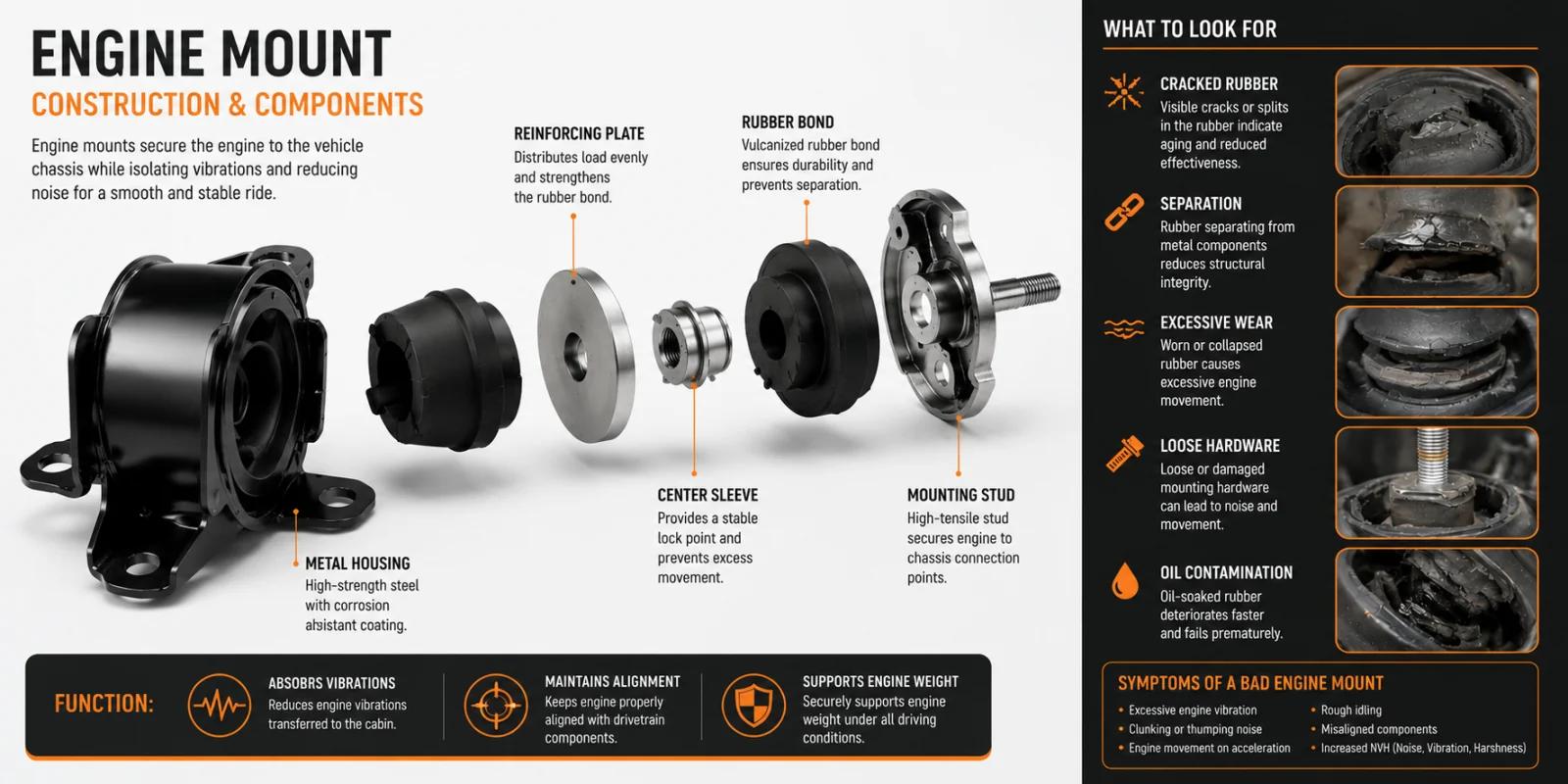
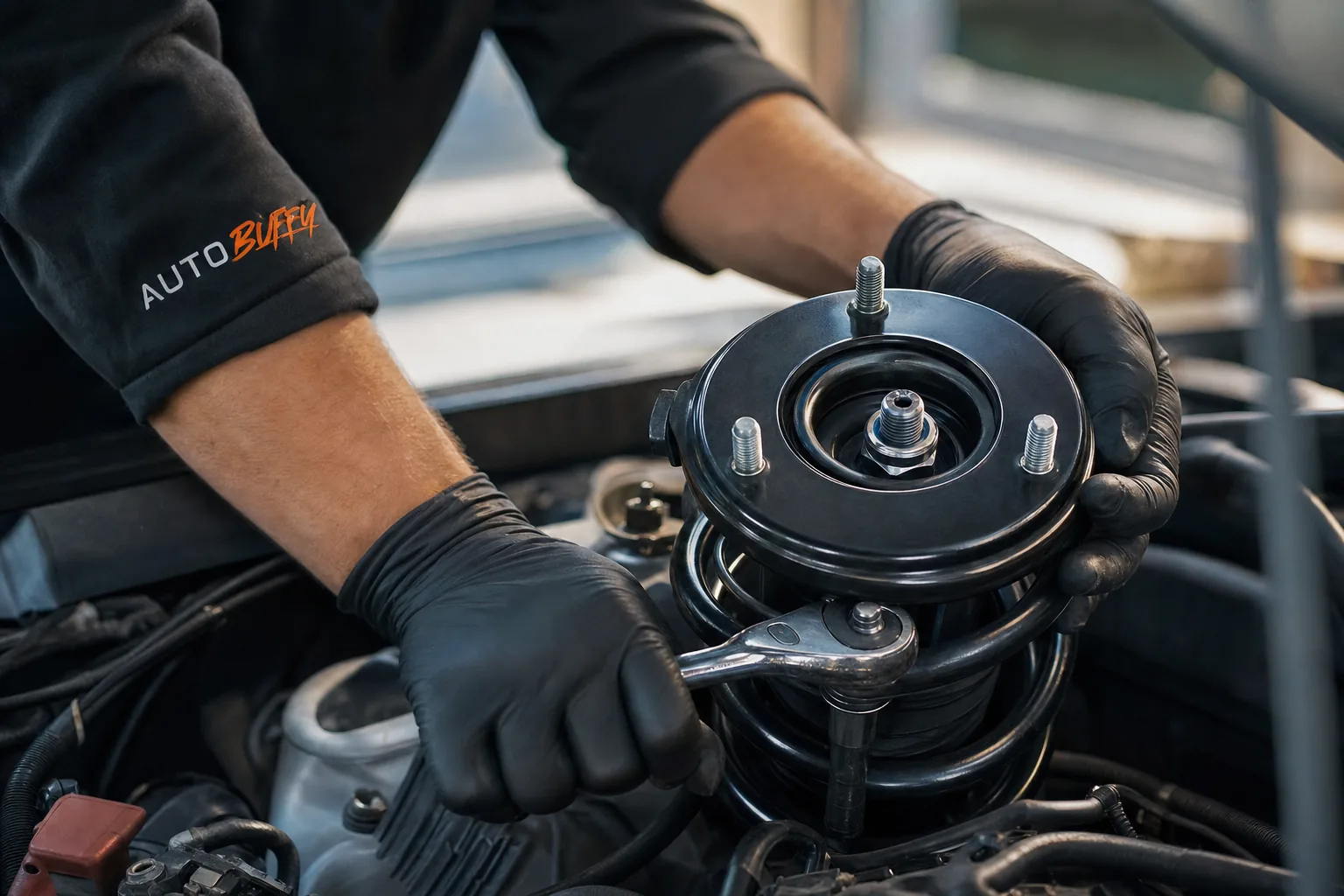
Your engine is a heavy chunk of metal that shakes constantly as it runs. Motor mounts (also called engine mounts) bolt the engine to the frame and do three jobs at once:
- Hold the engine's weight and keep it in exactly the right position relative to the transmission and axles.
- Absorb vibration so the shaking of thousands of combustion events per minute never reaches your seat, your steering wheel, or your coffee.
- Control engine movement under load. When you accelerate hard or brake, the engine wants to rock. Good mounts let it move a little, then snap it back.
Most cars have 3 to 4 mounts: a couple that carry the weight and one or two "torque" mounts (sometimes called a dogbone or torque strut) that stop the engine from twisting when you hit the gas. Some are simple rubber-and-steel. Higher-end ones are hydraulic, filled with fluid to soak up vibration even better. When any one of them wears out, you feel it.
Is It Your Motor Mounts? Check Your Vehicle
Enter your year, make, and model — we'll show only the mounts guaranteed to fit.
The 7 Symptoms of a Bad Motor Mount
1. Vibration or Shaking at Idle
This is the classic first sign. A healthy set of mounts keeps the engine's idle vibration away from you. When one starts to fail, the rubber cracks or a hydraulic mount leaks its fluid, and that vibration comes straight through.
What you'll notice: buzzing or shaking that's worst when the car is stopped and in gear (at a red light with your foot on the brake), often with the A/C on, and that smooths out once you're moving. Loose change rattles, the mirror blurs, the shifter hums.
How a mechanic confirms it: shift into Drive and then Reverse with the brake held and watch how much the engine jumps and how bad the shake gets. If it calms down noticeably in Neutral, that points straight at the mounts.
2. Clunk, Bang, or Knock on Acceleration and Braking
As the rubber breaks down, the engine gets free play, room to move that it shouldn't have. Every time the load changes, the engine shifts and something metal makes contact.
What you'll notice: a clunk or thud when you accelerate from a stop, let off the gas, or brake, and very often a hard knock the instant you shift from Park to Drive or Drive to Reverse.
How a mechanic confirms it: open the hood, have a helper shift through the gears with the brake on, and watch for the engine to visibly lurch and "catch" with a clunk. A pry bar against a suspect mount will reveal a rubber section that's separated or collapsed.
3. Excessive Engine Movement (the "Engine Jump")
Healthy mounts allow a small, controlled amount of movement. A dead mount lets the engine rock, tilt, or jump dramatically.
What you'll notice: pop the hood and blip the throttle. If the engine visibly twists or lunges an inch or more, a mount is gone. On start-up and shut-down you may feel a bigger-than-normal lurch through the whole car.
How a mechanic confirms it: the throttle-blip test above, plus a visual. A broken mount often lets the engine sag lower on one side, throwing off the gap between the engine and the frame.
4. Harsh, Jarring Gear Shifts
Because the mounts keep the engine and transmission aligned, worn mounts let that alignment wander, and every shift gets translated into the cabin as a jolt instead of a smooth transition.
What you'll notice: automatic shifts that feel like a shove or a bump instead of a smooth change; in a manual, harder engagement and more driveline "shunt" when you get on and off the throttle.
How a mechanic confirms it: rules out transmission issues first, then checks mount play. Harsh shifting plus the clunk-in-gear symptom above is a strong mount signature.
5. Rough Idle and a Lurch on Start-Up / Shut-Down
A failing mount can make an otherwise healthy engine feel rough, because you're now feeling vibration that used to be filtered out.
What you'll notice: the engine seems to shake more than it used to at idle, and there's a distinct lurch or shudder when you turn the key on and off.
How a mechanic confirms it: confirms the engine itself is running smoothly (no misfire codes), then attributes the "roughness" to vibration transfer through a bad mount.
6. Vibration in the Steering Wheel and Cabin at Speed
It's not only an idle problem. On the highway, a bad mount lets engine and driveline vibration reach the wheel and pedals.
What you'll notice: a steady buzz or shimmy in the steering wheel, seat, or pedals that rises and falls with engine RPM (not just road speed, which would point to tires or wheel balance).
How a mechanic confirms it: vibration that tracks with engine RPM rather than vehicle speed points to a mount or driveline mount, not a wheel/tire issue.
7. Visible Damage — Cracked Rubber, Leaking Fluid, Collateral Wear
Sometimes you can just see it.
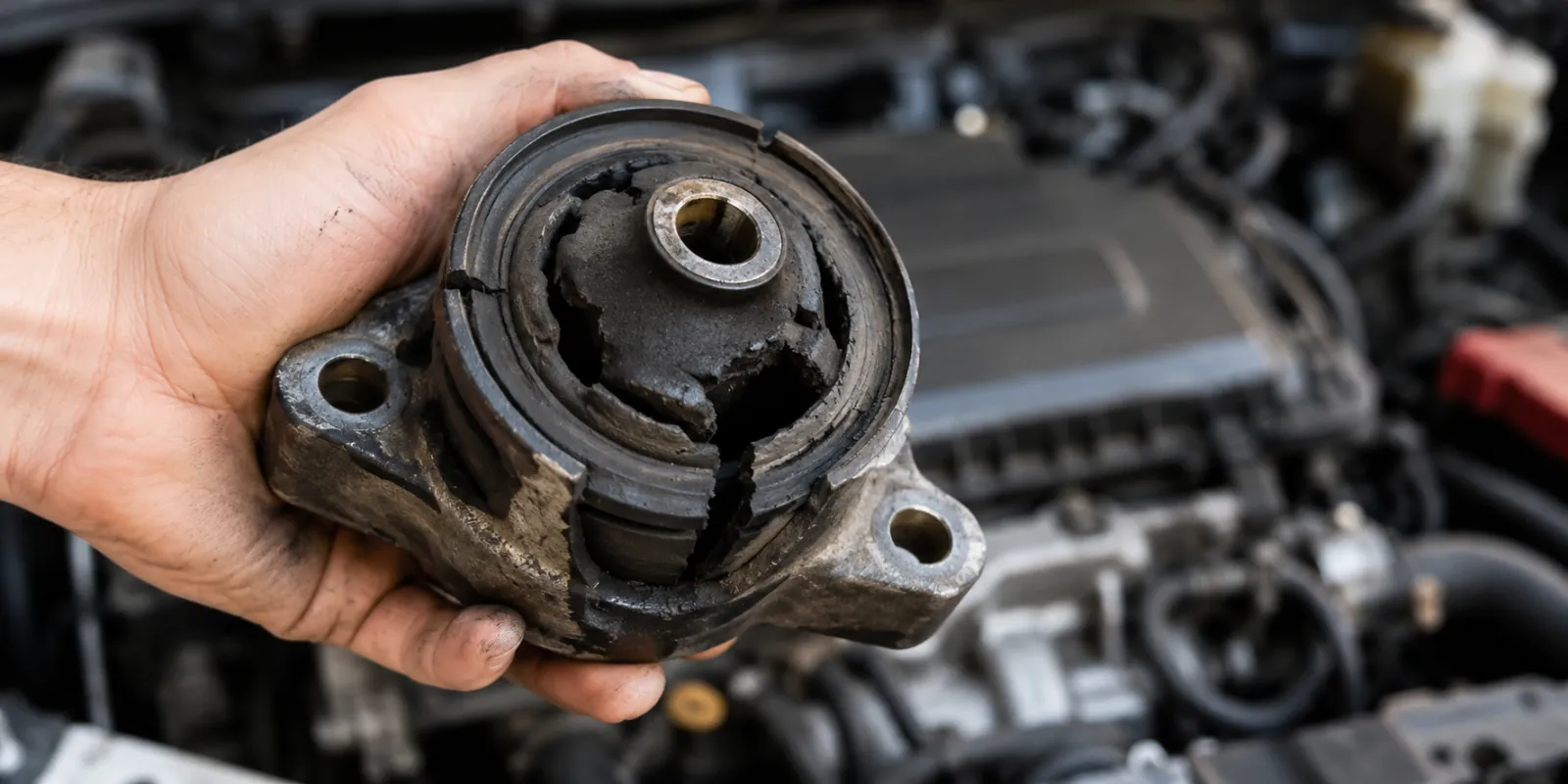
What you'll notice: cracked, dry-rotted, or split rubber; a hydraulic mount that's leaking oily fluid (that mount is done); a mount that's visibly separated or crushed; and downstream damage like frayed belts, rubbed hoses, or cracked exhaust connections caused by the engine moving where it shouldn't.
How a mechanic confirms it: a direct visual inspection with a flashlight, checking each mount's rubber and looking for fluid weeping from hydraulic units.
How Mechanics Diagnose a Bad Mount (Do This Yourself in 5 Minutes)
You don't need a lift. With the parking brake set, wheels chocked, and a helper:
- The load test: helper holds the brake and shifts Park → Reverse → Drive while you watch the engine from the front. A little movement is normal. A big lurch with a clunk is a bad mount.
- The throttle test: in Park, helper gives the throttle a quick blip while you watch. Excessive twist or jump means a worn mount.
- The visual: flashlight on each mount. Look for cracked or separated rubber and any fluid leaking from a hydraulic mount.
- The pry test (advanced): gently lever each mount with a pry bar. A good mount barely moves; a failed one shifts freely.
If two or more of the seven symptoms line up with a visible or movement test, you've found your problem.
How Long Are Motor Mounts Supposed to Last?
Quality mounts typically last 5 to 7 years, or roughly 80,000 to 150,000 miles, sometimes the life of the car. What kills them early:
- Heat and age. Rubber dries out and cracks over years under the hood.
- Oil and fluid leaks. Petroleum eats rubber; a leaky valve cover above a mount shortens its life dramatically.
- Aggressive driving. Hard launches and lots of shifting load-cycle the mounts harder.
- Cheap replacement mounts. This is the big one. Bargain-bin mounts with thin, hard rubber or under-spec brackets can start failing in as little as 3,000 to 5,000 miles. People "save" $40 and end up doing the job twice.
Why the Quality of the Replacement Mount Matters
Here's what most parts-store shoppers don't realize: a motor mount is only as good as its rubber compound and its steel. Get either wrong and the new mount either transmits too much vibration (rubber too hard) or fails early (rubber too soft or bracket too thin).
That's the argument for buying from a mount specialist rather than a generic catalog brand. Westar is a good example. It's a company founded in 1986 that focuses specifically on engine and transmission mounts, builds to OE-style design in ISO-certified plants, and carries deep coverage across North American, Japanese, and domestic applications. When a brand does one category all day, the durometer of the rubber and the gauge of the steel tend to be dialed in for a long-lasting, drop-in fit that stays smooth. Exactly what you want in a part you'd rather never touch again.
Shop Westar Engine & Transmission Mounts
Replace Them as a Set (and Check These Too)
When one mount fails, the others are usually the same age and not far behind. A fresh mount next to three tired ones makes the tired ones' vibration more obvious. Especially on higher-mileage cars, it's smart to replace mounts as a set, or at minimum replace the failed mount plus the opposing one.
While you're in there, check:
- The transmission mount. It fails the same way and causes the same clunk-on-shift. Shop Transmission Mounts
- The torque strut / dogbone mount, the small link that stops engine twist and a cheap, common failure point.
- Any belts and hoses the moving engine may have rubbed or stretched.
What Does Motor Mount Replacement Cost?
This is the other thing everyone Googles, so let's be straight about it.
The part itself is cheap. A basic rubber-and-steel mount often runs $15 to $80. Hydraulic (fluid-filled) mounts and complex applications run more, typically $50 to $200.
Labor is where it adds up. An easy, accessible mount might be a 30-minute job. A mount buried behind the engine can take two-plus hours. Shop labor on a single mount commonly lands around $150 to $460, so an all-in shop bill for one mount usually falls in the ~$400 to ~$800 range, more if you do several at once.
The DIY math is compelling. Because so much of the cost is labor, a driver who can turn a wrench can replace a mount for just the price of the part, often saving $300 to $600 on a single job. Many top mounts are a genuinely doable weekend repair with basic tools and a floor jack to support the engine.
Find the Exact Motor Mount for Your Car
Vehicles Notorious for Motor Mount Failure
Some platforms are simply known for it. If you drive one of these and feel the symptoms above, mounts are the first place to look:
- Honda Accord & Odyssey (V6): the hydraulic/active front mount is a well-known wear item. Honda Accord Mounts
- Honda Civic: front and rear mounts commonly soften with age. Honda Civic Mounts
- Toyota Camry: the fluid-filled front mount and the dogbone mount are frequent replacements. Toyota Camry Mounts
- Nissan Altima / Maxima: vibration at idle is a classic tired-mount tell.
- Chevy / GMC trucks & SUVs: high-torque V8s work the mounts hard over time.
Fix the Shake — Shop Mounts With Guaranteed Fitment
If your car is shaking at idle or clunking when you shift, don't overpay a shop before you've checked the cheapest cause first. AutoBuffy carries engine mounts, transmission mounts, and torque struts with guaranteed fitment for your exact vehicle.
Get the Exact Mount for Your Car
Add your vehicle and we'll show only the motor mounts that fit — backed by our fitment guarantee.
Prefer to browse? Shop All Motor Mounts · Shop Westar Mounts · Shop Transmission Mounts
FAQ / People Also Ask
Short-term, usually yes — but it gets worse, not better. The extra engine movement stresses the remaining mounts, driveline, belts, and hoses. Fix it before a nuisance becomes a chain of failures.
Comments
Loading comments...
Comments are moderated by the AutoBuffy team.