


Rack and Pinion Replacement Cost (2026 Guide)
A working mechanic's breakdown of what a rack and pinion replacement really costs in 2026, plus the symptoms of a bad rack, new vs. reman, and which brands are worth buying.
The Short Answer
For most cars, a rack and pinion replacement runs $900 to $1,800 all-in at an independent shop in 2026. Economy cars with a remanufactured rack can come in under $700. European luxury cars and newer models with electric power steering can push past $3,000 once you add the part, the labor, and the alignment.
| Scenario | Parts | Labor | All-in |
|---|---|---|---|
| Economy car, indie shop, reman rack | $150–$400 | $350–$650 | $600–$1,200 |
| Mid-size sedan / small SUV, new aftermarket | $250–$600 | $450–$800 | $900–$1,600 |
| Truck or full-size SUV, indie shop | $300–$900 | $500–$950 | $1,000–$2,000 |
| European / luxury (EPS), dealer | $900–$3,500 | $700–$1,400 | $1,800–$4,000+ |
| DIY (economy or mid-size) | $150–$550 | $0 | $250–$700* |
*DIY figure includes an alignment ($80–$150), which you can't skip no matter who does the wrench work.
Those numbers line up with what RepairPal, AutoZone, and the shops themselves are quoting this year. RepairPal's national estimator skews high because it leans on dealer parts pricing, but the working range most drivers actually pay is $1,100 to $2,400 at a shop, with the fat middle around $1,400 to $1,800.
What a Rack and Pinion Actually Does
Turn the wheel and something has to translate that spinning motion into your front tires swinging left or right. That's the rack and pinion's whole job.
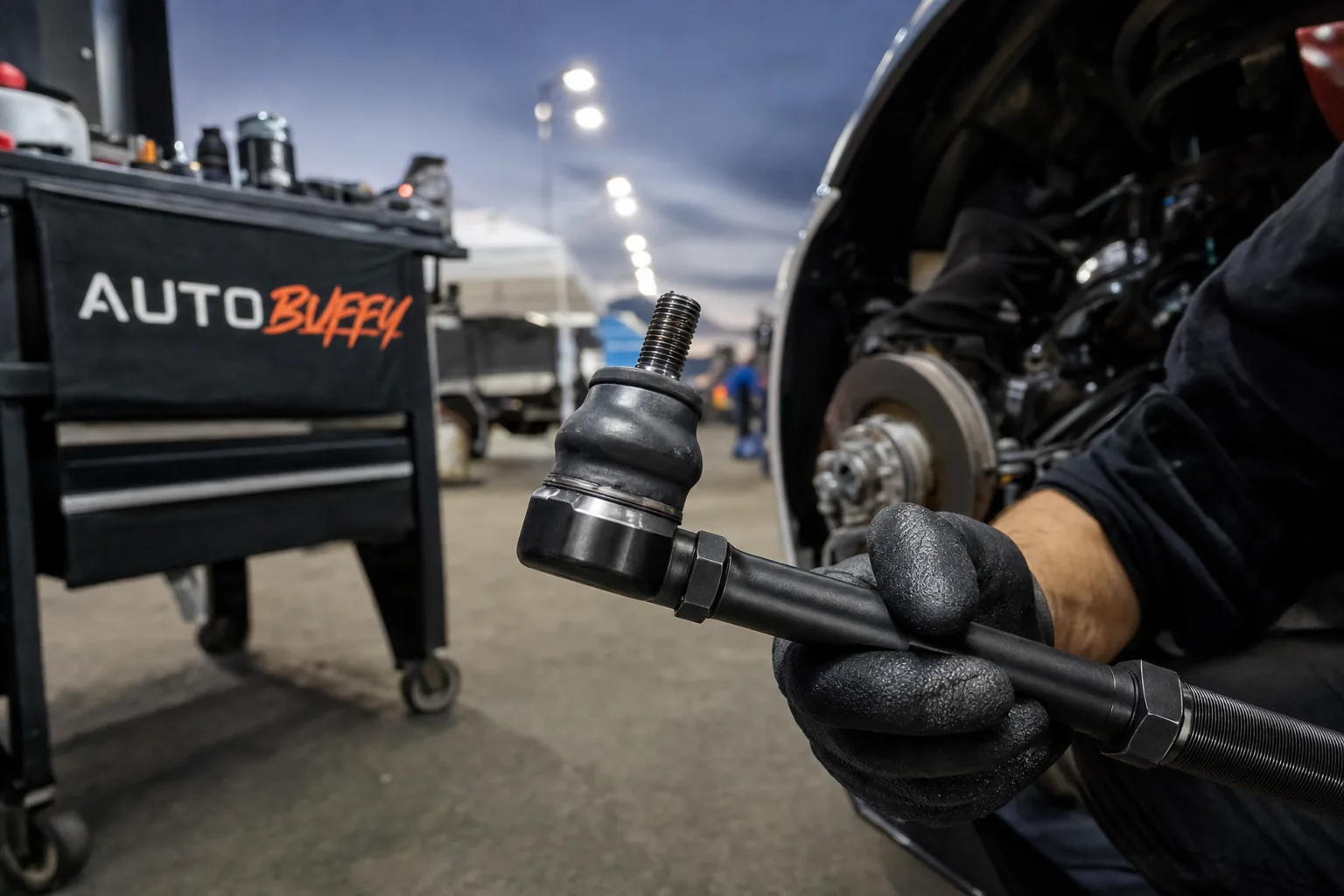
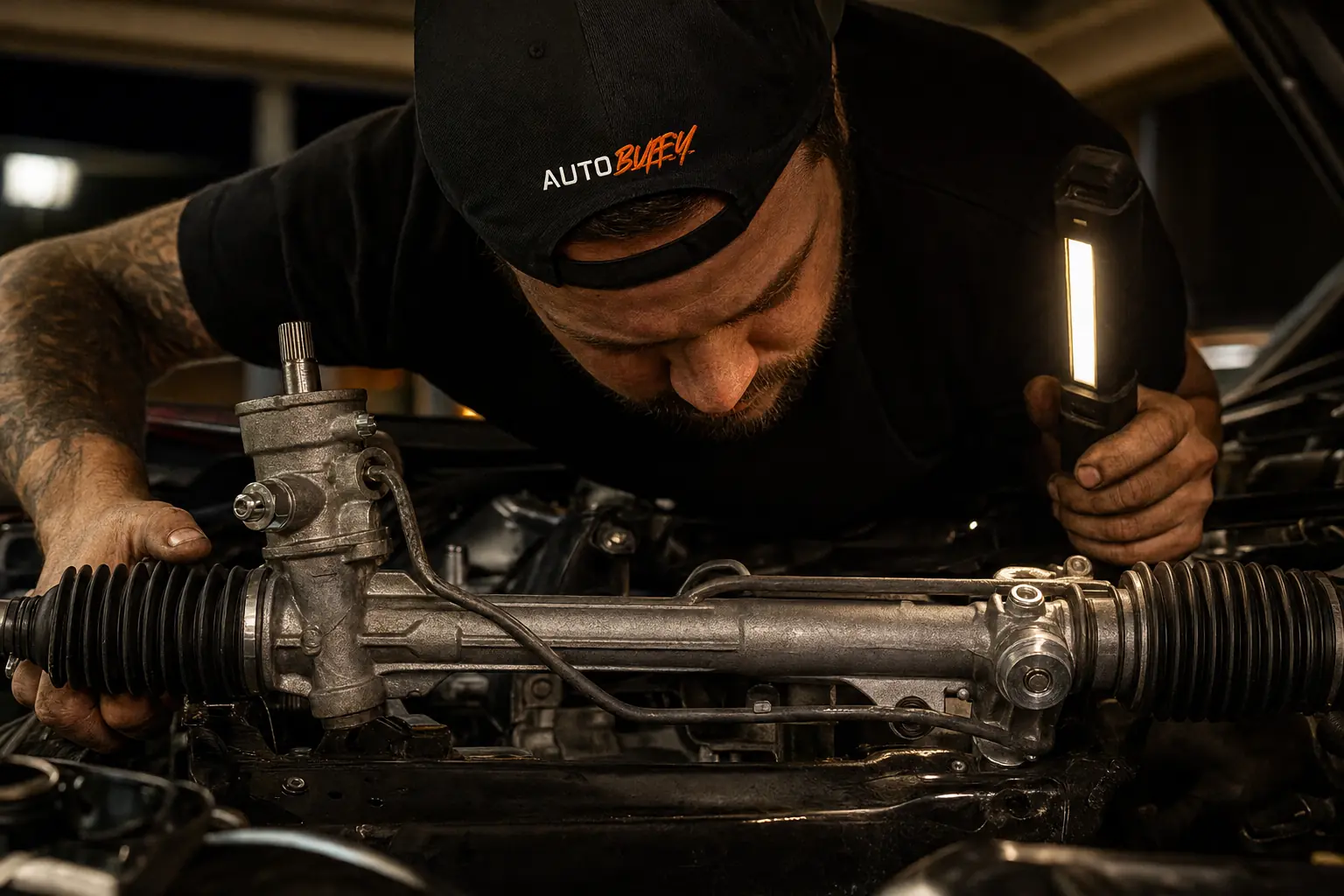
There's a round gear (the pinion) bolted to the bottom of your steering shaft, and it sits on a long, flat, toothed bar (the rack) that runs side to side across the front of the car. Spin the pinion and it walks the rack left or right. Each end of the rack connects to a tie rod, the tie rod connects to the steering knuckle, and the knuckle turns the wheel. That's it. Rotation in, straight-line push-pull out, wheels turn.
On almost every car built in the last 40 years this replaced the old recirculating-ball steering box because it's lighter, tighter, and gives you that direct feel through the wheel. When people say a car "steers like it's on rails," they're feeling a good rack.
The part that fails isn't usually the gears themselves. It's the seals and the internal bushings, plus on hydraulic units the power-assist components inside the housing. That's why a bad rack shows up as a leak or as slop long before the teeth ever wear out.
Signs Your Rack and Pinion Is Going Bad
You rarely get one dramatic failure. It creeps in. Here's what to watch for:
- Red or pink fluid on the ground under the middle-front of the car. That's power steering fluid escaping a failed rack seal. It's the number-one tell on hydraulic systems.
- A clunk or knock over bumps and when you turn — worn internal bushings letting the rack rattle in its housing.
- Steering that wanders or feels loose on the highway, like you're always making tiny corrections to hold a lane.
- Play in the wheel — you can move the steering wheel a bit before the tires respond.
- Heavy or stiff steering, especially at parking-lot speed, when the hydraulic assist starts losing pressure.
- A whine or groan that rises and falls with steering effort (often the pump starving on a low or leaking system, but the rack is frequently the reason it's low).
- A burning-oil smell after a hard drive — leaked fluid cooking on the exhaust.
- Uneven, feathered tire wear once the play throws your alignment off.
One or two of these? Have it looked at. Fluid on the driveway plus a clunk over bumps? That rack is on its way out, and you're now on borrowed time.
What Replacement Really Costs in 2026
Three things move the price: what kind of rack your car uses, who does the labor, and whether you buy new or remanufactured. Let's break each one down.
By vehicle class
| Vehicle type | Typical all-in (indie shop) |
|---|---|
| Compact / economy car | $700–$1,300 |
| Mid-size sedan | $900–$1,600 |
| Truck / full-size SUV | $1,000–$2,000 |
| European luxury (Audi, BMW, Mercedes) | $1,800–$4,000+ |
The spread comes down to access and hardware. A Corolla rack bolts up in a couple of hours. Some trucks and a lot of European cars route the rack behind the subframe, so the tech has to support the engine and drop the subframe to get it out. That's an extra two to four hours of labor before anyone touches the new part.
Labor: independent vs. dealer
This is where you win or lose real money. In 2026 independent shops run $120 to $159 an hour in most of the country, with rural shops closer to $85–$120 and big metros (LA, NYC, the Bay Area) hitting $170–$200. Dealers sit $20 to $40 an hour higher than the indie down the road, typically $150–$200.
The job itself is 3 to 6 hours of book time for a normal car, 6 to 8+ for a subframe-out European job. Do the math and you can see how the same repair swings from $450 in labor to well over $1,200 depending on your zip code and where you take it.
New vs. remanufactured
| Rack type | Part price | Best for |
|---|---|---|
| Remanufactured hydraulic | $150–$450 | Older, common domestic cars |
| New aftermarket (hydraulic) | $200–$700 | Most daily drivers |
| New OE / dealer | $500–$1,500+ | When fit and calibration have to be perfect |
| Electric (EPS) rack | $700–$3,500 | Newer cars, no way around it |
A quality remanufactured rack is 30% to 50% cheaper than a new OE unit and, on a common older car, is often the smart buy. A brand-new aftermarket assembly costs a bit more but skips the core-quality lottery. On a European car or anything with an electric rack, I'd steer toward new every time — the cheap reman electric racks have a real failure rate and you do not want to do this job twice.
One line item people forget: an alignment is mandatory after any rack replacement, $80–$150. The moment you disconnect the tie rods, your toe settings are gone. Skip the alignment and you'll chew through a set of front tires in a few thousand miles.
Power, Electric, or Manual: Which Rack Do You Have?
Three flavors, and it changes the price a lot.
Hydraulic power steering (HPS). The old standard, and still on tons of trucks and older cars. A belt-driven pump pushes fluid into the rack to help you turn. Lots of moving parts, a pump, a reservoir, hoses, and fluid that can leak. Cheapest to replace because the parts have been around forever and reman units are everywhere.
Electric power steering (EPS). An electric motor mounted on the rack or column does the assist. No pump, no fluid, no leaks, and it only draws power when you actually turn the wheel, which is part of why automakers switched — it's easier on fuel. Downside for repair: the rack has a motor, sensors, and electronics baked in, so it's the most expensive to replace and sometimes needs a scan-tool calibration afterward. If your car is a 2014-or-newer, odds are good you've got EPS.
Manual steering. No assist at all, just the rack and your arms. You'll find it on some economy cars, older vehicles, and track builds. Simplest and cheapest rack of the bunch, but rare on anything modern.
Not sure which you have? Pop the hood and look for a power steering fluid reservoir. If there's a reservoir and a belt-driven pump, you're hydraulic. No reservoir at all, usually EPS.
Repair (Reseal) vs. Replace vs. Reman
Can you just reseal a leaking rack instead of replacing the whole thing? Technically yes. Practically, almost nobody does it anymore, and here's why.
Reseal kits (new O-rings, bellows, and internal seals) are cheap, $20–$60 in parts. But the rack has to come out of the car to do it, which is 90% of the labor of a full replacement. So you pay nearly all the labor for a repair that's only as good as the internal bore condition, and if the housing is scored, you're back to leaking in a year. Most shops won't warranty a reseal for that reason.
That's exactly why the remanufactured rack exists. A reman unit is a used core that's been torn down, the bore inspected and cleaned up, and rebuilt with all-new seals and O-rings, then pressure-tested. You get the "resealed" benefit with a proper warranty, and the core charge you pay gets refunded when you send your old rack back. For the same labor, it's the better deal nine times out of ten.
My rule of thumb: replace with a reman or new complete assembly. Save the reseal-in-place idea for the rare case where the rack is dead simple to reach and money is truly tight. On a subframe-out car, resealing is throwing good labor after a maybe.
How Long Should a Rack Last — and Is It Worth Replacing?
A rack and pinion is not a wear item you service on a schedule. Most last 100,000 miles and often well past 150,000 before the seals give up. Rough roads, potholes, curb strikes, and running the power steering fluid low or dirty all shorten that. Some cars go to the junkyard on the original rack.
So when it finally fails, the real question is whether the car is worth the fix. Here's the honest math: if your car is worth less than about $3,000 and the rack is only weeping a little with no clunk or steering slop, I'd top off the fluid, keep an eye on it, and drive it. A $1,400 repair on a $2,500 car rarely pencils out.
But a rack that's clunking, wandering, or leaking fast is a safety part, not a maybe. Steering isn't the system to gamble on. If the car is otherwise solid and you plan to keep it, a fresh rack with a good warranty is money well spent — it's a once-in-the-life-of-the-car repair for most people.
Rack and Pinion Brands at AutoBuffy
We carry a little over 3,000 rack and pinion parts across 18 brands, from complete assemblies down to bellows kits and mount bushings. Here's what we actually stock and what each one is good at.
- Detroit Axle — our biggest seller by a mile, with about 1,369 complete assemblies in stock, all brand-new (not reman), priced from roughly $70 to $3,300 and averaging around $390. Each unit ships ready to install with new inner tie rod ends, seals, and boots, and they carry a long warranty. If you want a new complete rack for a mainstream car or truck without paying dealer money, start here.
- SKP — value-focused new assemblies, around 120 SKUs from about $155 to $2,000. A solid budget-to-mid option when you want new over remanufactured.
- Mopar — OEM racks for Chrysler, Dodge, Jeep, and Ram, roughly 177 assemblies, mostly remanufactured to factory spec. The right call when you want a genuine fit on a Mopar and factory calibration matters.
- GM Genuine Parts and ACDelco — OEM and OE-quality racks for GM cars and trucks, about 152 and 63 assemblies respectively, a mix of new and reman. ACDelco is GM's OE-service line and tends to run a bit friendlier on price than the GM Genuine badge.
- Motorcraft — Ford's OEM line, around 16 remanufactured assemblies for Ford, Lincoln, and Mercury applications. Genuine Ford fit.
- Bosch — a premium name that leans European and higher-spec, roughly 123 assemblies ranging from about $980 up past $3,500, both new and reman. Good coverage on import applications where quality has to be right.
- Bilstein — German-engineered new racks, about 53 SKUs, premium pricing ($750–$2,150). A performance-minded choice for European cars.
- AISIN — Japanese OE manufacturer (they supply the automakers directly), around 23 new assemblies. If you drive a Toyota, Honda, Lexus, or similar, AISIN is often the same part that came on the car.
- Dorman — the aftermarket's problem-solver, known for building new replacements for parts nobody else makes, including one of the first all-new electronic power steering racks for Ram trucks. We stock their full assemblies plus a deep bench of bellows kits, mount bushings, and hardware.
Whatever you pick, buy the rack that matches your steering type (hydraulic, electric, or manual) and your exact year, make, and model. A rack that "looks the same" but has the wrong mounting or sensor setup won't bolt in.
Find Your Exact Rack & Pinion
Guaranteed fit for your year, make and model
Find the Right Rack and Pinion for Your Vehicle
The single most common mistake with this repair is ordering a rack that doesn't match the car's steering system or trim. Punch in your year, make, and model above and we'll show you only the racks that actually fit, new and remanufactured, from Detroit Axle to the OEM lines. Match the part, get the alignment after, and this is a once-and-done repair that puts the tight, planted steering feel right back in your hands.
FAQ / People Also Ask
For most cars, budget $900 to $1,800 all-in at an independent shop, including the part, labor, and the required alignment. Economy cars running a remanufactured rack can come in under $700, while European luxury models and cars with electric power steering can top $3,000.
Comments
Loading comments...
Comments are moderated by the AutoBuffy team.