

Sway Bar Link Replacement Cost (2026 Guide)
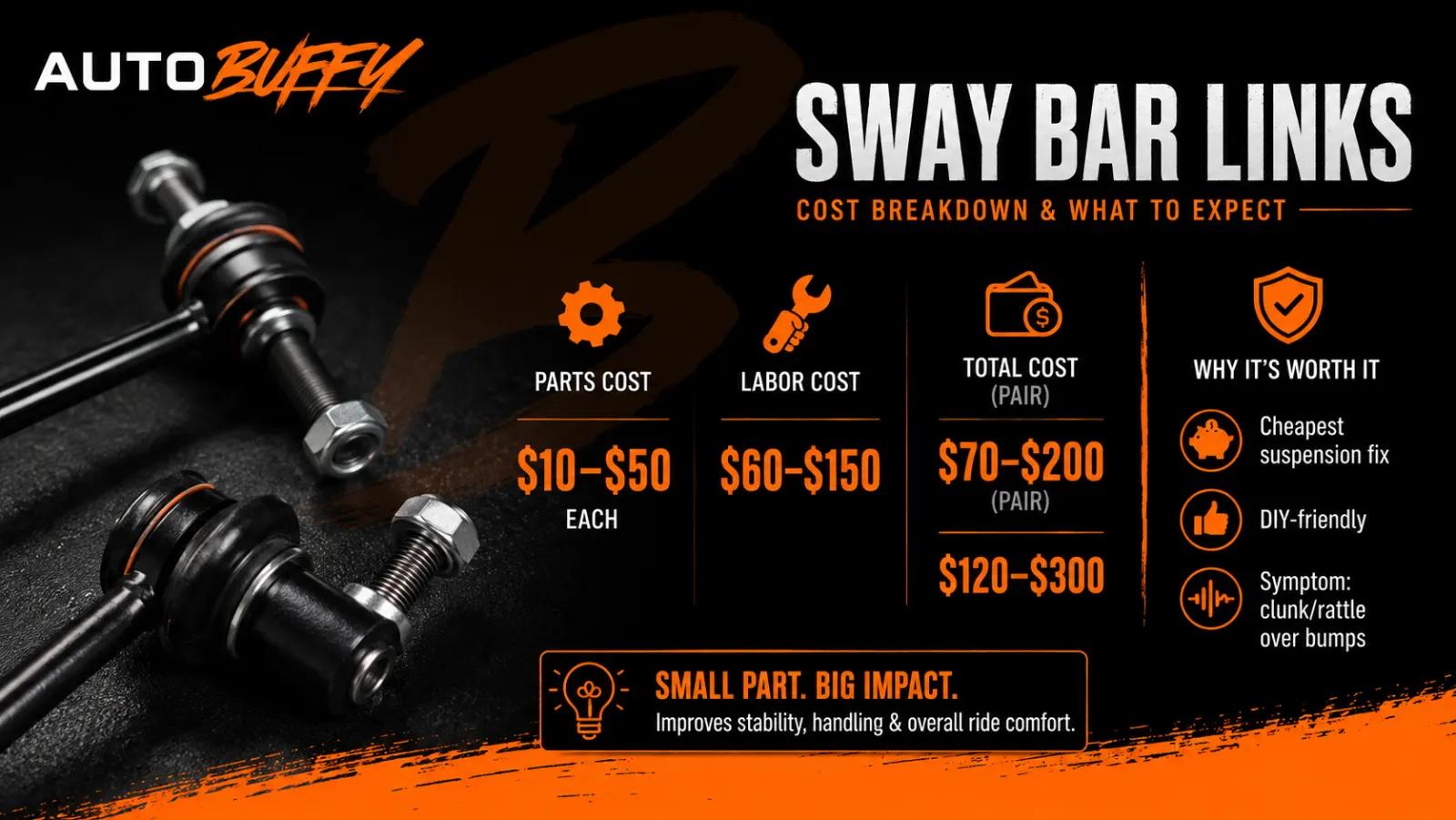
A sway bar link costs $70-$200 per link installed, or $120-$300 for a pair. Here's what the part does, the symptoms of a bad one, why you replace in pairs, and how to save with DIY.
The Short Answer
A sway bar link runs $70-$200 per link installed, or $120-$300 for a pair, in 2026. The part itself is cheap. Most of what you pay is the half-hour of labor to swap it, and even that is on the low end for suspension work. This is the cheapest fix on the whole suspension, and it's one of the few a weekend DIYer can knock out in a driveway.
| Scenario | Parts | Labor | All-in |
|---|---|---|---|
| One link (indie shop) | $10-$50 | $60-$150 | $70-$200 |
| Both links, one axle (pair) | $20-$100 | $100-$200 | $120-$300 |
| DIY (you supply the wrench) | $10-$50 | $0 | $10-$50 |
What a Sway Bar Link Actually Does
Your car has an anti-roll bar, also called a sway bar or stabilizer bar. It's a thick metal rod that runs across the car and ties the left and right sides of the suspension together. When you turn hard, the outside of the car wants to dip and the inside wants to lift. The sway bar fights that. It keeps the body flatter through a corner so the car doesn't lean like a boat.
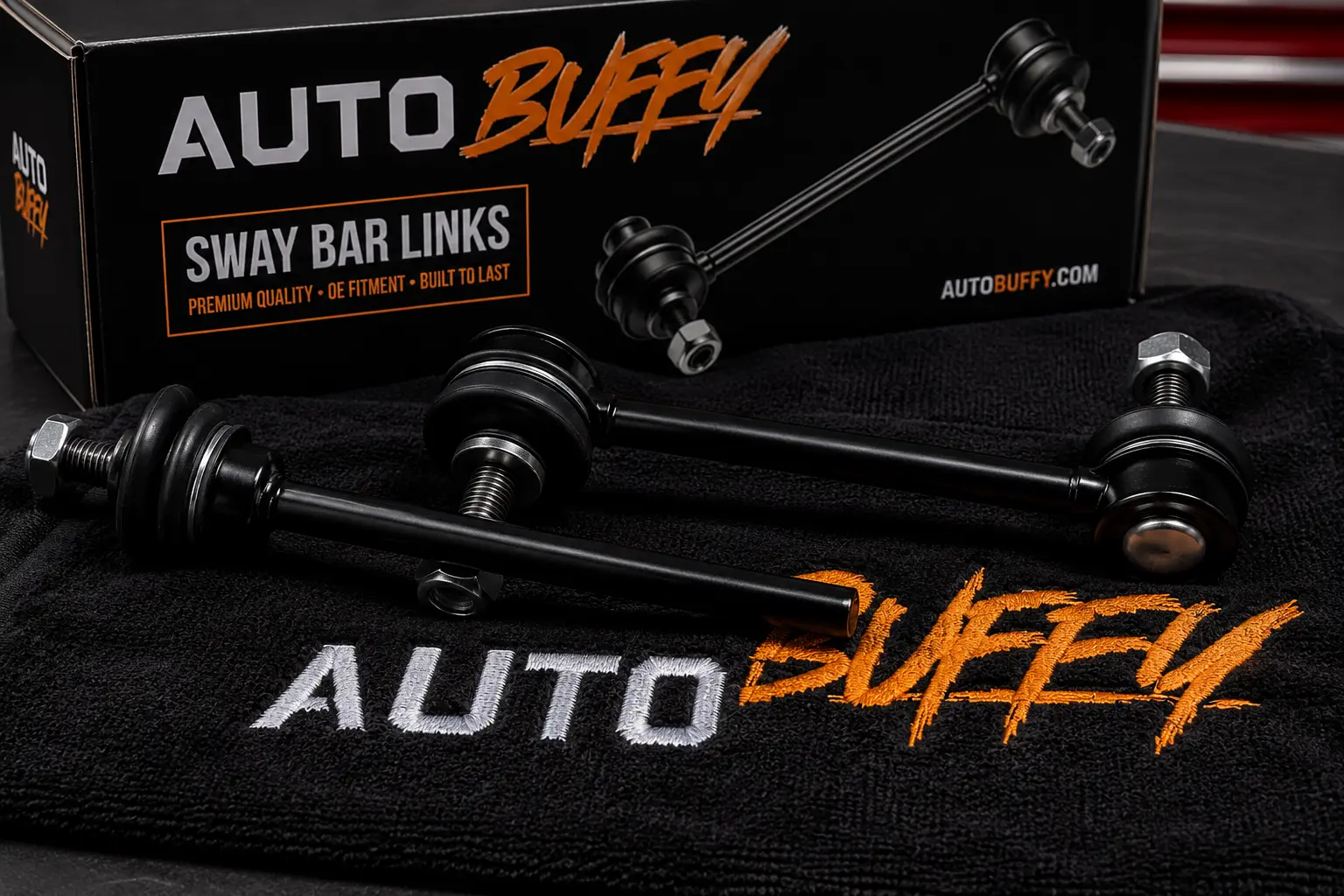
The sway bar link is the small connector that joins the end of that bar to the suspension itself, usually the control arm or the strut. Picture a short steel rod with a little ball-and-socket joint on each end, wrapped in a rubber boot with grease inside. That's it. It's a $15 part doing a job that keeps a two-ton vehicle composed at 70 mph.
Here's the thing people miss. The link is under constant motion. Every bump, every lane change, every driveway apron loads and unloads that joint. So even though it's simple, it's a wear item, same as brake pads. It's not a question of if it wears out, only when.
Symptoms of a Bad Sway Bar Link
Nine times out of ten, the customer walks in describing a noise, not a handling problem. The noise shows up first because the joint gets sloppy long before the link snaps. Watch for these:
- A clunk or rattle over bumps. This is the classic one. You hit a speed bump, a pothole, or a rough patch of road, and you hear a metallic knock from the front end. It's the worn joint slapping around inside its socket.
- Noise that gets worse on turns and rough roads. Cornering loads the sway bar, which loads the link. A bad one will clunk more when you're turning into a parking lot or driving a broken-up back road.
- A loose, rattly feel at low speed over uneven pavement, almost like something is knocking around under your feet.
- More body roll in corners. Once the link is really shot or broken, the sway bar can't do its job on that side, so the car leans more than it used to when you turn.
- Uneven or accelerated tire wear on a link that's been broken and ignored for a while.
- A visibly torn boot if you get under there and look. Once that rubber boot splits, water and grit get in, the grease washes out, and the joint rusts from the inside. That's the beginning of the end.
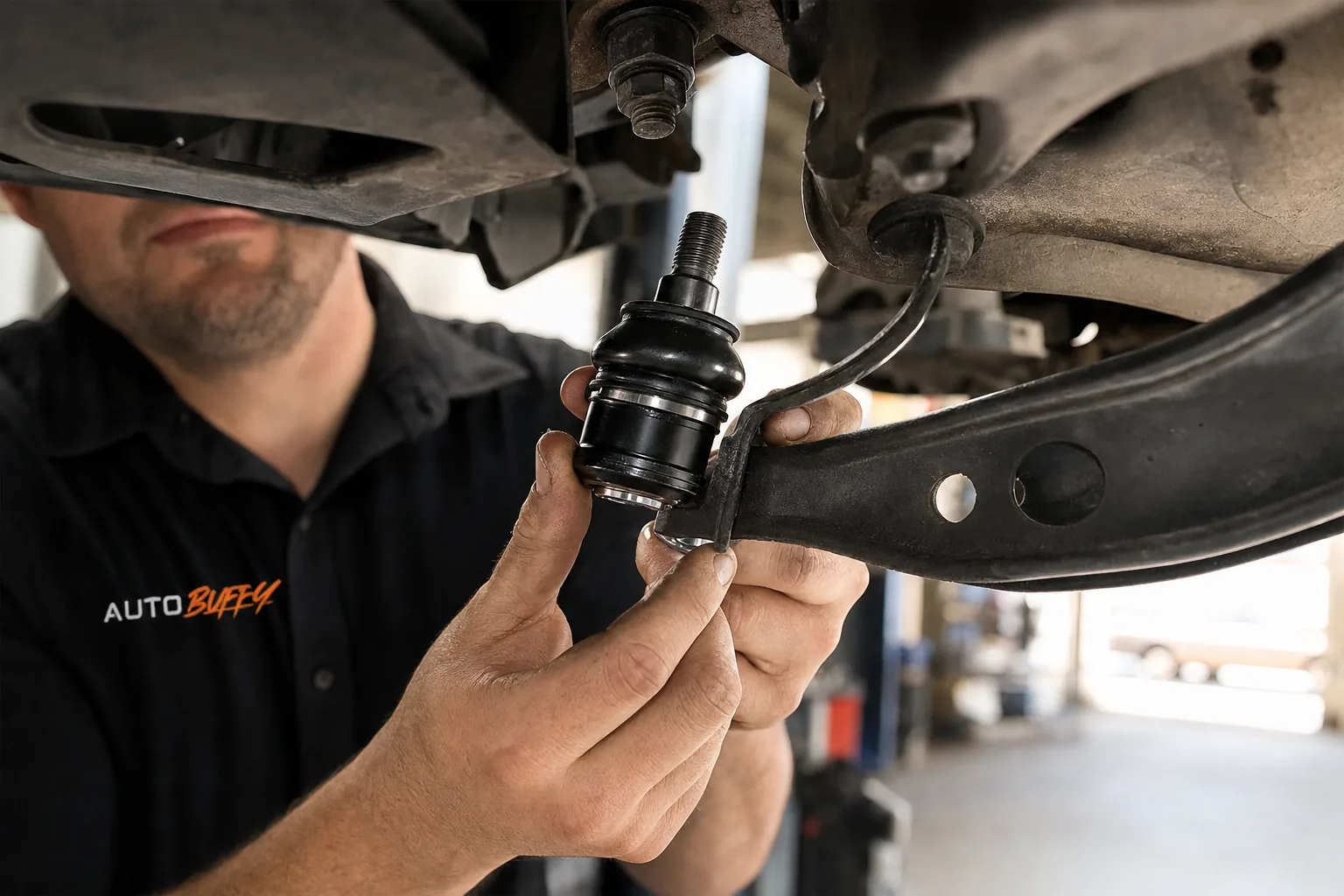
The easy shop test: grab the link by hand with the car in the air and try to wiggle it. A good one is tight. A bad one has visible play or makes a clicking sound when you push and pull it. You can also pry gently with a bar and watch for slop.
One honest note. That clunk can also come from a strut mount, a worn ball joint, or a bad bushing. Sway bar links are just the cheapest and most common cause, which is why a good tech checks them first. Don't assume every front-end noise is a link, but do check the links before you spend real money.
Why You Replace Them in Pairs
If your left link is worn out, your right link is the same age, same mileage, same rust, and it's living on borrowed time. Replacing just the one that failed is like buying a single new tire. It works, but you'll be back under the car in a few months doing the other side.
The labor case is even stronger. Both links live in the same corner of the car. Once the wheel's off and you're already down there, adding the second link costs you a few extra minutes and one more part. Pay a shop to come back a second time and you're paying the labor twice. That's why most mechanics quote the pair up front, and why the pair price ($120-$300) is barely more than a single link done alone.
The one exception: if you replaced one side recently and the other is still tight with a good boot, there's no rule that forces you to do both. But if the links are original and one has gone, do the pair and be done with it.
The Cost, Broken Down
Front vs. rear. Front links are the ones that usually fail first and the ones people replace most. They tend to be a little cheaper to reach on most cars, so they sit at the low end of the range. Rear links can cost a touch more if they're tucked up behind other suspension parts, but the ballpark holds. Either way you're inside that $70-$200 per link, $120-$300 per pair window.
Independent shop vs. dealer. An independent shop is your best value here. Expect roughly $120-$160 to do a pair on a common car. A dealer will use OE-branded parts and charge a higher labor rate, so the same job can push toward the top of the range or past it. On a luxury European car with a fussier link design, a dealer job can run higher still. For a plain suspension wear item like this, the indie shop is almost always the smarter spend.
DIY. This is where the math gets fun. If you can lift the car safely and turn a wrench, the whole job is just the part. That's $10-$50 for a quality link, and you keep the $60-$150 of labor in your pocket. On a pair you're saving a hundred bucks or more. It's genuinely one of the best value DIY jobs on the car.
What you need for the DIY route: a jack and jack stands (never work under a car on a jack alone), a basic socket and wrench set, and penetrating oil if you live anywhere they salt the roads. The one gotcha is that the stud can spin when you try to loosen the nut, because the whole ball joint turns with it. Good links come with a hex or Torx socket built into the end of the stud so you can hold it still. A cheap air impact gun makes the spinning stud a non-issue. Budget 20 to 40 minutes per side the first time.
How Long Do They Last
There's no fixed interval, and anyone who gives you an exact number is guessing. In moderate climates with normal driving, a factory sway bar link commonly goes 60,000 to 100,000 miles, sometimes more.
Where you live matters more than how you drive. If you're in the rust belt, road salt eats these things alive. Salt gets past the boot, the grease turns to paste, and the joint corrodes. In heavy-salt states it's not unusual to be replacing links at 40,000 to 60,000 miles. Rough roads, gravel, potholes, and off-road use all shorten the clock too, because every impact hammers that little joint.
My rule of thumb: have a shop wiggle-test your links at every other oil change or so, and definitely any time they've got the wheels off for brakes or tires. Catching a torn boot early won't save that link, but it tells you the clock's running so the clunk doesn't surprise you on the highway.
Can You Drive With a Broken One
Short version: yes, for a little while, but don't make a habit of it. A broken sway bar link won't strand you. The car still steers, still brakes, still drives. What you lose is stability in corners and quick maneuvers, because the sway bar on that side is now disconnected and can't fight body roll. You'll feel more lean and hear more noise.
The risk climbs with speed and with how hard you're cornering. Around town at 30 mph, a broken link is mostly an annoyance and a rattle. On the highway, or in an emergency swerve, the reduced control actually matters. And a link that's fully broken can flop around and bang into other parts, sometimes into a wheel or a CV boot, which turns a cheap fix into a more expensive one.
So treat it like this: safe to limp home or to the shop, not safe to ignore for weeks. Given that this is the cheapest suspension repair there is, there's no good reason to drive on a broken one for long. Fix it and move on.
Sway Bar Link Brands at AutoBuffy
We stock more than 11,500 sway bar link SKUs across every major chassis brand, so there's coverage for just about any year, make, and model. Here's what we carry and what each one is known for:
- Dorman (2,090 SKUs) — The value and coverage king. Dorman's whole game is fitment breadth, so if you've got an older or oddball vehicle that other brands skipped, Dorman usually has the part. Solid quality at a price that keeps a routine job cheap.
- Suspensia (1,885 SKUs) — Strong value line with wide application coverage. A smart pick when you want a fresh, quality link without paying a premium-brand markup, especially if you're doing your own work.
- Mevotech Supreme (1,617 SKUs) — The premium, built-tough option. Supreme links are engineered for harder use and longer life, and many feature greasable designs and beefed-up construction. If you're in the rust belt or you just want to install it once and forget it, this is the line to look at.
- MOOG (940 SKUs) — The problem-solver. MOOG is the name a lot of pro techs reach for when they want OE-grade or better, with designs built to outlast the factory part. When you want confidence that the fix sticks, MOOG earns its reputation.
Whichever direction you lean, the good news is the same one we started with: even the premium links here are inexpensive. The brand choice moves the part price by ten or twenty bucks, not by hundreds.
Find the Right Sway Bar Link for Your Vehicle
The only thing that matters when you buy is fitment. Sway bar link designs vary by vehicle, front and rear are usually different parts, and stud length and thread size have to match. Guessing wastes a trip. Punch in your year, make, and model and we'll show you only the links that actually bolt onto your car, from budget to premium, so you can match the brand to your budget and your climate.
Find Your Exact Sway Bar Links
Guaranteed fit for your year, make and model
A sway bar link is the rare repair that's cheap, fast, and DIY-friendly. Do the pair, use a quality part, and that clunk over the speed bumps is gone for another 60,000 miles.
FAQ / People Also Ask
In 2026, expect about $70-$200 per link installed at a shop, or $120-$300 for a pair on the same axle. The part is only $10-$50 each; most of the cost is the roughly half-hour of labor. If you do it yourself, the whole job is just the price of the parts.

Comments
Loading comments...
Comments are moderated by the AutoBuffy team.