

Toyota Camry Motor Mount Symptoms and Replacement Cost (2007–2024)
Toyota Camry motor mount symptoms, replacement cost by year ($405–$1,153), mount layout by generation, and which years fail most — with Westar kit options.
The Short Answer
Toyota Camry motor mount replacement typically costs $405–$1,153 depending on model year, with the cross-year average landing at $633–$718 for engine mounts and $348–$400 for the transmission mount alone.
| Model Year | Avg. Engine Mount Cost (RepairPal) |
|---|---|
| 2007–2009 Camry | $497–$548 |
| 2024 Camry | $405–$485 |
| 2025 Camry | $793–$878 |
| All Camry Years (average) | $633–$718 |
| Transmission Mount Only | $348–$400 |
*Source: RepairPal (now part of Yelp Inc. following its November 2024 acquisition)*
These are shop totals — parts plus labor. DIY cuts the number significantly, but motor mount work on the Camry requires supporting the engine properly, so it's not a job to rush.
Toyota Camry mount layout: what's actually under the hood
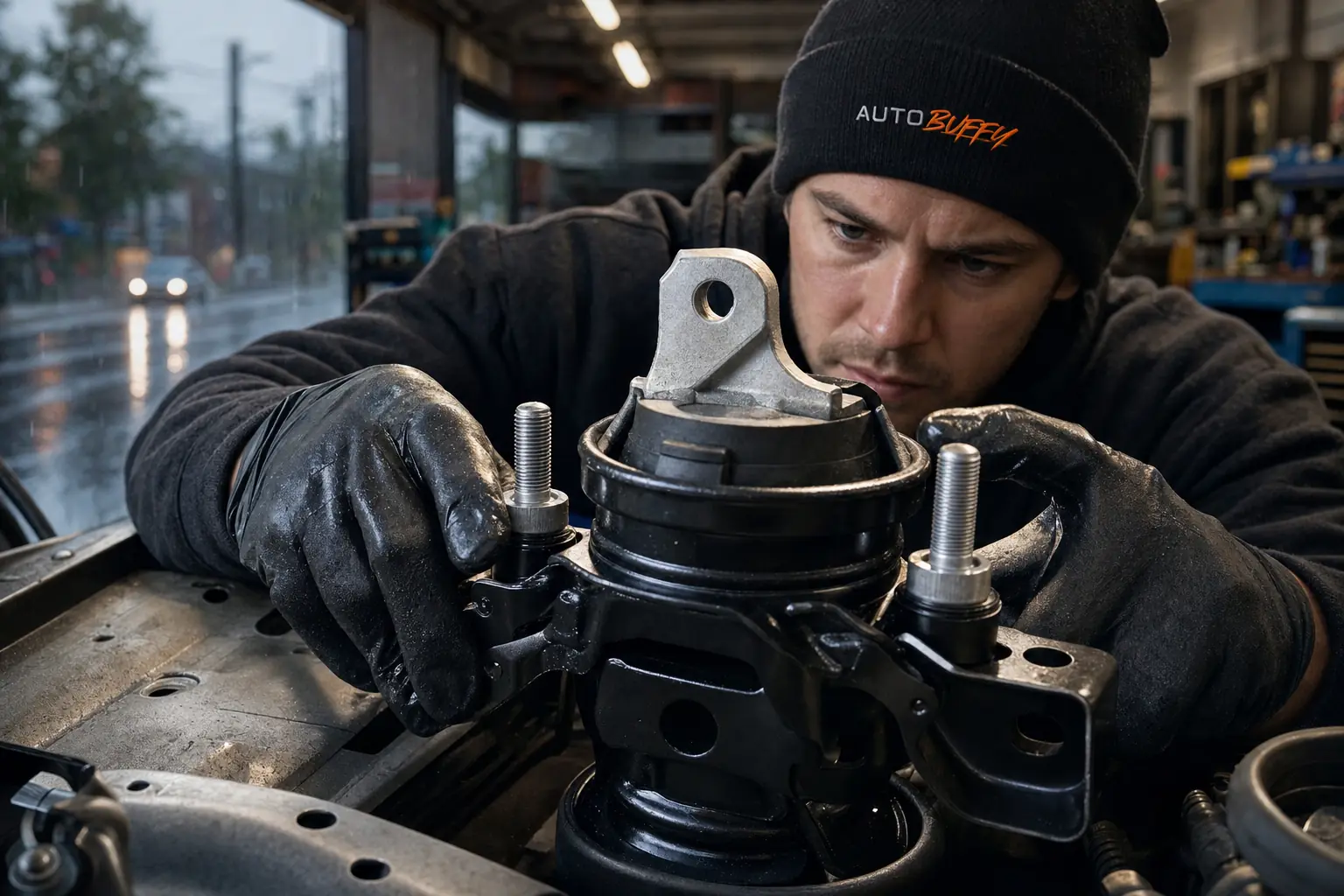
The Camry's front-wheel-drive architecture means the engine sits transversely and torques sideways under load — which is why it needs more than two simple rubber blocks to stay controlled. Westar makes six distinct mount types for the Camry. Here's where each one lives, what it actually does, and how it tends to fail on this platform.
| Mount Type | Where It Sits | What It Does | How It Usually Fails |
|---|---|---|---|
| Engine Mount | Passenger-side and/or driver-side of the block | Primary vertical support for the engine; carries most of the engine's weight | Rubber core cracks or separates; engine sits visibly lower on one side |
| Engine Mount Kit | Full mount system sold as a set | Replaces all engine mount positions in one purchase | N/A — this is the bundle; individual mounts within it fail as described |
| Engine Torque Strut Mount | Front or upper position, connecting engine to strut tower or crossmember | Controls fore-and-aft engine rocking during acceleration and braking | Bushing collapses or tears; first symptom is a clunk on throttle application |
| Automatic Transmission Mount | Under the transmission, rear of the drivetrain | Supports the gearbox and prevents drivetrain movement under load | Rubber degrades and transmission drops slightly; vibration worsens in gear |
| Manual Transmission Mount | Same position as auto mount, manual-trans models | Same job as above on stick-shift Camrys | Same rubber degradation; often outlasts auto mounts due to lower heat exposure |
| Suspension Strut Mount | Top of each front strut, at the strut tower | Isolates strut movement from the chassis; part of the front suspension | Bearing wears or rubber cracks; symptoms feel more like suspension noise than engine vibration |
The torque strut mount is worth flagging specifically. On the four-cylinder Camry it's the highest-stress mount in the system — it takes every throttle pulse directly — and it's typically the first to go.
Which Toyota Camry years and engines fail most
Westar's catalog shows the deepest mount coverage for 1997, 1998, 1999, 2000, 2001, and 1990 — those years have the most distinct mount SKUs, which reflects the most engine and transmission variants available. More variants usually means more complex mount layouts and, historically, more real-world failures.
Here's what's widely documented for this platform:
Fifth generation (1997–2001): The 2.2L four-cylinder is the most commonly reported problem child. Rear and front engine mounts on these cars frequently wear out between 100,000 and 130,000 miles — not surprising given that many of these cars are still on the road past 200,000 miles. The 1MZ-FE V6 of the same era is considerably smoother and easier on mounts.
Sixth generation (2002–2006): The 2.4L 2AZ-FE is the engine to watch here. This four-cylinder is known for vibrating more than Toyota's marketing suggested, and the front and upper torque strut mounts absorb that directly. Early wear in the 80,000–100,000-mile range is reported often enough to be a pattern, not a coincidence.
Seventh generation (2007–2011): The 2AZ-FE carried over, so similar torque strut wear patterns apply. The 2GR-FE V6 in this generation is much gentler on mounts overall.
Eighth and ninth generations (2012–2024): The 2.5L 2AR-FE and later the A25A-FXS hybrid four-cylinder put more torque load into the mount system than the V6. These are newer cars, so catastrophic failures are less common — but owners in the 80,000–120,000-mile range on the 2.5L are starting to report torque strut issues.
If you're not sure which generation you have, use the part finder below — it'll sort that out by year, engine, and trim automatically.
How to tell your Camry's motor mounts are going bad
These symptoms have Camry-specific signatures. Generic "engine vibration" isn't enough — context is what tells you it's a mount.
Noises specific to this platform
- A sharp clunk through the center console when shifting from Park to Drive or Reverse — on the Camry's FWD layout, a dead torque strut makes this unmistakable. It's different from a transmission clunk because it happens at the moment of engagement, not during actual movement.
- A metallic thud when merging onto the freeway — the engine rocks hard under full-throttle acceleration, and a failed mount lets it hit its limits audibly.
- Ticking or rattling near the firewall at idle — a mount that's collapsed enough to let the engine contact nearby bracketry will sometimes produce this.
The drive-vs-park vibration test
Sit at a red light. Feel the vibration through the steering wheel or floor. Now put it in Park. If the vibration drops significantly the moment you take it out of gear, that's almost certainly a mount. The Camry's 2.5L four-cylinder in gear produces enough torque oscillation that a failed mount becomes very obvious this way — and it doesn't go away at higher RPMs until engine speed smooths the combustion pulses.
Visible engine movement (the rev test)
Pop the hood, have someone rev the engine to about 2,500 rpm while you watch the engine block. A healthy Camry mount keeps movement tight. If the engine visibly rocks toward the firewall or strains against its mountings, the mount limiting that movement has failed. This is the most reliable DIY confirmation test on this platform.
Steering wheel shimmy at 60–70 mph
On the Camry, a failed mount can couple engine vibration directly into the subframe and up through the steering column. If your steering wheel shimmies at highway speed but the tires have been recently balanced, mounts are worth checking before you chase a wheel balance or alignment problem.
Toyota Camry motor mount replacement cost breakdown
Parts cost
Individual mounts typically run $30–$120 per piece depending on position. A complete kit covering 4–6 positions usually runs $290–$400 in parts — less than buying each mount separately, and everything matches. On the Camry, where the 4-cylinder and V6 of the same year use different layouts, buying a properly spec'd kit matters more than it does on simpler platforms.
Labor cost
Supporting the engine, unbolting, and reassembling typically takes 1.5–3 hours at a shop depending on which mounts and how many. At $100–$175/hour for shop labor, that adds up. The Camry isn't the worst FWD car to work on, but front and lower mounts require lifting the engine slightly, which takes time to do safely.
By year range
| Year Range | Cost Range | Notes |
|---|---|---|
| 2007–2009 | $497–$548 | 2GR-FE V6 or 2AZ-FE 4-cyl |
| 2010–2014 | Est. $500–$700 | FWD 4-cyl common, V6 available |
| 2015–2017 | Est. $500–$700 | Similar layout to prior gen |
| 2018–2022 | Est. $500–$750 | 8th gen, 2.5L DOHC |
| 2023–2024 | $405–$485 | Per RepairPal |
| 2025 | $793–$878 | New platform, likely higher complexity |
*Ranges from RepairPal. "Est." rows are reasonable interpolations — confirm with a local shop or the part finder below.*
Transmission mount (separate job)
If it's the automatic transmission mount rather than an engine mount, the job is generally more straightforward and cheaper. RepairPal averages $348–$400 for Camry transmission mount replacement as a standalone. Symptoms overlap — clunking, vibration in gear — but the transmission mount tends to feel worse under load at low speed rather than during initial engagement.
Should you replace one mount or all of them?
Here's an honest take: if you're past 80,000 miles, replace the full set. Mounts age together. The one that just failed has been getting help from the others — and those others have been absorbing its share of the load since it started going soft. Replacing just the obvious one and leaving the rest is how owners end up back at the shop within six months.
The labor math supports doing it all at once too. You're already supporting the engine and have the car on the lift. The incremental time to swap additional mounts during the same visit is small compared to a second appointment.
Westar focuses exclusively on engine and transmission mounts — that's the whole product line. For a car as common as the Camry, that specialization means their kits cover the exact configuration for your year and engine, whether you've got the 2.5L, the 3.5L V6, or a hybrid drivetrain. You're not getting a generic box of close-enough parts.
DIY vs. shop: what's realistic on a Camry
Reasonable for experienced DIYers:
- Upper torque struts — accessible on most generations without lifting the engine
- Rear mounts on many Camry years — straightforward bolt removal with the right socket set
Better left to a shop:
- Front and lower mounts — require lifting and supporting the engine from below with a floor jack and block of wood on the pan (never the drain plug), then carefully managing the engine's position while you work
- Any mount job if you're not confident with engine support procedures
If you go DIY, torque the new mount bolts to spec. An undertorqued mount fails faster than the worn one it replaced.
Choosing the right mount kit for your Camry
Before ordering, nail down three things:
- Model year — the Camry spans multiple platform generations from 1983 through 2023 and beyond
- Engine type — 2.5L 4-cyl, 3.5L V6, and hybrid all use different mount layouts
- Transmission type — automatic vs. manual changes which transmission mount you need
Westar's Camry coverage runs from 1983–2023, with 165 distinct mount SKUs across those years. Use the part finder below to match your exact year, engine, and trim — it pulls live inventory and current pricing so there's no guesswork.
Sources
- RepairPal cost estimates: repairpair.com
- Toyota Camry generations and engine specifications: Toyota USA
- Westar motor mount catalog data: AutoBuffy live inventory
Find the right part for your vehicle
Guaranteed fit, ships free
FAQ / People Also Ask
According to RepairPal, the total shop cost (parts + labor) ranges from $405–$1,153 depending on model year. The cross-year average for engine mounts is $633–$718; transmission mount replacement runs lower, averaging $348–$400. A 2025 Camry can reach $793–$878, likely due to new platform complexity.


Comments
Loading comments...
Comments are moderated by the AutoBuffy team.