

Upstream vs Downstream O2 Sensor: Which One Is Bad and Which Do You Replace?
Not all oxygen sensors are the same — and swapping them can cost you. Here's how to tell upstream from downstream, diagnose which one failed, and pick the right replacement.
The Short Answer
The upstream O2 sensor controls your air-fuel ratio and is far more likely to cause drivability problems when it fails; the downstream sensor monitors your catalytic converter, and replacing it rarely fixes a P0420 code.
| Sensor | Location | Primary Job | Failure Symptom |
|---|---|---|---|
| Upstream (Sensor 1) | Before catalytic converter | Air-fuel ratio feedback to ECU | Rough idle, poor MPG, fuel-trim codes (P013x–P015x) |
| Downstream (Sensor 2) | After catalytic converter | Monitor converter efficiency | P0420 / P0430, usually cat — not sensor — is failing |
| Interchangeable? | — | No | Wrong position = premature failure or wrong signal |
What Each Sensor Actually Does
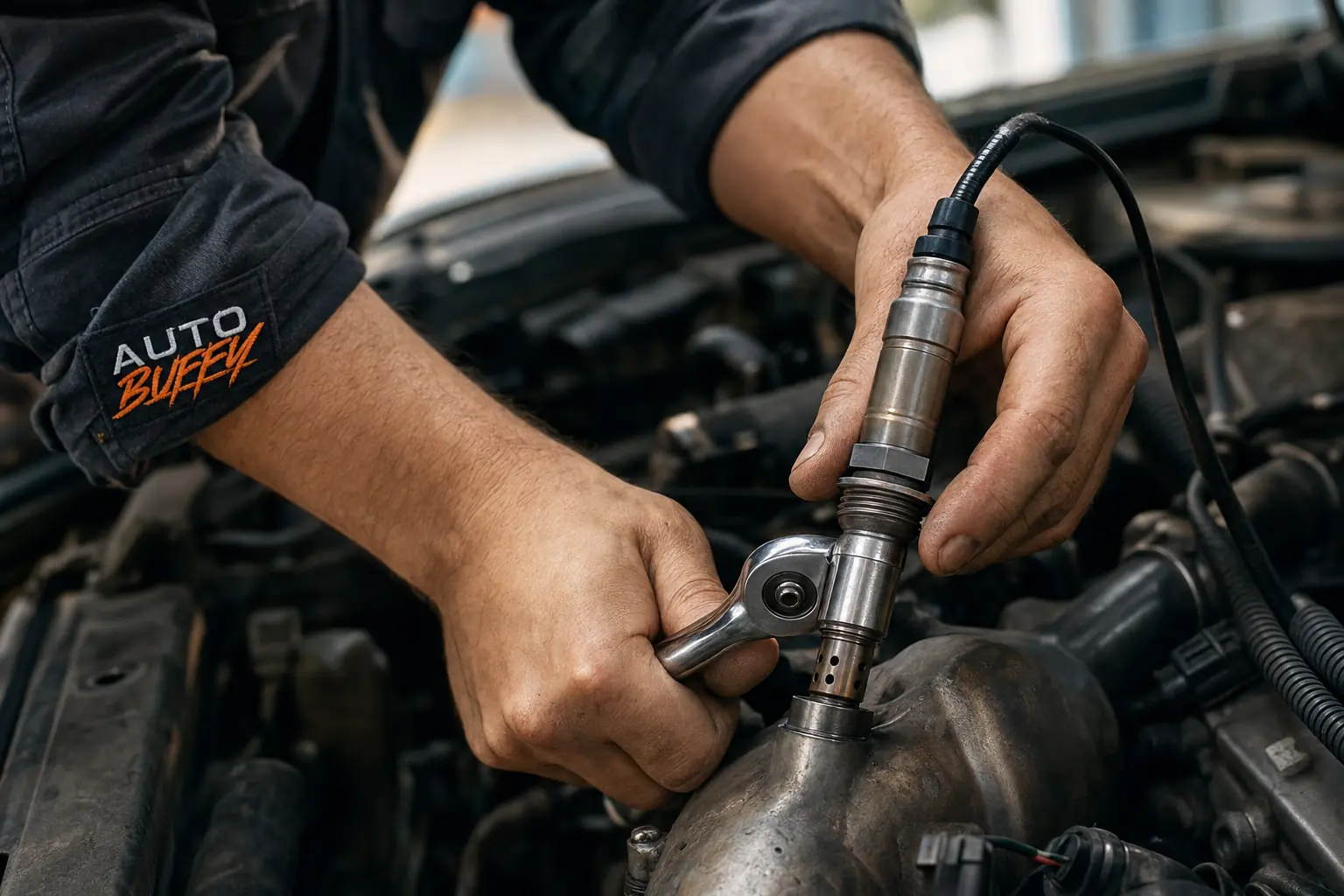
The upstream sensor lives in the exhaust stream before the catalytic converter — often threaded directly into the exhaust manifold or the pipe just downstream of it. It's measuring raw exhaust gas oxygen content and feeding that data back to the ECU constantly. The ECU uses it to trim the fuel mixture in real time. Get this sensor wrong and the engine runs blind. The downstream sensor sits after the converter. Its job is quieter: it watches whether the catalytic converter is doing its job of chemically scrubbing the exhaust. A healthy cat produces a stable, nearly flat signal from the downstream sensor. A dying cat produces a signal that starts to mirror the upstream sensor's rapid switching pattern. These two sensors experience very different operating environments. The upstream sensor faces the full heat of the exhaust manifold. The downstream sensor runs cooler because the converter itself absorbs a lot of that thermal energy. That's exactly why using a downstream sensor in the upstream position can cause premature failure — the part simply isn't built to survive the same temperature extremes. ---
How to Diagnose Which Sensor Is Actually Bad
Step 1: Pull the codes — and read them carefully
A scan tool is your starting point. Here's a quick code map:
- P0130–P0167 — Typically upstream sensor circuit faults (signal slow, out of range, heater circuit)
- P0136–P0167 — Can be downstream sensor circuit issues as well (check the full description)
- P0420 / P0430 — "Catalyst System Efficiency Below Threshold" — this is a downstream/cat system code, not an instruction to replace the downstream sensor
The P0420 misdiagnosis is genuinely expensive. This code means the downstream sensor has detected that the cat isn't converting emissions efficiently enough. The sensor is doing its job correctly — it's reporting a real problem with the converter. Replacing the sensor may clear the light for a few hundred miles before it returns. The correct fix is usually a new catalytic converter, not a new sensor. ### Step 2: Watch live sensor data
With a capable scan tool or OBD-II app, pull up the live O2 voltage readings while the engine is at operating temperature. Upstream sensor (healthy): Voltage cycles rapidly between ~0.1V and ~0.9V. It should switch at least 8–10 times over 10 seconds on a properly running engine. Downstream sensor (healthy): Signal is relatively flat and stable — usually hovering between 0.5V and 0.7V on a narrowband sensor. If it's mirroring the upstream waveform, the cat has lost efficiency. Upstream sensor (failing): Slow switching, stuck lean (near 0V), stuck rich (near 0.9V), or erratic/random voltage. Fuel trims will be elevated. ### Step 3: Check for exhaust leaks first
A cracked exhaust manifold or a leaking gasket upstream of Sensor 1 can pull in outside oxygen and give you a falsely lean reading — which can look exactly like a failing upstream sensor. Always inspect the exhaust for leaks before condemning a sensor, especially on higher-mileage vehicles. ---
Can You Swap Upstream and Downstream Sensors? Short answer: don't. In 99% of modern vehicles, upstream and downstream oxygen sensors cannot be mixed, swapped, or interchanged. Beyond the heat issue mentioned above, many vehicles use different sensor types by position:
- Narrowband (zirconia) sensors are common in both positions on older vehicles
- Wideband (air-fuel ratio) sensors are increasingly used in the upstream position on newer vehicles — they look similar but operate on a completely different principle and use a different connector and ECU calibration
- Thread pitch and connector type frequently differ between positions even on the same engine
Always verify position, sensor type, and connector configuration when ordering. ---
Which Brand Should You Buy? This matters more than most people realize. Oxygen sensors are precision electrochemical devices. An off-brand sensor with a slightly different heater resistance or output curve can trigger false codes or cause the ECU to run a slightly incorrect mixture — you'll pass the repair but still have a problem. **For European vehicles (BMW, Mercedes, VW, Audi, Volvo, Porsche):** Bosch is the correct answer, full stop. Robert Bosch GmbH invented the automotive oxygen sensor and began production in 1976. Bosch remains the OEM supplier for virtually every European manufacturer. VEMO is another strong option for European fitments — our inventory includes VEMO sensors specifically designed for VAG-platform vehicles. **For Japanese vehicles (Toyota, Lexus, Honda, Subaru, Acura):** Denso is the OEM supplier for most of these brands. Denso is part of the Toyota Group, with Toyota Motor Corporation holding approximately 21.25% of the company — which is exactly why Denso sensors fit and perform like OEM on these vehicles. We carry Denso sensors covering Honda, Acura, Volvo, and Mercedes-Benz fitments (yes, Denso supplies some European applications too). **For Ford and Lincoln vehicles:** Motorcraft is Ford's OEM parts division. The Motorcraft upstream sensor in our catalog is designed specifically for Ford applications and carries OEM-level specifications. **For broad domestic coverage (Buick, Chevrolet, Cadillac, Nissan, Honda):** Detroit Axle offers vehicle-specific O2 sensor fitments across a range of makes, often as complete kits that include sensors for multiple positions. > My honest take: I'd always try to match the brand to the vehicle's origin — Bosch for European, Denso for Japanese, Motorcraft for Ford. The price difference between a quality OEM-grade sensor and a discount aftermarket unit is usually $30–$80, but the labor to redo it if a cheap sensor fails or codes immediately is always more than that. ---
What Does Replacement Actually Cost? Sensor cost alone runs roughly **$50–$350** for most passenger vehicles, depending on sensor type (wideband sensors cost more), position, and brand. Some specialty fitments run higher. Labor at an independent shop typically adds **$50–$150** for an accessible sensor — rear-bank sensors on transversely mounted V6 engines can take two hours or more and cost accordingly. Use the part finder below to get your exact fitment and today's price rather than relying on any number printed here. ---
When to Replace Both Sensors
You don't always need to replace both sensors at once, but there are cases where it makes sense:
- High mileage (100k+): If one sensor has failed from age, the other isn't far behind. A kit covering both upstream positions (like a left/right pair on a V6) can save a second labor charge later. 2. After replacing a catalytic converter: A new cat paired with an old, sluggish downstream sensor can produce false efficiency codes right after installation. 3. After an engine-out repair: Any time the exhaust system is significantly disturbed, inspect sensor connectors and pigtails for heat damage. ---
Quick Diagnostic Checklist
- [ ] Pull codes — note the exact P-code prefix to determine position
- [ ] Check for exhaust leaks before condemning any sensor
- [ ] Watch live O2 data: upstream should switch fast, downstream should be stable
- [ ] P0420/P0430? Test the cat, not just the sensor
- [ ] Confirm sensor type (narrowband vs. wideband) before ordering
- [ ] Match brand to vehicle origin for best results
Find the right O2 sensor for your vehicle
Guaranteed fit, ships free
FAQ / People Also Ask
The upstream sensor (Sensor 1) sits before the catalytic converter and tells the ECU how to adjust the air-fuel mixture in real time. The downstream sensor (Sensor 2) sits after the converter and monitors how well the cat is scrubbing exhaust gases. They have different jobs, different heat exposures, and often different part numbers — even on the same engine.


Comments
Loading comments...
Comments are moderated by the AutoBuffy team.